

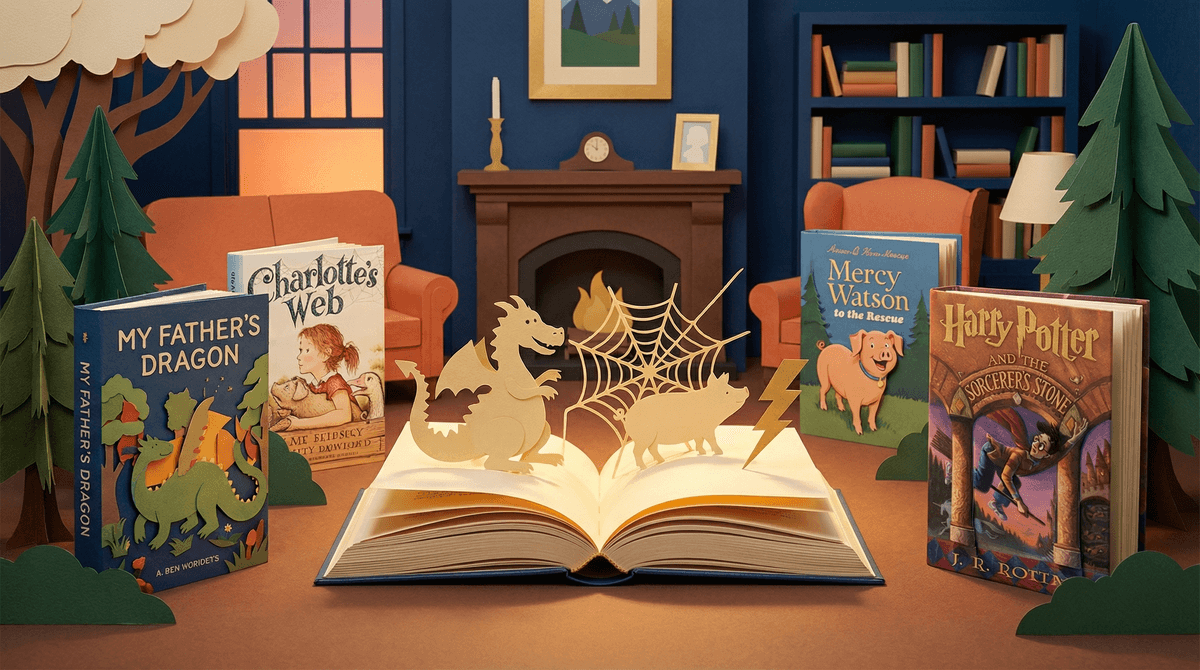
The Best Chapter Books to Read Aloud to a 9, 6, and 3-Year-Old at the Same Time
Finding chapter books that work for a 9-year-old, a 6-year-old, AND a 3-year-old feels like trying to find a streaming show everyone in the family agrees on—nearly impossible, but incredibly satisfying when you nail it. The secret? Short chapters, vivid characters, humor that works on multiple levels, and plots that move quickly enough to hold a preschooler's attention while still giving your oldest something to think about.
Top picks that actually work:
- My Father's Dragon by Ruth Stiles Gannett – Adventure, dragons, and chapters short enough for tiny attention spans
- Charlotte's Web by E.B. White – The classic that somehow works for everyone
- Mercy Watson by Kate DiCamillo – A cookie-loving pig in hilarious mishaps
- The Chocolate Touch by Patrick Skene Catling – King Midas meets candy obsession
- Anne Arrives by Kallie George – Anne of Green Gables energy for younger readers
- Harry Potter and the Philosopher's Stone by J.K. Rowling – Yes, really (with some caveats)
You're juggling three completely different developmental stages. Your 9-year-old is reading independently and wants real plot complexity. Your 6-year-old is learning to decode words and needs engaging but accessible language. Your 3-year-old has the attention span of a goldfish and needs constant sensory input—illustrations, funny voices, action that moves NOW.
But here's why it's worth the effort: family read-alouds create shared reference points that last for years. When your kids are teenagers, they'll still remember the voices you did for Mercy Watson or the time you all cried at the end of Charlotte's Web. Plus, it's one of the few activities that doesn't involve a screen and actually brings everyone together without someone complaining they're bored.
The trick is finding books with layered storytelling—simple enough on the surface for your youngest, but with enough nuance, vocabulary, and emotional depth to keep your oldest engaged.
Ages: 3-9
This is the gold standard for mixed-age read-alouds. The story follows a boy named Elmer who rescues a baby dragon from Wild Island, encountering quirky animals along the way. The language is straightforward, the chapters are genuinely short (like, 5-minute short), and the plot moves fast enough that your 3-year-old won't wander off to find their toy dinosaurs.
Why it works: The repetitive structure ("My Father's Dragon," "Elmer and the Dragon," "The Dragons of Blueland") gives your youngest predictability while the escalating adventures keep your 9-year-old invested. No scary content, no death, just pure adventure with a satisfying hero-wins arc. It's also recently been adapted into a Netflix movie, so you can compare notes afterward.
Ages: 3-9
Yes, it's a classic. Yes, everyone recommends it. And yes, it actually deserves the hype. Charlotte's Web is paced slowly enough for a preschooler to absorb—lots of farm imagery, clear character dynamics, and White's gentle humor—while the themes of friendship, loyalty, and mortality give older kids something real to chew on.
What parents should know: The ending is genuinely emotional (Charlotte dies), so be ready for some tears and questions about death. But that's also what makes it valuable—it's one of the first books many kids experience genuine loss through, and it handles it with grace. Your 9-year-old will appreciate the vocabulary and subtle satire; your 6-year-old will love Wilbur's personality; your 3-year-old will just want to hear about the pig who doesn't want to become bacon.
Pro tip: Use different voices for each character. Templeton the rat is especially fun to voice like a grumpy uncle.
Ages: 3-9
If you need something lighter after Charlotte's Web, Mercy Watson is your answer. This is a chapter book series that feels like a picture book—lots of illustrations, short self-contained episodes, and a plump pig who loves buttered toast and gets into ridiculous situations.
Why it works: Each chapter is basically a mini-story, perfect for your 3-year-old's attention span. The humor is physical and silly enough for the youngest listener while the witty dialogue and subtle satire (the neighbors are hilariously uptight) keep older kids laughing. No mature themes, no scary moments—just pure, cookie-loving chaos.
Kate DiCamillo also wrote The Tale of Despereaux and Because of Winn-Dixie, which are excellent next steps when your youngest ages up a bit.
Ages: 4-9
A modern twist on King Midas: a boy named John wishes everything he touches would turn to chocolate, and—surprise!—it becomes a problem real fast. The moral is clear (greed = bad, moderation = good), but the story is funny and fast-paced enough that it doesn't feel preachy.
What to expect: Your 3-year-old might be a little young for the slightly longer chapters, but the concept is simple enough to follow. Your 9-year-old will appreciate the narrative arc and consequences. And every kid will want chocolate afterward, so plan accordingly.
Fair warning: This book will absolutely prompt a conversation about candy consumption and why we can't just eat chocolate for every meal. Consider this a feature, not a bug.
Ages: 5-9
This is the first book in the "Anne Chapter Book Series," which adapts the beloved Anne of Green Gables spirit for younger readers. Short chapters, lively language, and Anne's imaginative personality make this a great bridge book—approachable enough for your 6-year-old learning to read independently, with enough character development to keep your 9-year-old invested.
Why it works: Anne is a talker, which means lots of dialogue and personality. Your 3-year-old might drift in and out, but the illustrations help keep them anchored. The themes are wholesome—friendship, imagination, finding your place—without being saccharine.
If your family loves this, the full Anne of Green Gables series is a natural progression for when your oldest is ready for longer, more complex novels.
Ages: 7-9 (with caveats for the 3-year-old)
Okay, hear me out. Harry Potter is a lot of book for a 3-year-old—longer chapters, some genuinely suspenseful moments (the troll, Voldemort on the back of Quirrell's head, the Forbidden Forest). But if your 9-year-old is ready for it and you're willing to pause for explanations or skip ahead during scary parts, it can work as a family read-aloud.
Why it's worth considering: The world-building is so vivid that even your youngest will latch onto details—Hagrid's size, the owls delivering mail, the idea of a school for magic. Your 6-year-old will love the clear good-vs-evil dynamic. Your 9-year-old will be hooked for weeks.
What parents should know: You'll need to gauge your 3-year-old's tolerance for mild suspense. Some kids are fine with it; others will have nightmares about three-headed dogs. You know your kid. If you're on the fence, save this one for next year and start with My Father's Dragon instead.
Pick books with engaging characters, lively language, and illustrations. Your 3-year-old needs visual anchors. Even chapter books with occasional illustrations help keep younger listeners engaged.
Pause to discuss themes. Let your 9-year-old predict what will happen next. Ask your 6-year-old how a character is feeling. Let your 3-year-old point at pictures or repeat funny words.
Rotate who picks the book. Give each kid a turn choosing from a pre-approved list. This gives everyone ownership and reduces the "I'm bored" complaints.
Use it as a wind-down routine. Car rides, bedtime, weekend mornings—find a consistent time when everyone's already sitting still. Don't try to force it during the witching hour when everyone's melting down.
Let the youngest "listen-in" without pressure. If your 3-year-old wanders off to play with blocks while you're reading, that's fine. They're still absorbing the language and story rhythms even if they're not sitting still.
For more strategies, check out this guide on building family reading habits or explore alternatives to screen time for mixed-age siblings.
Finding chapter books that work for a 9, 6, and 3-year-old is absolutely possible—you just need stories with short chapters, vivid characters, humor on multiple levels, and plots that move fast enough to hold everyone's attention. Start with My Father's Dragon or Mercy Watson if you want guaranteed wins, then branch out to Charlotte's Web or Harry Potter when you're ready for more depth.
And remember: the goal isn't perfect silence and rapt attention from all three kids. The goal is creating a shared story world your family can return to again and again—even if your 3-year-old is half-listening while stacking Legos.
Next steps: Pick one book from this list, commit to 10-15 minutes a day, and see what sticks. If you need more recommendations, try chapter books for early readers or books that teach empathy and emotional intelligence.