

Look, I'm going to be honest with you: in a world where your kid can watch 47 TikToks in the time it takes you to unload the dishwasher, getting them to sit with a book feels like a small miracle. But here's the thing—books are still one of the most powerful tools we have for teaching empathy.
Books that teach empathy aren't just "nice stories about being kind." They're stories that put kids directly into someone else's experience—someone who looks different, thinks different, faces different challenges, or lives in a completely different world. They're the literary equivalent of trying on someone else's shoes, except the shoes are actually their entire life, and your kid gets to walk around in them for 200 pages.
In an era when so much of kids' social interaction happens through screens—where blocking someone is easier than working through conflict, and algorithmic feeds can create echo chambers by age 10—books offer something genuinely different: sustained, deep perspective-taking. No skip button. No swipe away. Just you and another person's internal world.
Here's what we know from research: empathy isn't just a nice-to-have personality trait. It's a skill that can be taught and strengthened, and reading fiction is one of the most effective ways to do it. When kids read about characters facing challenges, making mistakes, or experiencing emotions, their brains actually simulate those experiences. It's like a flight simulator for human connection.
But empathy development is also getting harder. The average kid spends 5-7 hours a day on screens, and a lot of that time is spent in environments that don't exactly encourage deep emotional understanding. Roblox can teach problem-solving and creativity, but it's not teaching your kid what it feels like to be the new kid at school who doesn't speak English yet.
The empathy gap is real. Studies show that college students today score about 40% lower on empathy measures than students did 30 years ago. And while screens aren't the only culprit, the fact that kids are spending less time in face-to-face interaction and less time reading for pleasure definitely plays a role.
Books are the counterweight. They're slow, they're deep, and they require your kid to actually inhabit someone else's consciousness for extended periods.
Ages 3-5: Building the Foundation
At this age, empathy starts with identifying emotions in others. Look for books with clear emotional expressions and simple cause-and-effect scenarios.
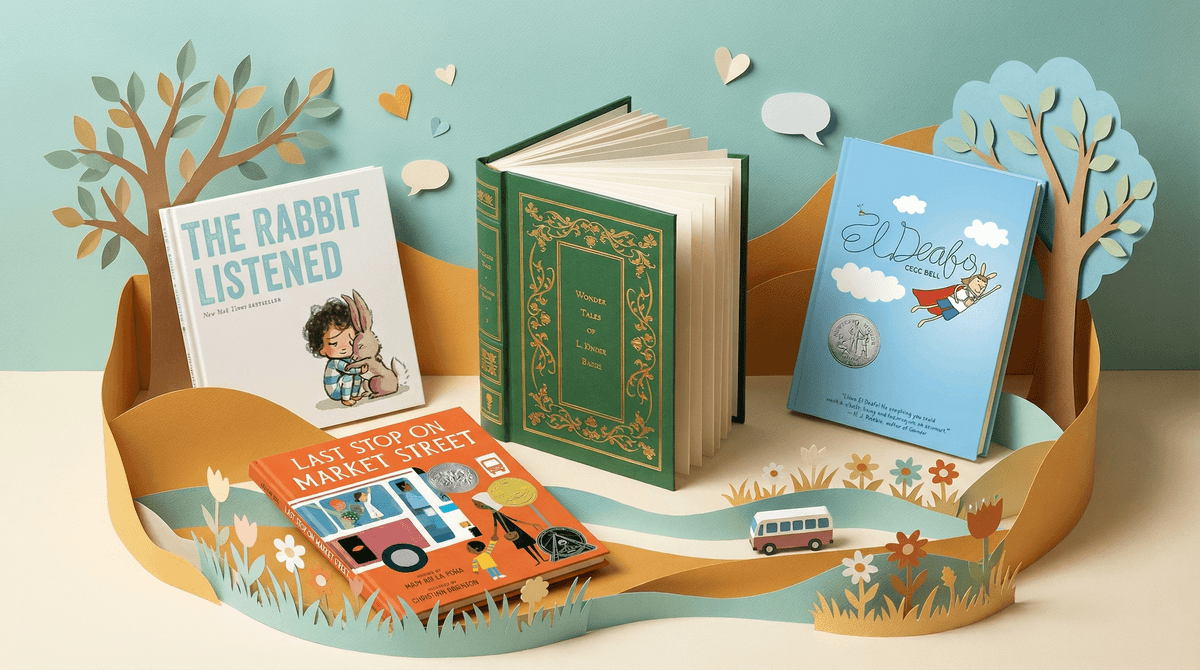
- The Rabbit Listened by Cori Doerrfeld—a masterclass in "sometimes people just need you to be there"
- Last Stop on Market Street by Matt de la Peña—sees beauty and humanity in unexpected places
- Julián Is a Mermaid by Jessica Love—celebrates self-expression and acceptance without making it a "lesson"
Ages 6-8: Expanding the Circle
Now kids can start understanding that people have different perspectives, backgrounds, and challenges. This is the sweet spot for books about friendship, family differences, and small acts of courage.
- Wonder by R.J. Palacio—yes, it's everywhere, but it's everywhere for a reason
- The Invisible Boy by Trudy Ludwig—about the kid who gets overlooked and the kid who notices
- Each Kindness by Jacqueline Woodson—doesn't give you a happy ending, which is exactly why it works
- Fry Bread: A Native American Family Story by Kevin Noble Maillard—introduces kids to Native American culture through food and family
Ages 9-12: Complex Perspectives
Middle grade is where books can really dig into moral complexity, systemic issues, and characters who make mistakes. These readers can handle ambiguity and multiple perspectives.
- New Kid by Jerry Craft—navigating predominantly white spaces as a Black kid, in graphic novel form
- The War That Saved My Life by Kimberly Brubaker Bradley—disability, abuse, and finding family in unexpected places
- Ghost by Jason Reynolds—trauma, poverty, and what it takes to keep running
- Front Desk by Kelly Yang—immigrant experience, economic struggle, and resilience
- The Crossover by Kwame Alexander—family, brotherhood, and loss, in verse
Ages 13+: The Deep End
Teens can handle books that tackle heavy topics head-on: racism, mental illness, violence, identity, injustice. These books don't simplify. They complicate. And that's exactly what empathy requires.
- The Hate U Give by Angie Thomas—police violence, code-switching, and finding your voice
- Speak by Laurie Halse Anderson—sexual assault and the cost of silence
- All American Boys by Jason Reynolds and Brendan Kiely—police brutality from two perspectives
- The Poet X by Elizabeth Acevedo—religion, family expectations, and finding your own voice
It's okay if they cry. Actually, it's great if they cry. Books that make kids feel things deeply are doing their job. Empathy isn't just intellectual understanding—it's emotional connection.
Representation matters, but so does exposure to difference. Yes, kids need mirrors (books that reflect their own experience). But they also need windows (books that show them lives very different from their own). Both build empathy, just in different ways.
Graphic novels count. If your kid devours graphic novels but won't touch chapter books, that's fine. New Kid, El Deafo, and Guts are teaching just as much empathy as traditional novels. Maybe more, because the visual element adds another layer of emotional information.
Talk about the books. The empathy-building happens in the reading, but it deepens in the conversation. Ask questions like "Why do you think they did that?" or "How would you feel in that situation?" or "Have you ever felt like that character?"
Don't force it. If you hand your kid a book and say "this will teach you empathy," they'll run in the other direction. Just... leave good books around. Read them yourself. Talk about what you're reading. Model the behavior.
Books aren't going to single-handedly solve the empathy crisis or counteract every negative effect of growing up extremely online. But they're one of the few tools we have that consistently, reliably help kids practice seeing the world through someone else's eyes.
In a digital landscape that often rewards quick judgments, hot takes, and tribal thinking, books offer something radically different: the opportunity to spend hours inside another person's head, heart, and lived experience.
So yeah, it's worth fighting for reading time. It's worth the library trips. It's worth letting your kid stay up past bedtime if they're in the middle of a chapter. Because every book that teaches empathy is also teaching your kid how to be a more thoughtful, connected, fully human person in a world that desperately needs more of those.
Start a family book club. Pick one book a month that everyone reads (or you read aloud to younger kids) and talk about it over dinner or during a weekend breakfast.
Follow diverse book lists. Organizations like We Need Diverse Books, the Conscious Kid, and Reading While White curate excellent recommendations.
Hit up your local library. Librarians are criminally underused resources. Tell them what your kid is into and ask for empathy-building recommendations. They've got you.
Balance the digital diet. For every hour of YouTube or Fortnite, try to carve out even 20 minutes of reading time. Not as a punishment—as an equally valuable form of entertainment and growth.
And if you want more specific recommendations based on your kid's age, interests, and reading level, Get recommendations for personalized suggestions.