

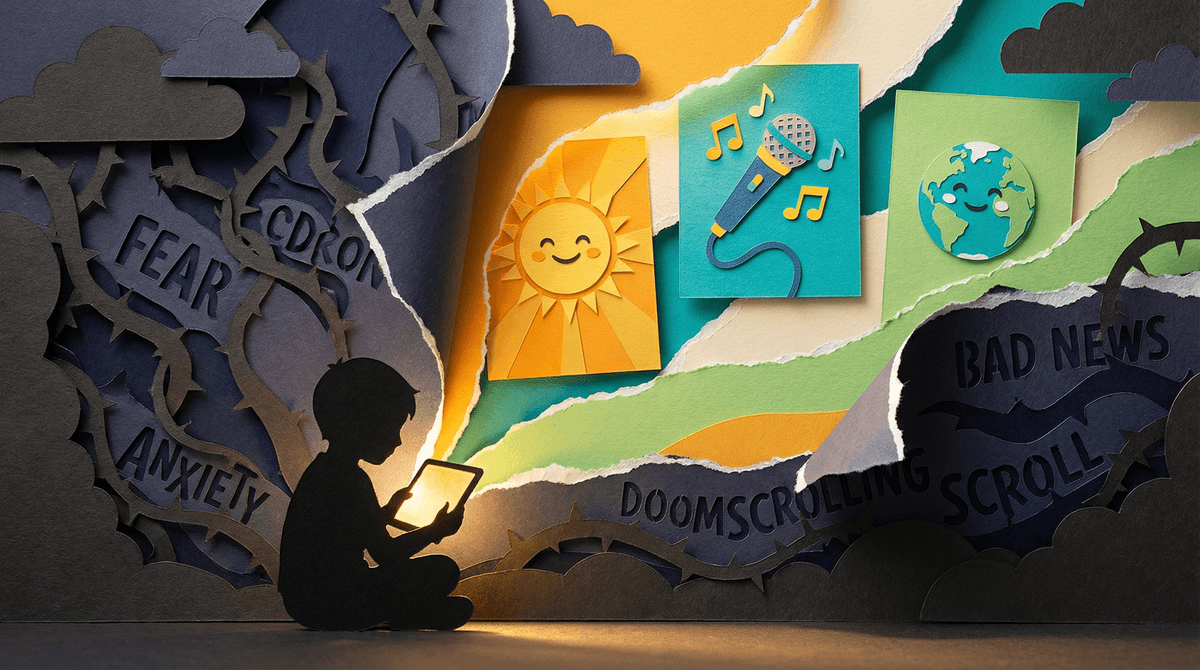
Let's be real: the internet wasn't designed to make us feel good. It was designed to keep us scrolling. And what keeps us scrolling? Bad news, outrage, disaster footage, and that special algorithmic cocktail of "the world is ending and here's why."
Doomscrolling is exactly what it sounds like—endlessly scrolling through negative news and content until you feel like garbage. And it's not just adults doing it. Kids as young as 8 or 9 are getting caught in the same spiral, watching climate disaster videos, school shooting coverage, war footage, and an endless stream of "everything is terrible" content served up by TikTok, Instagram, YouTube, and even Discord servers where kids share the darkest stuff they find.
The problem isn't that kids are learning about real issues. The problem is the volume, the presentation, and the lack of context. When your 11-year-old sees 47 videos about microplastics in their bloodstream before breakfast, that's not education—that's anxiety fuel.
Here's the thing about developing brains: they're not great at risk assessment or emotional regulation yet. When kids see scary content, they don't have the life experience to think "okay, but statistically speaking..." They just feel the fear. And algorithms love fear because fear drives engagement.
Plus, kids are getting this stuff in bite-sized, context-free chunks. A 60-second TikTok about ocean acidification doesn't include the part about the scientists working on solutions, or the historical context that humans have solved seemingly impossible problems before. It's just doom, doom, doom, swipe, doom.
And let's talk about the social element: in many friend groups, sharing dark or disturbing content has become a form of social currency. Being "aware" of every terrible thing happening everywhere becomes a weird badge of honor. Kids who try to stay positive can get labeled as naive or "cringe."
Research shows that Gen Z and Gen Alpha are significantly more pessimistic about the future than previous generations were at the same age. Some of this is about real-world challenges (climate change, economic uncertainty, etc.), but a huge part is about how information reaches them.
When you're algorithmically fed a curated stream of worst-case scenarios, your brain starts to believe that's the full picture. It's like if someone only showed you photos of car accidents and then asked you to estimate how dangerous driving is—you'd wildly overestimate the risk.
Okay, so what do we actually DO about this? Because the answer isn't "pretend everything is fine" or "ban all news forever."
1. Curate Their Information Diet (Especially for Younger Kids)
For kids under 12, you have more control here—use it. This doesn't mean hiding reality, but it means being the filter.
- Keep them off algorithm-driven feeds as long as possible. YouTube Kids (with parental controls) is better than regular YouTube. PBS Kids is better than TikTok.
- When they do need to learn about serious topics, you choose the source. A well-produced documentary or age-appropriate book gives context that a viral TikTok doesn't.
- Introduce news through kid-specific sources like NPR's Up First for Kids or KidNuz that present current events in age-appropriate, balanced ways.
2. Teach Media Literacy Early
By age 9 or 10, kids need to understand that algorithms are not neutral. Have explicit conversations:
- "TikTok shows you videos that will make you watch more videos. What emotion makes you keep watching?"
- "When you see something scary online, remember: you're seeing it BECAUSE it's scary. Normal, boring good news doesn't go viral."
- "If you saw 100 plane crashes on your feed, would that mean planes are dangerous? Or would it mean plane crashes are dramatic and get views?"
3. Balance Awareness with Action
One of the best antidotes to doom is agency. When kids learn about problems AND see examples of people solving them, it completely changes the emotional impact.
- If your kid is worried about the environment, find age-appropriate ways they can contribute (school recycling program, community garden, learning about renewable energy innovations).
- If they're anxious about social issues, look for stories of young activists making change. Not to pressure them to become activists, but to show that humans aren't helpless.
- The message is: "Yes, there are problems. AND humans are creative, resilient, and constantly working on solutions."
4. Create "Good News" Rituals
This might sound cheesy, but it works. Make space for actively seeking out positive stories:
- Weekly "good news" dinner conversation where everyone shares something hopeful they learned
- Subscribe to good news sources together (Good News Network, Some Good News, etc.)
- Follow social media accounts that highlight human progress, scientific breakthroughs, acts of kindness
The goal isn't to be Pollyanna. It's to correct the algorithmic bias toward negativity.
5. Monitor for Signs of Doom Spiral
Watch for:
- Increased anxiety or hopelessness about the future
- Obsessive checking of news or social media
- Talking constantly about disasters/worst-case scenarios
- Withdrawing from activities they used to enjoy
- Expressing beliefs like "nothing matters anyway"
If you're seeing these signs, it's time to intervene—not with toxic positivity, but with perspective, support, and probably some screen time boundaries.
6. Model Optimistic Realism Yourself
Kids are watching how YOU talk about the world. If you're constantly doomscrolling and venting about how everything is terrible, they're learning that worldview.
This doesn't mean faking it. It means:
- Acknowledging problems without catastrophizing
- Talking about your own strategies for staying informed without becoming overwhelmed
- Sharing stories of progress alongside challenges
- Demonstrating that you believe in the possibility of positive change
Raising optimistic kids in 2026 isn't about sheltering them from reality. It's about teaching them to process reality in a healthy way, giving them tools to distinguish between "staying informed" and "marinating in anxiety," and helping them understand that algorithms are designed to make the world look scarier than it actually is.
The world has real challenges. It always has. But it also has more people working on solutions, more resources for solving problems, and more reasons for hope than any generation before has had. Your kids deserve to know that part of the story too.
And if you need to have a family "no doomscrolling" rule? That's not being naive. That's being smart about mental health in the algorithm age.
