

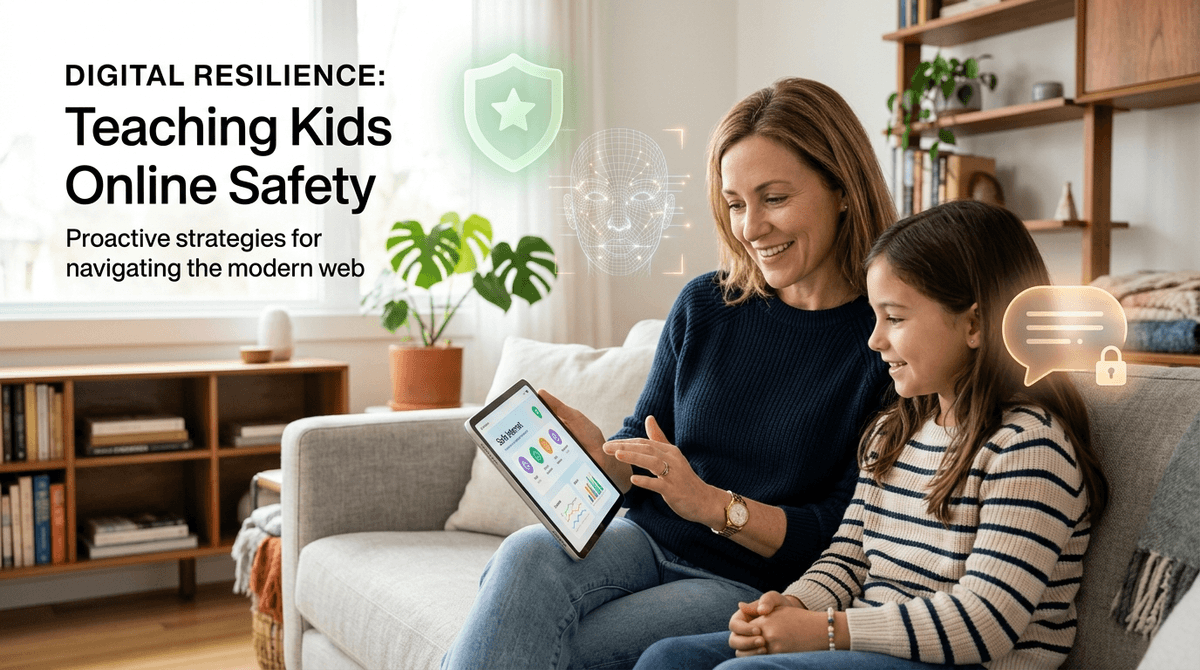
TL;DR: The old "don't talk to strangers" advice is officially obsolete. In 2026, the stranger is rarely a guy in a white van; they’re a "friend" in a Roblox lobby, a voice on Discord, or an AI-generated deepfake of their favorite YouTuber. To keep kids safe, we have to move from fear-based rules to resilience-based skills.
Quick Links for Vetted Social Spaces:
- Best for younger kids (Ages 6-10): Messenger Kids
- Best for creative play without the "Wild West" chat: Toca Life World
- Best for controlled social gaming: Minecraft (Private Servers)
- Safe video consumption: YouTube Kids
We grew up with the image of a creepy stranger offering candy from a car. Today, that "stranger" is likely a 14-year-old avatar in Roblox offering free Robux or a "rare pet" in Adopt Me!.
The danger isn't just "talking" to someone; it's the grooming process that happens through micro-interactions. It starts with a game invite, moves to a gift (digital currency), and eventually migrates to an unmonitored platform like Discord or Snapchat.
By the time a kid feels like something is "Ohio" (that’s Gen Alpha for "weird" or "cringe"), they’re often too deep in a digital friendship to know how to back out without feeling like they’re losing a social circle.
This is where it gets a little sci-fi and a lot scary. We are seeing a rise in AI-powered grooming.
Predators can now use AI voice-cloning software to sound like a child’s favorite streamer or even a classmate. They can create deepfake videos or photos that look incredibly convincing. If your kid thinks they are talking to a peer because the person "sounds like a kid," they are much more likely to lower their guard.
Let’s talk about the big two: Roblox and Fortnite.
Parents often ask if Roblox is teaching entrepreneurship because kids can "make games." Honestly? For 99% of kids, it’s just a platform designed to drain your bank account through psychological tricks and peer pressure. The chat feature is a mess. Even with filters, kids find ways to bypass them (using "leetspeak" or symbols).
While Fortnite is more about the game and less about the "hangout" than Roblox, the voice chat is where things get toxic. It’s not just about strangers; it’s about the culture of the strangers.
Check out our guide on setting up Roblox parental controls
If your kids are begging for social interaction but aren't ready for the open ocean of TikTok, here are the tiered options we recommend:
Messenger Kids (Ages 6-12)
This is the "training wheels" of social media. Parents have to approve every single contact. There is no "search" feature for strangers to find your child. It’s a closed loop. Is it perfect? No, it’s still Meta, but from a safety standpoint, it’s the gold standard for elementary-aged kids.
Minecraft (Ages 7+)
Minecraft is great because you can control the environment. If you host a private "Realm" or server, your child only plays with people you know in real life. Avoid the massive public servers (like Hypixel) until they are older and understand how to mute chat.
Zigazoo (Ages 5-12)
Think of this as a "TikTok for kids" where every video is moderated by actual humans before it goes live. There is no direct messaging between kids, which removes the biggest avenue for "Stranger Danger 2.0."
Kids don't go looking for predators. They go looking for connection, status, and free stuff.
- The "Gifting" Hook: In games like Roblox, someone offering "free Robux" is the digital equivalent of candy.
- The "Pro" Hook: A stranger might offer to help a kid level up in Fortnite or give them a rare skin.
- The "Fear of Trouble": Predators often tell kids, "If you tell your parents, they’ll take your iPad away." This is the most effective tool in their kit.
Get scripts on how to talk to a 10-year-old about digital grooming
Instead of the "Don't Talk to Strangers" lecture, try these three conversation shifts:
1. The "Public Square" Analogy
Explain that being in a Roblox lobby is like standing in the middle of a busy city park. You can play there, but you wouldn't follow someone into a private building (like a Discord server) just because they said they have a cool toy.
2. The "No-Take-Away" Rule
Make a pact: "If you see something weird or someone makes you uncomfortable, I promise I won't take your device away if you tell me." The #1 reason kids hide online interactions is the fear of losing their digital life. If they know you’re their partner and not their warden, they’ll come to you when things get "Skibidi" (weird/bad).
3. Spotting the AI "Glitch"
Teach your kids to look for "glitches" in digital friends. If a friend’s voice sounds slightly robotic, or if a "celebrity" is asking them for personal info or photos, that’s a red flag. Real celebrities don't hang out in random Among Us lobbies.
Ages 5-8
- Settings: Chat should be OFF by default. Use apps like PBS Kids or Toca Life World.
- Supervision: Co-playing is your best defense. Sit next to them while they play.
Ages 9-12
- Settings: Chat should be "Friends Only." No "Everyone" settings.
- Education: Explain what "Personal Identifying Information" (PII) is. No school names, no city names, no real birthdays.
Ages 13+
Read our guide on the dangers of financial sextortion
Online safety in 2026 isn't about building a wall around your child; it's about teaching them how to navigate the woods. They will encounter strangers. They will see things that are "brain rot."
Your goal isn't to be a high-tech spy (though parental controls help—check out our guide on Bark vs. Qustodio). Your goal is to be the first person they talk to when a "stranger" stops being a fun digital friend and starts being a red flag.
- Audit the Friends List: Sit down with your kid this weekend and go through their Roblox or PlayStation Network friends list. Ask, "Who is this?" If they can't name them from school or soccer, delete them.
- Turn Off Location: Check Snapchat and Instagram settings to ensure "Snap Map" and location sharing are off.
- Use Screenwise: Take our Family Digital Habits Survey to see how your community is handling social gaming and where your family stands.