

Look, I get it. Your kid can tell you 47 facts about axolotls they learned from a 60-second TikTok, but ask them to read a chapter book and suddenly they're "too tired." Welcome to the information age, where knowledge comes in bite-sized chunks and attention spans are... what were we talking about?
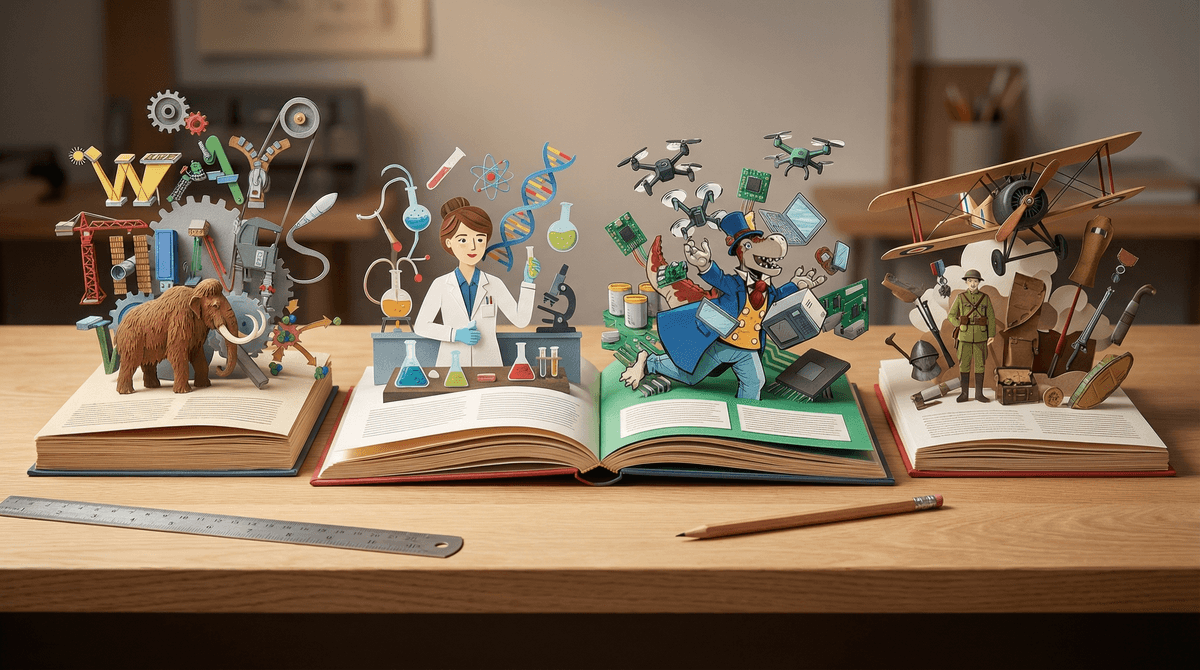
But here's the thing: nonfiction books aren't just dusty textbooks gathering dust on a shelf. Today's nonfiction for kids is stunning—filled with gorgeous illustrations, interactive elements, and topics ranging from "How to Build a Robot" to "The Secret Life of Farts" (yes, really). And they offer something that algorithmically-served content just can't: deep dives, context, and the ability to follow one's curiosity without being interrupted by an ad for Squishmallows every 30 seconds.
The real question isn't whether nonfiction books are good for kids (spoiler: they are). It's how do we get our screen-native children to actually pick them up when their devices are literally engineered to be more compelling?
I'm not here to tell you that books are inherently superior to digital content. That's not the point. But there's something specific that high-quality nonfiction books do that most digital content doesn't:
They teach kids how to sustain attention on something complex.
When your 9-year-old watches a YouTube video about space, they get cool facts. Great! But when they read The Mysteries of the Universe or crack open a DK Eyewitness book on astronomy, they're learning how to:
- Follow an extended argument or explanation
- Cross-reference information (remember indexes? wild concept)
- Sit with confusion and work through it
- Build genuine expertise rather than surface-level familiarity
This isn't about being a book snob. It's about building the cognitive muscles for deep work—something they'll desperately need when they're trying to understand climate change, evaluate political claims, or figure out literally anything that matters in adult life.
Also? Nonfiction books don't have comment sections. Sometimes that alone is worth the price of admission.
Kids are naturally curious. Like, obsessively so. Your 6-year-old wants to know everything about sharks. Your 10-year-old is suddenly fascinated by ancient Egypt. Your teen is weirdly into true crime or World War II aviation.
The problem isn't that kids don't like learning—it's that we often hand them the wrong books. That encyclopedia from 2003? Yeah, no. But something like The Way Things Work Now by David Macaulay or Women in Science by Rachel Ignotofsky? Those are legitimately cool.
Good nonfiction for kids:
- Respects their intelligence (no talking down)
- Looks amazing (visual design matters, folks)
- Connects to their interests (not just what adults think they should care about)
- Has personality (humor, voice, attitude—not just dry facts)
When kids find nonfiction that speaks to them, they devour it. I've seen 8-year-olds read 300-page books about video game design cover-to-cover. The key is matching the right book to the right kid at the right time.
Ages 4-7: Picture-Heavy Nonfiction This age group needs:
- Lots of visuals (photos, illustrations, diagrams)
- Short text chunks
- Topics they can observe in real life
- Interactive elements (lift-the-flap, touch-and-feel)
Try: National Geographic Little Kids First Big Book series, anything by Steve Jenkins, Ada Twist, Scientist series by Andrea Beaty
Ages 8-12: The Deep Dive Years This is the golden age for nonfiction obsessions:
- Can handle longer texts and complex concepts
- Want to become "experts" on their chosen topics
- Love gross facts, weird history, and "behind the scenes" content
- Starting to question and evaluate information
Try: Horrible Histories series, The Wild Robot (okay, that's fiction, but it's STEM-adjacent), Guinness World Records (the gateway drug to reading)
Ages 13+: Real-World Relevance Teens want nonfiction that:
- Connects to identity, social issues, or their future
- Treats them like adults
- Offers perspectives they're not getting elsewhere
- Has narrative drive (reads like a story, not a textbook)
Try: The 57 Bus by Dashka Slater, Born a Crime by Trevor Noah, anything by Steve Sheinkin for history buffs
"My kid only wants to read about Minecraft." Cool! Let them. Minecraft guides are nonfiction. They're learning to follow instructions, solve problems, and build expertise. It counts. Once they've exhausted every Minecraft book at the library, you can gradually introduce books about coding, engineering, or game design. Meet them where they are.
"They say books are boring." Because the books they've been offered probably are boring (to them). The solution isn't to force it—it's to get better at book-matching. Librarians are your secret weapon here. Tell them: "My kid is obsessed with Among Us and fart jokes" and watch them work magic.
"How do I compete with screens?" You don't. You make books part of the screen ecosystem. Listen to nonfiction audiobooks on car rides. Watch a nature documentary, then grab a book about the same topic. Use their YouTube interests as a jumping-off point. Crash Course Kids watching can lead to science books. Mark Rober fans might love engineering books.
"Are graphic novels and comics okay?" Yes! Graphic nonfiction is having a moment. Nathan Hale's Hazardous Tales, Science Comics, and Brazen: Rebel Ladies Who Rocked the World are all fantastic. Stop gatekeeping what "real" reading looks like.
Nonfiction books aren't a replacement for digital content—they're a complement. In a world where information comes at kids in rapid-fire snippets, books teach them how to slow down, go deep, and build real understanding.
The goal isn't to raise kids who never watch YouTube or scroll TikTok. It's to raise kids who also know how to sit with a book for 30 minutes and emerge with genuine knowledge about something they care about.
-
Hit the library this weekend. Seriously. Let your kid wander the nonfiction section and grab anything that looks interesting. No judgment on choices.
-
Start with their obsessions. Whatever they're into right now—use that as your entry point. There's a nonfiction book about literally everything.
-
Make it visible. Stack interesting nonfiction books on the coffee table, in the bathroom, by their bed. Casual exposure matters.
-
Model it. Let them see you reading nonfiction (or listening to nonfiction podcasts like Radiolab or 99% Invisible). Kids do what we do, not what we say.
-
Use Screenwise to balance it all. Understanding your family's actual screen patterns helps you figure out where books might fit—not as punishment or screen replacement, but as another tool for curiosity.
The digital world isn't going anywhere. But neither are books. And honestly? Kids who can navigate both are going to be just fine.