

MMO Games Explained: The Ultimate Beginner's Guide
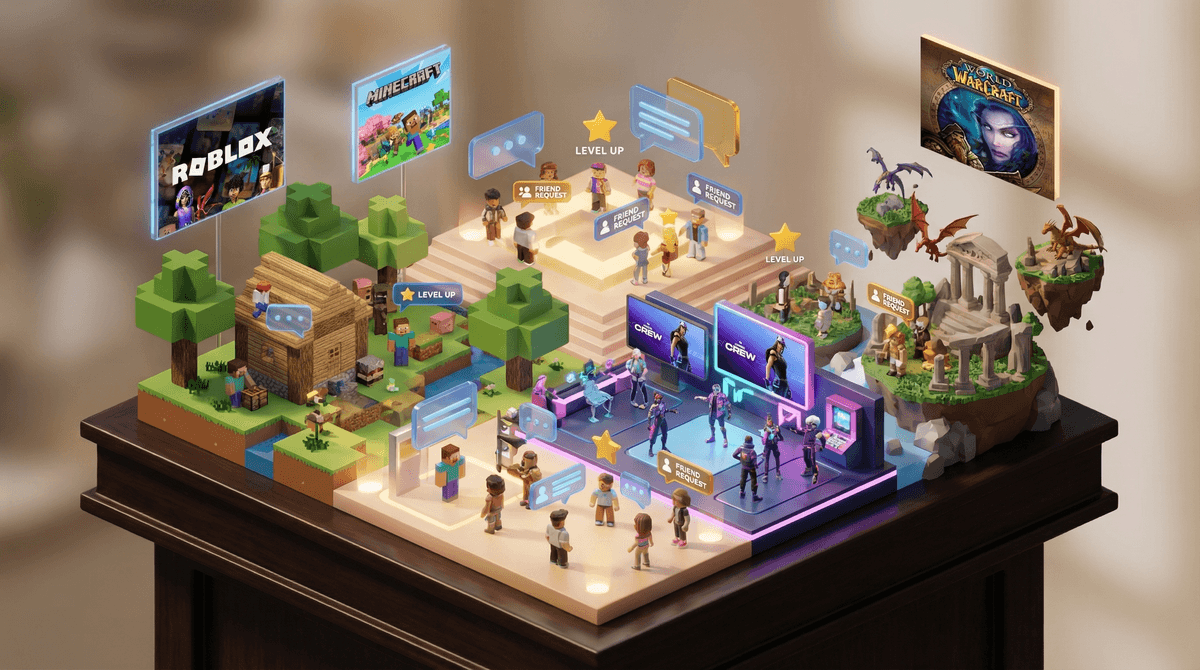
TL;DR: MMOs (Massively Multiplayer Online games) are virtual worlds where thousands of players interact simultaneously. Think Roblox, Minecraft servers, and World of Warcraft. They can teach teamwork and problem-solving, but come with real safety considerations around chat, in-game purchases, and time management. Here's what you actually need to know.
MMO stands for "Massively Multiplayer Online" game. Unlike playing Mario Kart with your sibling on the couch, MMOs connect hundreds or thousands of real people in a shared digital space at the same time. Players create characters (avatars), explore virtual worlds, complete quests, and interact with other humans across the globe.
The key difference from other online games? Persistence. The world keeps running even when your kid logs off. Their friend might build a castle while they're at soccer practice. Someone might leave them a gift. Drama might unfold in their guild. This "always-on" nature is both the appeal and the concern.
The social connection is real. During the pandemic, we all watched kids maintain friendships through Animal Crossing and Among Us. MMOs take that further—they're digital third spaces where kids hang out, collaborate, and yes, sometimes just goof around together.
They offer identity exploration. Creating and customizing an avatar lets kids try on different versions of themselves. Your shy 10-year-old might become a confident guild leader. Your chatty 13-year-old might prefer being a quiet healer who supports their team.
The progression feels meaningful. Leveling up, earning rare items, mastering skills—MMOs scratch the achievement itch in ways that feel more substantial than a 30-second TikTok dopamine hit. Whether that's actually better is debatable, but the engagement is different.
They teach real skills. Resource management, strategic planning, teamwork, even basic economics—good MMOs require complex thinking. Some kids are legitimately learning entrepreneurship through Roblox's developer tools or problem-solving through Minecraft server challenges.
Ages 8+ (but really, kids as young as 6 are on it)
Not technically one game but a platform of millions of user-created games. Your kid can play obstacle courses (obbys), roleplay games (adopt me!), simulators, and more. The social aspect is huge—it's basically a digital mall where kids hang out.
The catch: In-game purchases are aggressive, chat safety is inconsistent, and content quality varies wildly. You'll want to set up parental controls immediately.
Minecraft (Multiplayer Servers)
Ages 7+
In single-player mode, Minecraft is basically digital Legos. On multiplayer servers, it becomes a full MMO experience with communities, economies, and social hierarchies. Servers like Hypixel host tens of thousands of players.
The catch: Public servers expose kids to unmoderated chat and strangers. Private realms with friends are safer for younger kids.
Ages 10+ (officially rated T for Teen)
Yes, it's primarily a battle royale shooter, but the Creative mode and social spaces make it MMO-adjacent. Kids spend hours in Creative maps, attending virtual concerts, or just hanging out in the lobby.
The catch: Voice chat with strangers, intense competition, and that same aggressive cosmetics marketplace that makes kids feel left out if they don't have the latest skin.
Ages 13+ (officially rated T)
The OG MMO that defined the genre. Rich fantasy world, complex gameplay, serious time commitment. If your teen is into it, they're probably really into it.
The catch: Monthly subscription ($15), steep learning curve, and a reputation for being incredibly time-consuming. The "just one more quest" factor is real.
Ages 13+
Often recommended as the more wholesome MMO alternative to WoW. Strong story, supportive community culture, beautiful visuals.
The catch: Still a monthly subscription and significant time investment. The community is genuinely better than most MMOs, but it's still the internet.
Ages 7-12
Educational MMO focused on wildlife and nature. Kids create animal avatars, play minigames, and learn about ecosystems. Designed specifically for younger players with stronger safety features.
The catch: Membership pressure (free vs. paid) and some kids find it babyish by age 10.
Chat is the biggest concern. MMOs require communication for teamwork, but that means your kid is texting with strangers. Some games have decent filters and reporting systems. Many don't.
What you can do:
- Start with games that have robust parental controls (Roblox parental controls, for example)
- Disable or restrict chat for younger kids (under 10)
- For older kids, have conversations about never sharing personal information—not their school, not their city, not even their age
- Periodically check in: "Who are you playing with? How did you meet them?"
In-game purchases are designed to feel necessary. Free-to-play MMOs make money by selling cosmetics, power-ups, and convenience items. Kids feel left out when they can't afford the cool stuff their friends have.
What you can do:
- Set spending limits through platform parental controls
- Use gift cards instead of linking credit cards
- Have honest conversations about how free-to-play games make money

- Consider games with flat subscription fees (like Minecraft Realms) where everyone has equal access
Time management becomes a real issue. MMOs are designed to keep you playing. Daily rewards, limited-time events, fear of missing out—it's all intentional.
What you can do:
- Set clear time limits before they start playing (not in the heat of "just five more minutes")
- Use built-in parental controls to enforce playtime limits
- Watch for signs of compulsive play: irritability when not gaming, declining grades, dropping other activities
- Consider games with natural stopping points rather than endless progression
Online "friends" aren't always friends. Predators do exist in these spaces, but honestly, peer pressure and bullying from other kids is more common.
What you can do:
- Keep gaming devices in shared spaces for younger kids
- Know their usernames and periodically review their friend lists
- Teach them that real friends don't pressure them to share passwords, personal info, or inappropriate content
- Make yourself the "bad guy" they can blame: "My mom checks my chat, so I can't"
Ages 6-8: Stick with Animal Jam or private Minecraft Realms with IRL friends only. Disable all chat with strangers. Honestly, this age might be better served by cozy single-player games.
Ages 9-11: Roblox with strict parental controls, Minecraft on approved servers, or Animal Crossing (which is more limited multiplayer but very safe). Enable chat but with heavy filtering. Play alongside them regularly.
Ages 12-14: Most mainstream MMOs become appropriate with proper boundaries. Fortnite, Roblox, Minecraft servers, maybe World of Warcraft or Final Fantasy XIV if they're mature. Focus shifts from blocking everything to teaching critical thinking about online interactions.
Ages 15+: If they've demonstrated responsible gaming habits, most MMOs are fair game. Your role becomes more consultant than gatekeeper—helping them recognize when gaming is interfering with real life, talking through social drama, and maintaining open communication.
MMOs aren't inherently bad. The research on gaming is actually pretty nuanced. Moderate MMO play (1-2 hours daily) can improve problem-solving, spatial reasoning, and social skills. It's the excessive play (4+ hours daily) that correlates with problems.
Your kid's social life is partly happening here. Just like you might not understand why they need to go to the mall to "just hang out," they're doing the same thing in Roblox or Fortnite. Completely banning MMOs might actually isolate them from their peer group.
"Just one more minute" isn't defiance—it's game design. MMOs don't have natural stopping points. A quest might take 20 minutes. A dungeon run with friends can't be paused. Build in transition time and warnings: "You have 15 minutes to find a stopping point."
The skills are transferable. Guild leadership teaches management skills. Trading teaches economics. Raid coordination teaches project management. I'm not saying MMOs replace school, but the learning is real.
You don't need to become a gamer yourself. But you do need to show interest. Ask them to show you their character. Learn the names of their in-game friends. Understand what they're working toward. The kids who handle MMOs best have parents who stay engaged without being overbearing.
- Lying about how much time they're spending gaming
- Rage-quitting or extreme emotional reactions to in-game events
- Declining grades or dropping extracurriculars
- Choosing gaming over IRL social opportunities consistently
- Secretive behavior about who they're playing with
- Spending (or asking to spend) increasing amounts of money
- Sleep deprivation from late-night gaming sessions
One or two of these occasionally? Normal. Multiple issues persisting over weeks? Time for a serious conversation and possibly a gaming reset.
Step 1: Start with lower-stakes options. A private Minecraft Realm with school friends is a safer introduction than jumping straight into Fortnite public lobbies.
Step 2: Set up parental controls from day one. It's much harder to add restrictions later than to start strict and loosen up. Here's how to set up Roblox parental controls as an example.
Step 3: Establish the rules before they start playing:
- How much time per day/week?
- What happens if they break the rules?
- Which types of interactions are okay?
- How much money can they spend (if any)?
Step 4: Check in regularly. Not interrogation-style, but genuine interest. "Show me what you built today" or "Tell me about your guild" opens doors.
Step 5: Adjust as needed. What works for a 9-year-old won't work for a 14-year-old. Be willing to renegotiate as they demonstrate responsibility.
MMOs aren't going anywhere. They're a significant part of modern childhood social life, and completely avoiding them might not be realistic or even beneficial. The goal isn't to prevent your kid from ever playing MMOs—it's to help them engage with these virtual worlds safely and healthily.
Think of it like teaching them to swim. You don't keep them away from water forever, but you don't throw them in the deep end alone either. You teach them the skills, watch them practice, and gradually give them more independence as they prove they can handle it.
The best-case scenario? Your kid learns teamwork, makes genuine friendships, develops problem-solving skills, and has fun—all while you maintain enough oversight to keep them safe. The worst-case scenario? You pretend MMOs don't exist, they play anyway (at friends' houses, on devices you don't know about), and they never learn healthy gaming habits because you weren't part of the conversation.
Start small, stay involved, and adjust as you go. And remember—the fact that you're reading this guide means you're already doing better than most parents who just hand over the iPad and hope for the best.
- If your kid is already playing MMOs: Run through this safety checklist to make sure you've covered the basics
- If you're considering allowing MMOs: Check out alternatives to Roblox or alternatives to Minecraft to compare options
- If you're worried about screen time: Read about healthy gaming habits for kids
- If spending is out of control: Learn about how to manage in-game purchases
And if you're feeling overwhelmed by all of this? Welcome to modern parenting. We're all figuring this out together.