

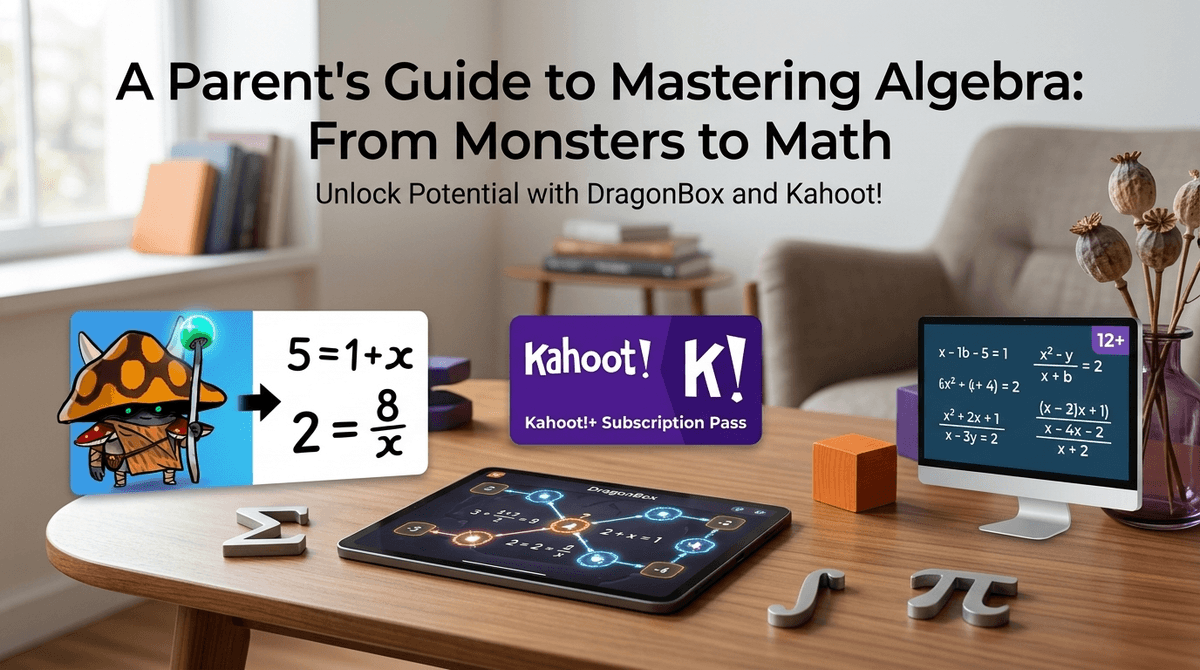
TL;DR: DragonBox Algebra 5+ and DragonBox Algebra 12+ remain the absolute gold standard for "stealth learning"—teaching complex algebraic thinking before kids even realize they’re doing math. However, the shift from a one-time $5 purchase to a recurring Kahoot!+ subscription (roughly $10/month or $60+/year) is a tough pill to swallow.
Our verdict: It’s worth a one-month "sprint" subscription during a school break or a particularly tough math unit, but unless your kid is obsessed with the entire Kahoot! ecosystem, don't let this one sit on your "forgotten subscriptions" list.
If you’ve been in the intentional parenting space for a while, you probably remember when DragonBox Algebra 5+ was the "it" app. It was the one thing we could point to and say, "See? Screen time isn't all Skibidi Toilet and Roblox 'obby' maps."
For years, DragonBox was a standalone purchase. You paid your five bucks, your kid learned how to balance equations by moving cute little monsters around a digital tray, and everyone was happy.
Then Kahoot! bought DragonBox.
Now, if you want the "Math Magic," you generally have to buy into the Kahoot! Kids or Kahoot!+ subscription model. This has sparked a lot of debate in parent groups: Is a recurring monthly fee worth it for a game your kid might finish in three weeks?
Before we talk about the money, we have to talk about the method. Most "educational" games are just flashcards with a thin coat of glitter. You answer a math problem, then you get to shoot a bird at a pig. The "game" and the "learning" are two separate things.
DragonBox Algebra 12+ is different. The game is the math.
- Stealth Learning: It starts with no numbers. Kids manipulate icons (monsters, boxes) to "isolate the dragon." By the time the game swaps the monsters for "x" and "y," the child already understands the logic of balancing an equation.
- Zero Pressure: There’s no timer, no "wrong answer" buzzing sound, and no high-pitched characters yelling at them. It’s quiet, focused, and deeply satisfying.
- High Success Rate: I’ve seen seven-year-olds solve equations that would make a middle schooler sweat, simply because the app removed the "fear" of math notation.
Check out our full guide on why DragonBox works where others fail
When you subscribe to Kahoot!+ to get access to DragonBox, you aren't just getting one app. You’re getting a bundle. The question is: do you actually want the rest of the bundle?
The subscription typically includes:
- DragonBox Numbers: Great for the 4-8 age range to understand number sense.
- DragonBox Big Numbers: Focuses on long addition and subtraction.
- DragonBox Elements: An incredible geometry game based on Euclid’s Elements.
- Kahoot! Kids: A library of trivia quizzes and "learning tracks."
- Poio: A solid learn-to-read app.
If you have multiple kids—say, a 5-year-old learning to read and a 10-year-old struggling with variables—the subscription starts to look like a much better deal. If you only have one kid who just needs to pass their 6th-grade algebra unit, it feels like paying for a whole buffet when you just wanted a side of fries.

We often talk about "brain rot" in the context of YouTube or mindless clicker games. But there is also "educational brain rot"—apps that claim to teach but actually just overstimulate kids with dopamine hits and ads.
Prodigy Math is the biggest offender here. While Prodigy is "free," it is heavily gamified with pets, battles, and constant prompts to buy a membership. It’s basically Pokemon with a few math problems thrown in to keep parents off their backs.
DragonBox is the "slow food" of the digital world. It requires actual cognitive effort. It doesn't use "Ohio" memes or flashing lights to keep your kid's attention. It uses the inherent satisfaction of solving a puzzle.
Recommended Math Alternatives:
- Mathigon: Often called the "World of Mathematics," it’s free, interactive, and beautiful. Best for ages 10+.
- Zearn: A non-profit that aligns with school curriculums. It's more "schooly" but very effective.
- Khan Academy Kids: The undisputed king of free, high-quality early learning (Ages 2-8).
Ages 5-8: Stick with DragonBox Algebra 5+. At this age, the goal isn't to prep for the SAT; it's to build a mental model that "math is just a game with rules."
Ages 9-12: This is the sweet spot for DragonBox Algebra 12+. Even though it says "12+," many 4th and 5th graders can handle it and will feel like absolute geniuses when they see "real" algebra later.
Ages 13+: If they are already in an Algebra 1 class and struggling, DragonBox can help bridge the conceptual gap, but it might feel a little "young" for a cynical teenager. For them, Mathigon or Brilliant.org might be a better fit.
The biggest frustration with the Kahoot! model is the "subscription creep." You sign up for the free trial, forget about it, and six months later you’ve paid $60 for an app your kid played for four days.
The Strategy: Treat DragonBox like a seasonal camp.
- Wait for a break (Winter break or Summer).
- Subscribe for one month.
- Set a "DragonBox Challenge" where the kid tries to finish the game in that month.
- Cancel immediately after subscribing so it doesn't auto-renew.
This turns a "draining the bank account" situation into a $10 investment in their education, which is cheaper than a single tutoring session.
Is DragonBox Algebra worth the Kahoot! subscription?
Yes, but with conditions. If you are looking for a deep, meaningful way to help your kid understand math rather than just memorizing formulas, DragonBox is still the best in the business. The Kahoot! wrapper is annoying, and the price hike is frustrating, but the actual content remains world-class.
If your kid is already a math whiz or if you’re on a tight budget, skip the subscription and head over to Mathigon or Khan Academy. But if you have a kid who says "I'm not a math person," the $10 for a month of DragonBox might be the best money you spend this year to prove them wrong.