

Look, we all want our kids to love science—but handing them a worksheet about the periodic table isn't exactly going to compete with Fortnite or YouTube. Science learning games are the sweet spot: actual games that happen to teach chemistry, physics, biology, or engineering concepts through gameplay that's genuinely fun. Not "educational fun" (which usually means neither), but actually engaging.
The best ones don't feel like school. They feel like puzzles, adventures, or creative sandboxes where scientific thinking is just... how you play. Your kid isn't memorizing the water cycle—they're engineering a water filtration system to save their Minecraft village. They're not studying physics—they're launching rockets and watching them explode (virtually) until they figure out thrust-to-weight ratios.
Here's the thing: most kids decide whether they're "science people" by middle school. And that decision often has nothing to do with whether they're actually good at science—it's about whether science feels accessible, creative, and interesting to them.
Games can change that equation. They let kids experiment without fear of getting the "wrong answer." They make abstract concepts visible and tangible. And honestly? They can teach scientific thinking—hypothesis, experimentation, iteration—better than a lot of classroom experiences.
Plus, if you're going to have screen time anyway (and let's be real, you are), wouldn't you rather it involve orbital mechanics than watching someone else play Roblox?
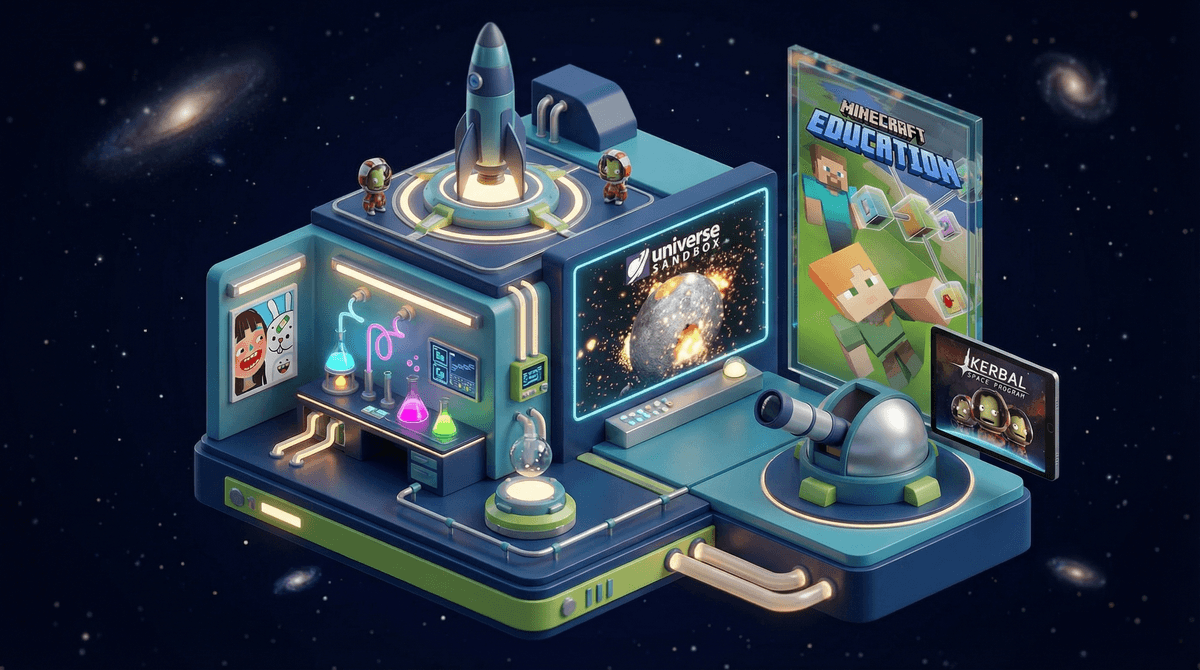
Kerbal Space Program (Ages 8+)
This is the gold standard. You build rockets and spacecraft for adorable little aliens, then launch them into space. Except the physics are real—so your rockets will absolutely explode if you don't account for things like fuel weight, aerodynamics, and orbital velocity.
Kids learn genuine aerospace engineering concepts through trial and (lots of) error. The game is complex enough that NASA has literally used it for outreach. But it's also goofy and forgiving enough that an 8-year-old can have fun crashing rockets into the moon.
Parent note: There's a learning curve. Expect your kid to fail a lot at first—that's the point. Also, the sequel (KSP2) exists but is buggy; stick with the original for now.
Universe Sandbox (Ages 10+)
Want to see what happens if you throw Jupiter at Earth? Or add a second sun to our solar system? This is a physics simulator that lets kids play god with actual astrophysics. They can create solar systems, smash planets together, and watch black holes devour stars—all with real gravitational physics and collision modeling.
It's mesmerizing and teaches astronomy, gravity, and planetary science through pure experimentation. Fair warning: your kid will definitely try to destroy Earth. Multiple times. It's fine.
Minecraft Education Edition (Ages 7+)
Yes, regular Minecraft teaches problem-solving and creativity. But Education Edition has built-in chemistry, physics, and biology lessons that actually work. Kids can build compounds using a real periodic table, create chemical reactions, and even program little robots using block coding.
The chemistry lab is surprisingly robust—your kid can make glow sticks by combining real chemical formulas. It feels like magic but teaches actual molecular science.
Parent note: This requires a separate (free) account and isn't the same as regular Minecraft. Some schools provide access; you can also get it at home.
SpaceChem (Ages 12+)
This is a puzzle game about chemistry and programming disguised as a space factory simulator. You're building molecular assembly lines, bonding atoms together to create compounds. It teaches actual chemistry concepts—bonding, molecular structure, reaction sequences—through increasingly complex puzzles.
It's hard. Like, really hard. But for kids who love logic puzzles, it's incredibly satisfying. Think of it as Portal but for chemistry nerds.
Scribblenauts (Ages 6+)
This one's a bit different. You solve puzzles by typing any noun and watching it appear in the game. Need to cross a river? Type "boat" or "bridge" or "helicopter" or "pterodactyl."
The science learning is more subtle—it's about understanding how objects work, their properties, and how they interact. Kids learn that a "fire extinguisher" puts out fires, a "magnet" attracts metal, and "wings" let you fly. It builds scientific vocabulary and cause-and-effect thinking through creative problem-solving.
Poly Bridge (Ages 8+)
Engineering simulation where you build bridges and watch cars drive over them. Or, more accurately, watch your bridges collapse spectacularly until you figure out structural physics. It teaches tension, compression, load distribution, and material properties through pure trial and error.
The physics are real enough to matter, but the game is forgiving enough to be fun. Plus, watching your bridge fail is half the entertainment.
The Incredible Machine and Contraption Maker (Ages 7+)
Classic Rube Goldberg puzzle games where you build chain-reaction machines using pulleys, ramps, springs, and other physics objects. Kids learn mechanical physics, cause and effect, and systems thinking by creating increasingly elaborate contraptions.
These games are old-school but still fantastic for teaching how simple machines work together.
Most "educational" apps are honestly pretty shallow—they're flashcards with animations. But a few stand out:
-
Toca Lab (Ages 4-8): Playful chemistry exploration for younger kids. You experiment on elements using tools like a centrifuge or Bunsen burner to discover new elements. It's not rigorous science, but it builds curiosity and comfort with scientific tools.
-
The Cat in the Hat Builds That (Ages 5-9): Engineering challenges for younger kids. Build bridges, towers, and machines using simple physics. It's PBS Kids quality—actually educational, actually fun.
-
[Monster Physics](https://screenwiseapp.com/media/monster-physics-game (Ages 8-12): Build contraptions to solve puzzles using real physics. Think of it as a simpler, mobile-friendly version of The Incredible Machine.
Ages 4-7: Start with Toca Lab, Scribblenauts, or The Incredible Machine. Focus on cause-and-effect and exploration over "correct answers." Let them experiment freely.
Ages 8-11: Kerbal Space Program, Minecraft Education Edition, and Poly Bridge hit the sweet spot. They're complex enough to teach real concepts but accessible enough to stay fun. Expect to help with the learning curve on KSP.
Ages 12+: SpaceChem and Universe Sandbox are perfect for kids ready for deeper complexity. These games don't hold hands—they assume your kid wants to actually understand the science, not just pass a level.
These aren't magic bullets. Your kid won't become a rocket scientist from playing Kerbal Space Program (though honestly, some have). But they will build intuition about how physics works, comfort with scientific thinking, and—most importantly—the sense that science is something they can do, not just memorize.
Play with them, at least at first. These games have learning curves. Sitting down for the first hour to figure out the controls together makes a huge difference. Plus, you might actually enjoy launching rockets into space or building collapsing bridges.
Don't quiz them. The worst thing you can do is turn game time into pop quiz time. "So what did you learn about gravity?" is a great way to make them stop playing. Let the learning be intrinsic. If they're excited, they'll tell you about it.
Balance is still important. Yes, these games are more enriching than watching YouTube shorts. But they're still screen time. They don't replace hands-on experiments, nature walks, or building actual stuff with their hands.
The best science learning games don't feel educational—they feel like games that happen to require scientific thinking. Kerbal Space Program is the crown jewel if your kid is ready for it. Minecraft Education Edition is perfect for kids already obsessed with Minecraft. And Scribblenauts is great for younger kids just starting to think scientifically.
The goal isn't to replace school or turn screen time into "productive" time. It's to give kids a chance to experience science as creative, experimental, and genuinely interesting—before they decide it's "not for them."
And honestly? If your kid becomes the person who can explain orbital mechanics at a dinner party, that's just a bonus.