

TL;DR: Human Resource Machine is a puzzle game that tricks kids into learning low-level computer programming (Assembly language) by framing it as a quirky, slightly dystopian office job. It’s brilliant, challenging, and contains zero "brain rot."
If your kid has graduated from Scratch or is bored with the logic in Minecraft, this is the "boss level" of educational gaming.
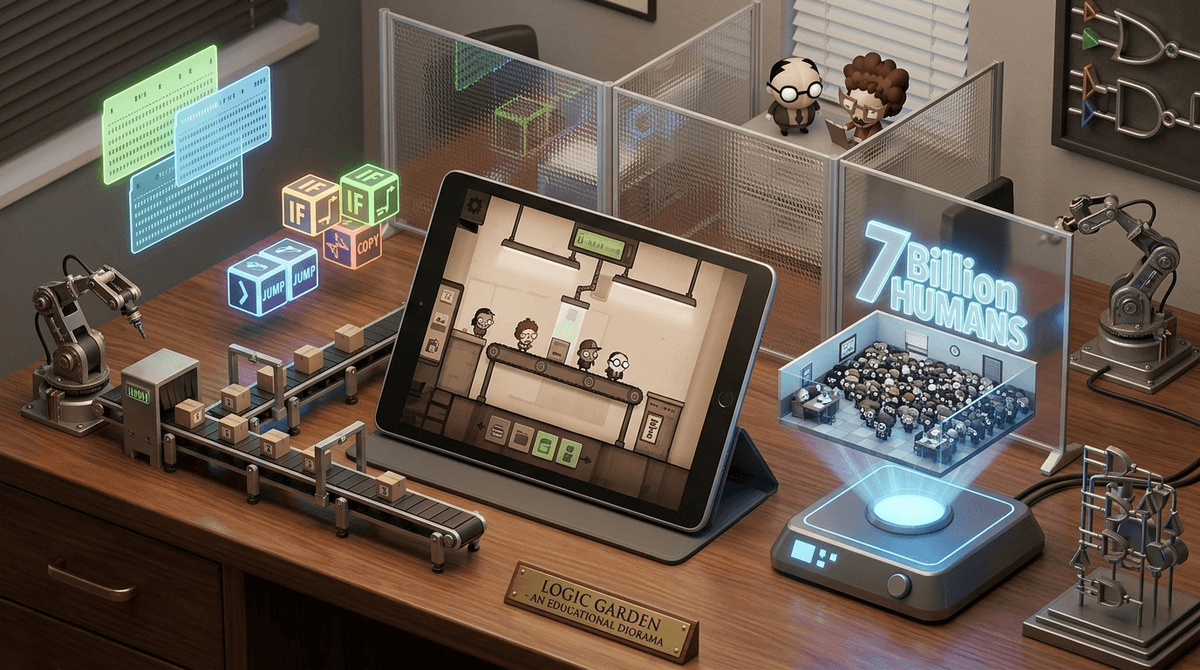
Imagine a 1950s office building where everything is automated, but the "computer" is actually just a bunch of tiny people moving boxes around. You play as a nameless office worker. Your job is simple: take boxes from the "In" conveyor belt, follow a specific set of instructions to change or move them, and put them on the "Out" conveyor belt.
The "instructions" you use are actually basic programming commands. You aren't typing code; you’re dragging and dropping commands like copyto, add, and jump.
As the years pass in the game (each level is a "year" of your career), the tasks get harder. You start by just moving a box. By the end, you’re creating complex algorithms to sort strings of letters or find prime numbers. It’s published by Tomorrow Corporation, the same team behind World of Goo and Little Inferno, so it has that signature dark-but-charming art style and a weirdly catchy soundtrack.
Most "coding games" for kids are... well, they're kind of patronizing. They use bright colors and fluffy characters to mask the fact that you’re learning. Human Resource Machine doesn't do that. It’s honest about the fact that logic is hard, and it makes the "eureka" moment of solving a puzzle feel earned.
It teaches Assembly Language logic. In the hierarchy of coding, Assembly is "low-level," meaning it's very close to how the actual hardware of a computer thinks. While Python or Javascript lets you use big, powerful commands, this game forces you to break every problem down into tiny, microscopic steps.
If your kid can beat this game, they don't just "know a language"—they understand how computers actually function at their core.

You’d think a game about being a corporate drone would be a hard sell, but it works for a few reasons:
- The "Optimization" Hook: After you solve a level, the game shows you two charts: one for how many instructions you used and one for how many steps the "worker" took. This triggers the "gamer brain." Kids who love speedrunning or getting high scores will obsess over rewriting their code to make it faster and leaner.
- The Humor: The game is a satire of corporate culture. There are cutscenes about the "machines" taking over and funny, cryptic messages from the boss. It feels "mature" in a way that Code.org or Tynker doesn't.
- Low Stakes, High Reward: There’s no "game over." If your code fails, the worker just trips, boxes fly everywhere, and you try again. It rewards experimentation rather than punishing mistakes.
While the game is rated for everyone, there is a definite "logical floor" here.
- Ages 9-11: They will likely breeze through the first 10-15 levels. After that, things like "pointers" and "jump loops" might require some parental help (or a YouTube tutorial). It’s a great co-op experience for a parent and child to solve together.
- Ages 12-15: This is the sweet spot. They have the mathematical maturity to handle the later puzzles, and the "optimization" challenges will keep them busy for hours.
- Ages 16+: Even for teens taking AP Computer Science, the later levels of this game are legitimately difficult. It’s a great way to reinforce what they’re learning in school without it feeling like homework.
This is the "wellness" part of the guide that parents love: Human Resource Machine is a pure single-player experience.
- No Chat: There is no online component, so you don't have to worry about "Ohio" memes or toxic strangers.
- No Microtransactions: You buy the game once, and you own it. There are no "Human Resource Coins" to buy or "Skins" to unlock with your credit card.
- Offline Play: It works perfectly on a tablet in "Airplane Mode," making it a top-tier travel game.
Let’s be real: this game is hard. Around "Year 20" in the game, the difficulty spikes. Some kids might get frustrated and quit. This is actually a great "teachable moment" about the frustration of debugging code.
If they get stuck, don't just give them the answer. Encourage them to "be the machine"—get some physical index cards or Post-it notes and have them act out the steps of their "program" on the kitchen table.
Also, the sequel, 7 Billion Humans, introduces "parallel processing" (controlling multiple workers at once). It’s even more complex, so save that for after they’ve mastered the first one.
Similar Recommendations:
- While True: learn() — A game about machine learning and cats.
- Baba Is You — A puzzle game that is secretly about logic and rulesets.
- TIS-100 — If your teen thinks Human Resource Machine is "too easy" (warning: this one is very "hacker" aesthetic and very difficult).
- Lightbot — A great "junior" version for kids under 9.
Human Resource Machine is one of those rare "educational" games that doesn't feel like a vegetable disguised as a dessert. It’s a legitimate, high-quality puzzle game that happens to teach a high-value skill.
If you're looking to swap out some Roblox time for something that builds logic and problem-solving skills, this is a $5-$15 investment (depending on the platform) that pays off in actual brainpower.
- Download it on the iPad, Switch, or PC. It's best on a tablet because the drag-and-drop interface is very intuitive for kids.
- Play the first 5 levels with them. Show them that you’re interested in how they "solve" the office tasks.
- Watch for the "frustration wall." When they hit a hard level, ask them to explain their logic to you. Often, explaining the code out loud (called "Rubber Ducking" in the tech world) helps them find the error themselves.