

TL;DR
If you are looking for the antidote to "brain rot" and high-decibel YouTube influencers, Hilda is your new best friend. It’s a beautifully animated Netflix series based on the graphic novels by Luke Pearson that feels like a warm blanket mixed with a shot of adrenaline. It’s perfect for kids aged 6-12 who love adventure, mythology, and a protagonist who actually has a healthy (if occasionally strained) relationship with her mom.
Quick Links:
- Watch the show: Hilda (Netflix)
- Read the source material: Hilda graphic novels
- For the movie finale: Hilda and the Mountain King
- Similar vibes: Gravity Falls and The Wild Robot
Hilda follows the adventures of a blue-haired girl who grows up in the "Wilderness"—a vast, magical landscape filled with giants, tiny invisible elves, and "Deerfoxes" (her pet, Twig, is a fan favorite).
Early in the first season, Hilda and her mother, Johanna, move from their isolated cabin to the walled city of Trolberg. The show is essentially about Hilda navigating the transition from a free-range life in nature to a more structured life in the city, all while discovering that the "urban" world has just as many magical secrets and dangers as the forest did.
Unlike many modern cartoons that rely on frantic pacing and slapstick, Hilda leans into a "cozy-spooky" aesthetic. It draws heavily on Scandinavian folklore, featuring trolls that turn to stone in the sunlight and "Nisse" (house spirits) who live in the "nowhere space" behind your furniture.
There’s a specific kind of magic in Hilda that resonates with kids who are starting to crave independence. Hilda is a "Sparrow Scout," which is the show's version of the Girl Scouts, and much of the plot involves her and her friends, Frida and David, exploring the city and its outskirts without constant adult supervision.
Kids also love the stakes. The show doesn't talk down to them. When a giant accidentally steps on Hilda’s house, it’s a genuine crisis. When the "Marra" (nightmare spirits) target her friend David, it’s legitimately creepy. It respects the audience's ability to handle complex emotions like loneliness, the fear of change, and the moral ambiguity of "monsters" who might just be misunderstood.
Check out our guide on why kids are obsessed with "cozy" media
If you’ve spent any time looking at what’s trending on YouTube Kids lately, you know that a lot of content is designed to keep kids in a state of high-arousal—constant screaming, bright flashing colors, and rapid-fire cuts. Hilda is the exact opposite.
It’s what we call "low-arousal, high-engagement" content. The color palette is muted—lots of autumnal oranges, deep blues, and mustard yellows. The music is atmospheric (the theme song is by Grimes). It encourages kids to slow down, observe details, and think about the "why" behind a character's actions.
From a digital wellness perspective, Hilda is a "prestige" show. It’s the kind of media that sparks creative play afterward. Don’t be surprised if your kid wants to go outside and draw "field notes" on local bugs or start a collection of interesting rocks after an episode.
Learn more about the difference between high-arousal and low-arousal media
If your family finishes the three seasons of Hilda, here is how to keep that momentum going without falling back into the Roblox rabbit hole:
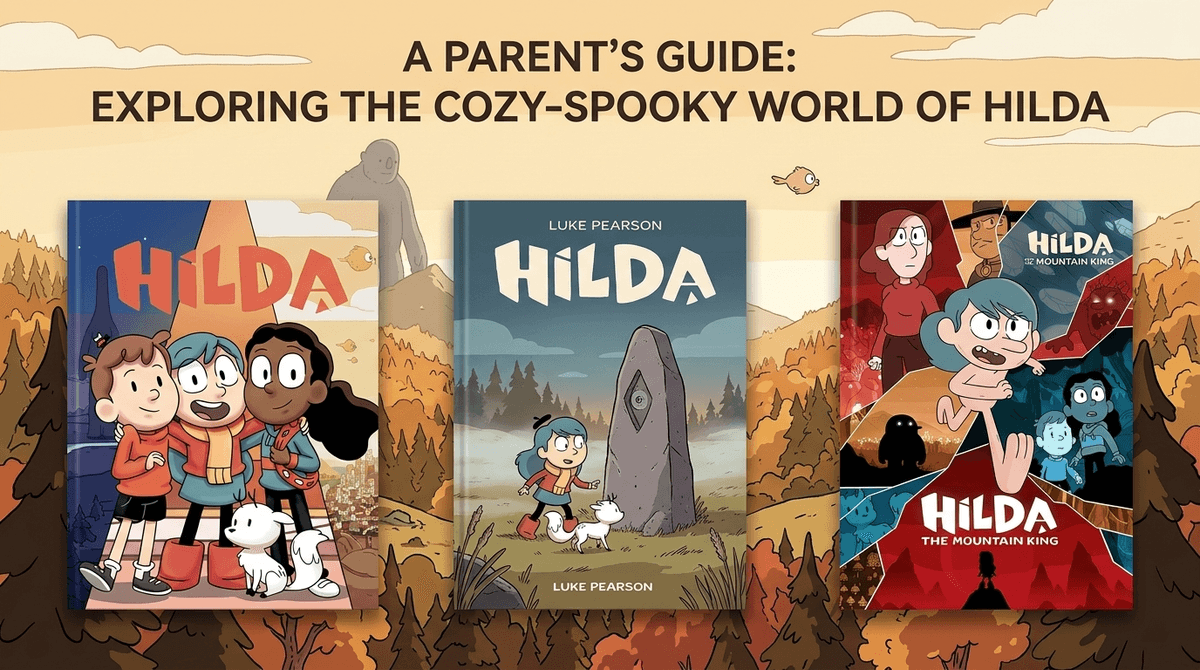
The show is a very faithful adaptation, but the books have a charm all their own. They are perfect for reluctant readers because the art is so engaging.
If your kids like the mystery and the "weird things in the woods" aspect of Hilda, this is the logical next step. It’s a bit snarkier and faster-paced, but it has a deep lore that rewards attentive viewers.
This is a miniseries that is best watched in the fall. It’s slightly spookier than Hilda—think "folk horror for kids"—but it shares that same respect for atmosphere and storytelling.
For kids who like the "creature" aspect of Hilda but want something with a bit more action and a killer soundtrack. It’s post-apocalyptic but vibrant and hopeful.
If the theme of "nature vs. civilization" in Hilda really hit home, this book (and the movie adaptation) is a must. It explores survival and found family in a way that feels very "Hilda-adjacent."
Hilda is rated TV-Y7, which is pretty accurate. However, as every parent knows, "Y7" can mean a lot of things.
The Spooky Factor
There are elements that might be too much for very sensitive 5 or 6-year-olds. The Trolls are huge and can be menacing. The Marra are teenagers who literally invade people's dreams to give them nightmares. There’s also a "Black Hound" in Season 1 that is essentially a giant, shadowy wolf.
If your kid handled the "scary" parts of Frozen or Moana fine, they’ll be okay here. If they still have nightmares about the vacuum cleaner in Teletubbies, maybe wait a year.
Independence vs. Rebellion
Hilda is a "good kid," but she is also a frequent rule-breaker. She sneaks out of the house, she goes into "Forbidden" areas, and she often thinks she knows better than the adults.
In a world where we’re often terrified to let our kids walk to the end of the block, Hilda’s "free-range" lifestyle can feel like a fantasy. It’s worth talking to your kids about the difference between "Hilda-style adventure" and real-world safety.
Check out our guide on talking to kids about "TV safety" vs "Real life safety"
One of the best things about Hilda is the portrayal of Hilda’s mom, Johanna. In so many kids' shows, parents are either:
- Invisible/Dead
- Bumbling idiots
- The "No-Fun" police
Johanna is none of those. She’s a graphic designer (relatable for many of us), she’s patient, but she also gets genuinely angry when Hilda lies to her. Their relationship evolves throughout the series, especially in the movie Hilda and the Mountain King, where they have to literally walk in each other's shoes. It’s a great jumping-off point for conversations about why we have rules and how trust is built.
Here are a few conversation starters for your next car ride:
- On Empathy: "The people in Trolberg are terrified of Trolls, but Hilda realizes they just want to be left alone. Why do you think the city people are so scared of things they don't understand?"
- On Change: "Hilda really missed her old house in the woods when she moved to the city. What’s something you’ve had to change that felt hard at first?"
- On Bravery: "Hilda says, 'Such is the life of an adventurer.' Does being brave mean you aren't scared, or does it mean doing the thing even when you are scared?"
Hilda is a rare gem in the streaming landscape. It’s intelligent, visually stunning, and promotes a sense of wonder about the natural world that is often missing from our digital-heavy lives.
It’s not just "not bad" for your kids—it’s actually good for them. It’s the kind of show that makes you feel like a "good parent" for putting it on, and honestly, in 2026, we’ll take all the wins we can get.
- Watch the first two episodes with your kid to gauge their "spooky" tolerance.
- Grab the first graphic novel, Hilda and the Troll, for their nightstand.
- Check your Screenwise dashboard to see how Hilda compares to the other shows your community is watching.
Take the Screenwise survey to see your family's media habits in context