

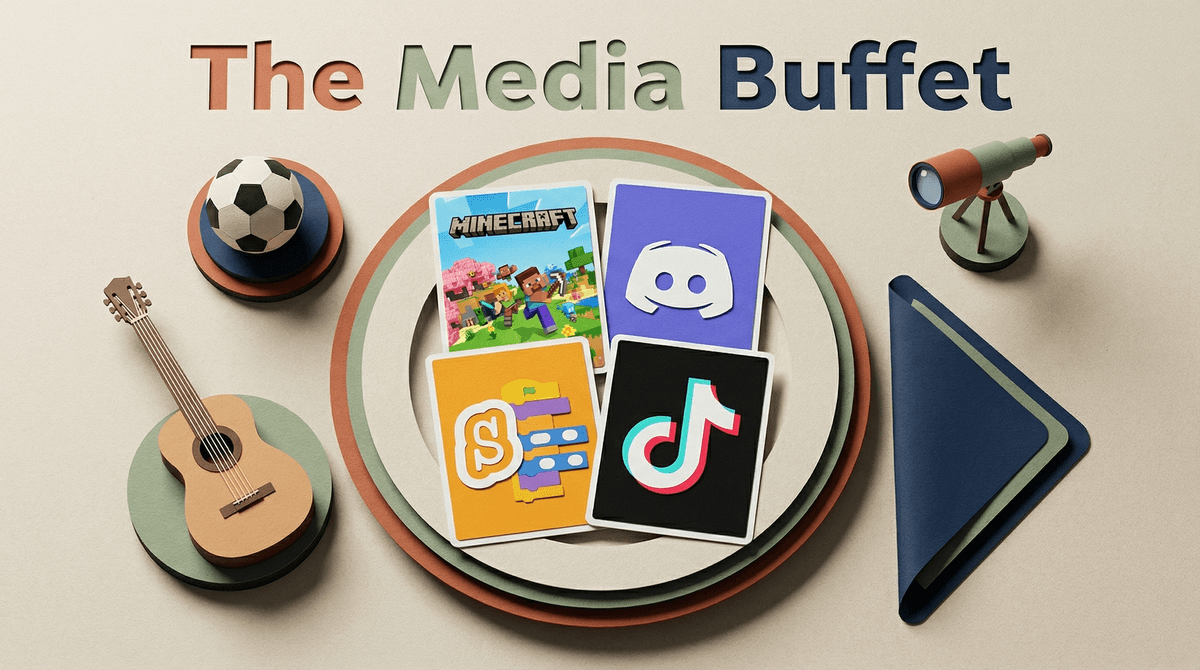
Let's be real: "screen time limits" sounds great in theory, but in practice? It's like trying to count calories at a buffet while your kids are melting down because their friend just got a new phone and they're the ONLY ONE without Snapchat (they're not).
A healthy family media diet isn't about setting a timer and calling it a day. It's about building a balanced relationship with technology that actually fits your real life—not some Instagram-perfect version of parenting where kids happily choose nature walks over YouTube.
Think of it like actual food. You wouldn't just say "eat less" and consider your job done. You'd think about nutrition, variety, when you eat, how you eat, and yeah, the occasional pizza night because life is short. Same thing with media.
Here's the thing: our kids are growing up in a world where "digital" and "real" aren't separate categories anymore. Their friendships happen on Discord. Their creativity lives in Minecraft. Their identity gets shaped by TikTok trends and YouTube personalities.
But also? The platforms are literally designed by teams of engineers whose job is to maximize engagement. Your 10-year-old's willpower is no match for an algorithm that's been A/B tested on millions of users.
And unlike food, where you can just... not buy the cookies, digital media is everywhere. School assignments require screens. Social connections happen online. Even "healthy" activities like learning an instrument now involve YouTube tutorials and practice apps.
So when we talk about a healthy media diet, we're really talking about teaching kids (and ourselves) how to be intentional about something that's unavoidable.
Forget the "2 hours max" rule you read in 2015. A healthy media diet is about quality, variety, and context—not just quantity.
The Four Food Groups of Screen Time
1. Creative/Productive Media This is the stuff that's generative—kids are making, building, learning. Think Scratch coding, GarageBand, digital art, even quality time in Roblox Studio building games. This is your protein.
2. Social/Connection Media FaceTime with grandma. Group chats with friends. Even multiplayer gaming where they're actually collaborating and talking. This is relationship food—essential, but can go sideways if it's all junk (looking at you, toxic Fortnite lobbies).
3. Learning/Enrichment Media Educational shows that don't feel like homework. Crash Course videos. Well-designed learning games. Podcasts like Brains On! that make kids curious. This is your vegetables—genuinely good for you, and can actually be delicious.
4. Entertainment/Downtime Media Yes, this includes the "brain rot." The silly YouTube compilations. The comfort rewatch of Bluey. The mindless scrolling. Here's the controversial take: some of this is fine. Brains need downtime. The problem is when this becomes the entire diet.
Ages 5-8: Heavy on creative play and learning content, light on passive consumption. At this age, co-viewing is your friend. They're building their relationship with screens, so what you model matters more than rules.
Ages 9-12: This is when social media pressure starts hitting hard. Balance becomes about helping them understand why they're reaching for a screen. Are they bored? Avoiding homework? Actually connecting with friends? Start teaching them to self-reflect on their media choices.
Ages 13+: You're shifting from manager to consultant. They need to build their own media literacy and self-regulation skills because, spoiler alert, you won't be able to control their screens much longer. Focus on conversations over rules.
1. Media-Free Zones, Not Media-Free Days Trying to ban screens on weekends? Good luck with that. Instead: no phones at dinner, bedrooms are phone-free after 9pm, first hour after school is screen-free. Small boundaries that stick beat big rules that don't.
2. The "Green Light" List Instead of everything being forbidden until approved, create a list of pre-approved shows, games, and apps they can access without asking. Reduces negotiation fatigue and gives them some autonomy. Update it quarterly as they grow.
3. Model What You Preach (Ugh, I Know) If you're doomscrolling at dinner while lecturing them about TikTok, that's not going to land. Kids are hypocrite detectors. You don't have to be perfect, but you do have to be trying.
4. Make the Alternatives Actually Appealing "Go play outside" doesn't work when outside is boring and their friend is online. Stock board games they actually want to play. Have art supplies that aren't dried out. Be willing to play with them sometimes. Compete with the dopamine.
5. Teach Them to Audit Their Own Feeds
Sit with your middle schooler and scroll through their TikTok or YouTube feed together. Ask: "How does this make you feel?" "Is this person selling you something?" "Do you actually like this creator or are you just watching because the algorithm served it up?" Media literacy is the new literacy .
.
It's Not All or Nothing The parents who are most stressed about screens are often the ones trying for perfection. Some days will be high-screen days. That's not failure—that's life. What matters is the pattern over time.
Your Kid's Digital Life Is Their Real Life When your teen says they "need" to be on Instagram because that's where their friends are, they're not being dramatic. Social exclusion is real, and it increasingly happens online. The answer isn't always "tough luck"—sometimes it's setting up Instagram with strong privacy settings and having ongoing conversations.
Different Kids Need Different Approaches Your kid with ADHD might actually focus better with background YouTube. Your anxious kid might spiral on social media. Your creative kid might genuinely be learning valuable skills in Roblox Studio. One-size-fits-all rules rarely work.
You're Going to Get This Wrong Sometimes You'll let them watch something you regret. You'll be too strict and they'll resent it. You'll be too loose and they'll stumble into something rough. That's called parenting. The goal is good enough, not perfect.
A healthy family media diet isn't about hitting some magic number of screen-free hours. It's about building intentionality, teaching self-awareness, and creating a family culture where technology serves your values instead of hijacking them.
It means having awkward conversations about why infinite scrolling feels good but leaves you feeling empty. It means saying yes to screens sometimes and no other times, and being able to explain the difference. It means admitting when you don't know the answer and figuring it out together.
Most importantly, it means accepting that you're raising kids in a digital world, and pretending otherwise isn't protection—it's just denial.
Start small. Pick one thing from this guide that resonates and try it for two weeks. Maybe it's implementing phone-free dinners. Maybe it's creating that "green light" list. Maybe it's just having one honest conversation about how social media makes your kid feel.
And if you want personalized guidance based on your actual family situation—not generic advice—that's literally what Screenwise is built for. Take the family survey, see how your media diet compares to your community, and get specific recommendations that fit your kids' ages, interests, and your family values.
Because the goal isn't to eliminate screens. It's to raise humans who can navigate a digital world thoughtfully, critically, and without losing themselves in the algorithm.
You've got this. (Most days, anyway.)