

TL;DR: The Quick List
If you’re hiding in the pantry for five minutes of peace, here are the top picks to grab for your next family night. These aren't your grandmother’s dusty copies of Scrabble—they’re fast, engaging, and won't end in someone flipping the table (usually).
- Best for Chaos: Taco Cat Goat Cheese Pizza
- Best for Strategy: Catan
- Best for Teamwork: Pandemic
- Best for Quick Rounds: Exploding Kittens
- Best for Visuals: Wingspan
- Best for Travel: Spot It!
Get a board game recommendation based on your kid's favorite video games
We’ve all been there. It’s 9:00 PM on a Tuesday, the kids are vibrating at a frequency only dogs can hear, and you’re staring at a screen-time report that says your 10-year-old spent four hours on Roblox building a digital lemonade stand. You want to connect, but the thought of playing Monopoly makes you want to volunteer for a root canal.
Let’s be real: Monopoly is basically a three-hour lesson in generational wealth disparity and why you should never trust your siblings. It’s slow, it’s mean, and someone always ends up crying in the bathroom.
In 2026, family board games have evolved. They’ve borrowed the "just one more round" dopamine loops from games like Fortnite and the resource-management logic of Minecraft, but they keep everyone around a physical table. They are the ultimate "analog" wellness tool. They build executive function, teach kids how to lose without becoming a "sore loser" (a skill many adults still haven't mastered), and provide a much-needed break from the "brain rot" of endless scrolling.
If you’re just starting to build a modern board game library, these are the non-negotiables. They are the "Goldilocks" games—not too simple, not too complex.
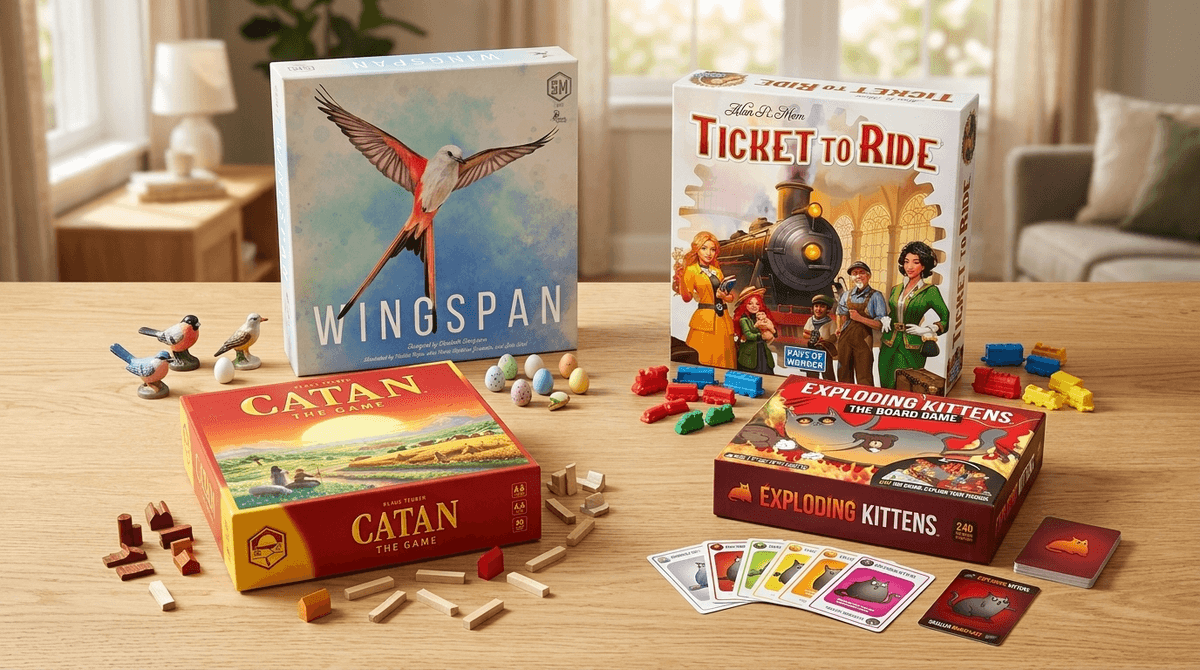
This is the game that changed everything. If your kid spends their time on Roblox trying to figure out how to trade skins or "entrepreneur" their way into more Robux, they will love Catan. It’s all about trading resources (sheep for brick, anyone?) to build settlements. It teaches negotiation and probability without feeling like a math lesson.
- Ages: 10+ (though savvy 8-year-olds can hang).
- Why it works: No one is ever truly "out" of the game until the very end.
Think of this as the sophisticated cousin of Monopoly. You’re building train routes across North America. It’s incredibly satisfying to click those little plastic trains into place. It’s quiet, strategic, and low-stress.
- Ages: 8+.
- Why it works: It’s visually intuitive. Even if you aren't winning, completing your own little train route feels like a win.
Sometimes you don’t want a 60-minute strategy session. Sometimes you just want to slap a card on a table and scream. These are the games for the "Skibidi" generation—fast-paced, slightly absurd, and high engagement.
The name is the instructions. You say the words, you flip the cards, and when they match, you slap the pile. It sounds stupid. It is stupid. But it’s also the most fun you’ll have with a deck of cards. It’s great for sharpening reflexes and visual processing.
- Ages: 6 to 99.
- Why it works: It levels the playing field. A 7-year-old has just as much chance of winning as a 30-year-old.
Created by the folks behind The Oatmeal, this is basically Russian Roulette but with kittens, laser pointers, and goat cheese. It’s cynical, funny, and fits perfectly into the humor profile of a middle-schooler who thinks everything is "Ohio" or "cringe."
- Ages: 7+ (with the standard deck).
- Why it works: The "Defuse" cards give kids a sense of agency over their "doom."
The ultimate travel game. It’s a tin of round cards where every two cards have exactly one matching symbol. It’s a pure test of visual perception.
- Ages: 4+.
- Why it works: It’s over in 5 minutes. Perfect for waiting for food at a restaurant without handing over your iPhone.
Check out our guide on the best travel-friendly games for families
If your kids have a sibling dynamic that resembles a cage match, stop playing competitive games immediately and switch to cooperative ones. In these games, the family plays against the board. You either all win together, or the board beats you.
A bit on the nose after the last few years? Maybe. But Pandemic is the gold standard of co-op gaming. Everyone has a specific role (Medic, Scientist, etc.) and you have to communicate to stop global outbreaks. It’s a masterclass in teamwork.
- Ages: 10+.
- Why it works: It forces kids to listen to each other's ideas.
A slightly simpler, more visual version of the "teamwork" mechanic. You’re on a sinking island trying to recover treasures. The tension is real, but because you’re working together, the "loss" doesn't feel as personal.
- Ages: 8+.
- Why it works: The board literally disappears as tiles "sink," which is very cool to watch.
For the families with older kids or teens who are getting bored of the basics, these games offer deep "crunchy" strategy and beautiful art.
This game is a literal work of art. You’re bird enthusiasts trying to attract the best birds to your wildlife preserves. It sounds boring, but the "engine-building" mechanic is incredibly addictive. It’s the kind of game that makes you feel smarter just by looking at it.
- Ages: 12+.
- Why it works: It’s "cozy gaming" in board game form. No one is attacking you; you’re just building your own beautiful ecosystem.
A word association game that is perfect for parties or big family gatherings. You have to give one-word clues to get your teammates to pick the right cards. It’s a great way to see how your kids’ brains actually work and what kind of weird associations they make.
- Ages: 10+.
- Why it works: It’s all about the "inner circle" vibes.
Learn more about how board games can help with ADHD and focus
When picking a game, don't just look at the box age. Look at your kid.
- Ages 5-7: Focus on "Dexterity" games (slapping cards, moving pieces) and games with no reading required. Sleeping Queens is a hidden gem for this age group that actually teaches basic addition.
- Ages 8-12: This is the sweet spot. They can handle complex rules but still love the "silly" factor. This is the time to introduce Catan or Ticket to Ride.
- Teens: They want strategy and social deduction. They want to feel like they can outsmart you. Games like Codenames or even more complex "Legacy" games (where the board changes permanently every time you play) are the move.
1. The "Losing" Problem
Digital games like Fortnite or Among Us allow kids to disconnect the moment they lose. They can just quit and find a new lobby. In a board game, they have to sit with the loss. They have to watch someone else win. This is a feature, not a bug. It’s where the social-emotional learning happens. If they melt down, don't stop playing—switch to a cooperative game for a bit to rebuild that "we're on the same side" feeling.
2. The "Brain Rot" Antidote
We talk a lot about "brain rot" content on YouTube or TikTok. Board games are the opposite. They require sustained attention, reading of social cues, and delayed gratification. If your kid can sit through a 45-minute game of Ticket to Ride, their focus muscles are getting a serious workout.
3. Don't be a Rule Lawyer
The goal isn't to play the game perfectly; it's to have a good time. If your 6-year-old wants to change the rules of Uno so that "Draw 4" also means you have to do a dance, let them. Engagement is more important than accuracy.
The best board game for your family isn't the one with the highest rating on BoardGameGeek; it's the one that actually makes it off the shelf.
If you’re tired of the "digital tug-of-war," put the phones in a basket, clear the table, and start with something fast like Taco Cat Goat Cheese Pizza. You’ll probably get some eye rolls at first, but once the first person slaps the table, the "real world" connection starts.
- Audit your closet: If it’s all Monopoly and Candy Land, donate them and buy one "Gateway" game (like Catan) and one "Chaos" game (like Exploding Kittens).
- Set a "No-Phone" Zone: Board games don't work if Dad is checking Slack and the teen is checking Instagram.
- Survey your family: Use Screenwise to see what kind of digital themes your kids are into—if they love building, look for "Engine Building" board games. If they love combat, look for "Area Control" games.