

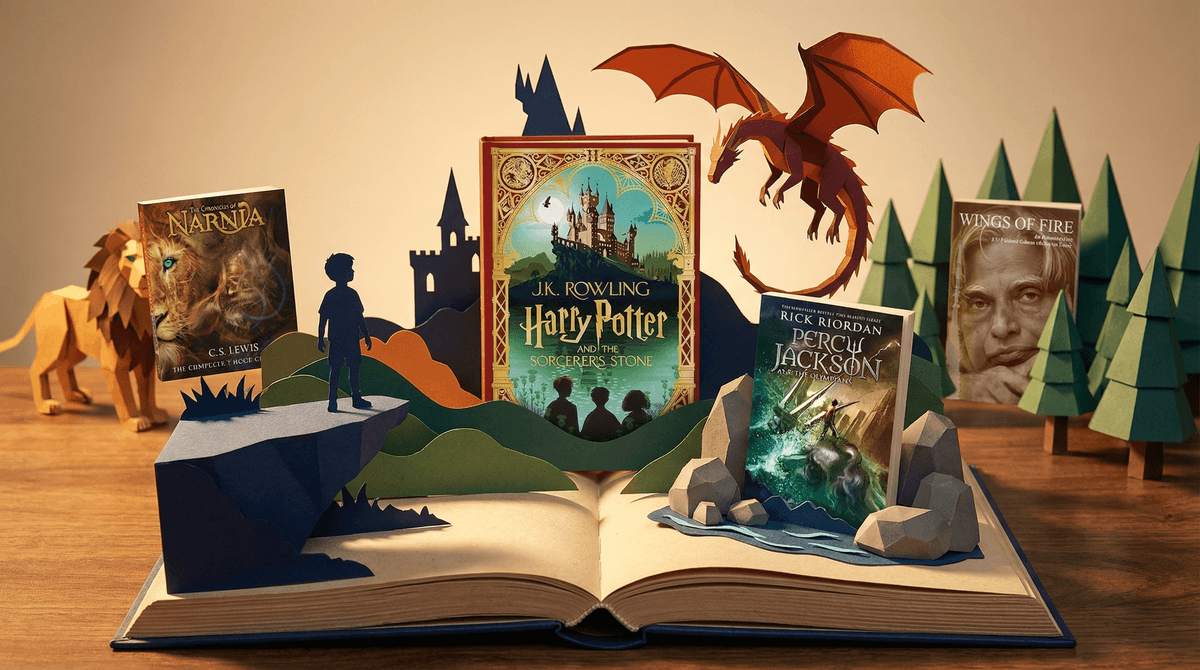
Look, we need to talk about something that might sound a bit backward in a digital wellness guide: books. Old-school, paper-and-ink (or e-reader) books. Specifically, fantasy books—the ones with dragons, magic systems, chosen ones, and worlds that exist nowhere except in a kid's imagination.
Fantasy books are stories set in imaginary worlds with magical elements. We're talking Harry Potter, Percy Jackson, The Chronicles of Narnia, Wings of Fire—stories where the rules of our world don't apply and literally anything can happen.
And here's the thing: in a world where we're constantly trying to manage screen time and digital boundaries, fantasy books might be one of the most powerful tools in your parenting toolkit. Not as a punishment ("no iPad until you read for 30 minutes"), but as a genuine alternative that can be just as engaging as any game or show.
I know what you're thinking. "My kid won't sit still for a book when Roblox exists." And yeah, that's real. But here's what's interesting: fantasy books and video games actually scratch some of the same itches. Both offer:
- Immersive world-building - Just like exploring a Minecraft world, fantasy books let kids discover new places with their own rules
- Character progression - The hero's journey in a fantasy novel mirrors the leveling-up mechanics kids love in games
- Problem-solving - Magic systems have rules, quests have obstacles, just like game objectives
- Social currency - Kids talk about books at school just like they talk about games
The difference? Books require active imagination instead of passive consumption. When a kid reads about Hogwarts, their brain has to construct it. When they watch it on screen, it's handed to them pre-made. Both are fine, but the former is building different cognitive muscles.
Also, and this matters: books don't have microtransactions, loot boxes, or algorithmic feeds trying to maximize engagement time. A book ends. There's no autoplay to the next chapter (well, unless your kid is that into it, which is actually great).
Ages 6-8: Gateway Fantasy
- The Magic Tree House series - Short chapters, time travel, educational elements
- The Princess in Black series - Subverts princess tropes, great illustrations
- Dragon Masters series - Easy readers with dragons, perfect for reluctant readers
These are training wheels fantasy. Simple plots, clear good vs. evil, lots of pictures. They're building the habit of reading and the understanding that books can be fun.
Ages 8-10: Building Stamina
- Percy Jackson series - Greek mythology, humor, ADHD representation
- Wings of Fire series - Dragons as main characters, complex world-building
- Nevermoor series - Magical trials, found family themes
- The Land of Stories series - Fairy tale mashups
This is where kids start reading longer books with more complex plots. Percy Jackson especially is a gateway drug—funny, fast-paced, and the chapters are short enough that kids feel accomplished.
Ages 10-12: Deep Dives
- Harry Potter series - The obvious one, but it works for a reason
- Keeper of the Lost Cities series - Telepathic elves, mystery elements
- Fablehaven series - Magical creature preserves, sibling dynamics
- The School for Good and Evil series - Fairy tale deconstruction
These are commitment books. Multiple volumes, intricate plots, character development. Kids who get hooked on these series will voluntarily put down their devices to read "just one more chapter."
Ages 12+: Young Adult Territory
- Six of Crows - Heist story with magic, morally complex characters
- The Hunger Games - Dystopian with fantasy elements, social commentary
- A Wizard of Earthsea - Classic fantasy, beautiful prose
- Children of Blood and Bone - West African mythology, social justice themes
These deal with heavier themes—war, death, injustice, identity. They're also incredibly engaging and can compete with any Netflix series for a teen's attention.
1. Let them see you read Kids model behavior. If you're on your phone while telling them to read, that's not going to work. You don't have to read fantasy (though it wouldn't hurt), but they need to see reading as something adults do for pleasure, not just homework.
2. Start with their interests
- Kid obsessed with Minecraft? Try The Land of Stories or other portal fantasies
- Love Pokémon? Wings of Fire has creature-collection vibes
- Into Greek mythology from Hades? Percy Jackson is the obvious move
3. Audiobooks count Seriously. If your kid will listen to Percy Jackson audiobooks during car rides or before bed, that's still building literacy and imagination. The audiobook narrator for Percy Jackson (Jesse Bernstein) is legitimately great and makes the books even better.
4. Don't make it a punishment "No screens until you read" makes reading the vegetable you have to eat before dessert. Instead: "We have 30 minutes before dinner, you can read, draw, or play outside—your choice." Reading should be one option among non-screen activities, not the penalty box.
5. Let them read "below their level" If your 10-year-old wants to reread Dog Man for the fifteenth time instead of tackling The Hobbit, let them. Reading for pleasure is the goal. A kid who loves reading "easy" books will eventually seek out harder ones when they're ready.
6. Create a reading routine Twenty minutes before bed. No screens, just books. This works for multiple reasons: it's a wind-down activity that's actually good for sleep (unlike screens), it's consistent, and over time it becomes automatic. Plus, kids will often read longer than the required time if they're into the book.
Kids who read for pleasure have better vocabulary, writing skills, and general knowledge than kids who don't—even controlling for other factors. Reading fiction specifically builds empathy and social cognition because kids practice understanding characters' motivations and emotions.
And fantasy specifically? It encourages creative thinking and problem-solving. When kids engage with magical systems and fantastical scenarios, they're exercising their ability to think beyond the literal and immediate. That's a skill that transfers to everything from math to social situations.
Fantasy books aren't a replacement for screen time management—they're a complement. They offer many of the same rewards kids get from games and shows (immersion, excitement, social connection) without the algorithmic manipulation and endless scroll.
The goal isn't to turn your kids into bookworms who never touch a screen. It's to give them options. A kid who can be equally engaged by Keeper of the Lost Cities and Zelda has more tools for managing their own attention and entertainment.
Start small. One book. One series. See what clicks. The kid who discovers that books can be just as engaging as screens? That's a kid who has genuine alternatives when you say "no more iPad today."
- Visit your library and let your kid pick three fantasy books based on covers alone (yes, really—cover appeal matters)
- Try this guide to finding the right fantasy series for your kid
- Consider starting a family read-aloud with a fantasy book—even older kids often enjoy this
- Learn more about audiobooks as a reading tool if you have a reluctant reader