

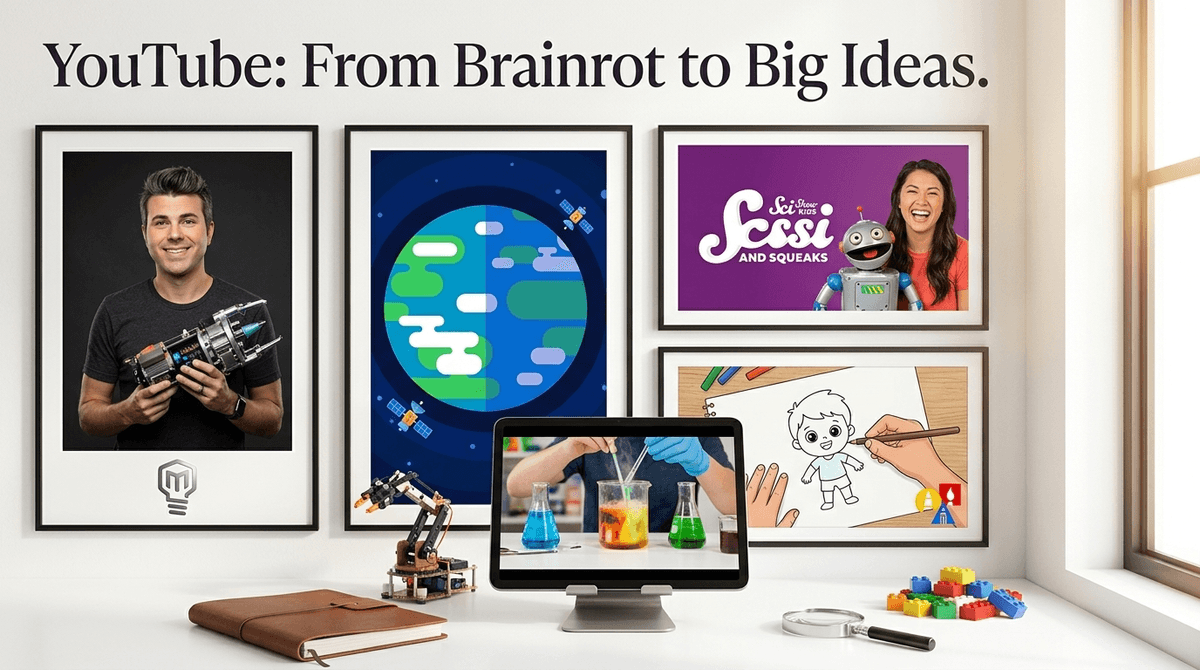
TL;DR: The "Gold Standard" Channels
If you only have thirty seconds before your kid asks for your phone, here are the heavy hitters that actually respect your child’s intelligence. These aren't just "not bad"—they are genuinely excellent.
- For the Mini-Engineers: Mark Rober
- For the "Why?" Phase: SciShow Kids
- For Existential (but cute) Science: Kurzgesagt – In a Nutshell
- For the Artists: Art for Kids Hub
- For History Buffs (Middle School+): Oversimplified
Check out our full ranking of the best educational YouTube channels for every age
We’ve all been there. You need fifteen minutes to cook dinner or take a work call, so you hand over the iPad. You start with something innocent—maybe a clip from Bluey—but thirty minutes later, you look over and your kid is deep in a "Skibidi Toilet" rabbit hole or watching a faceless "content farm" video where colorful Elsa and Spider-Man are doing things that feel... off.
This is the "AI Slop" era of YouTube. It’s low-effort, high-stimulation garbage designed by algorithms to keep kids clicking. It’s what kids today call "Brainrot." It’s "Ohio" (weird/cringe) in the worst way possible.
But YouTube isn't all bad. In fact, it’s arguably the greatest library of human knowledge ever assembled—if you know where to look. The goal isn't to ban the screen; it's to curate it so the "passive scroll" becomes an "active spark."
Kids are drawn to high-energy, fast-paced editing and loud noises. That’s why MrBeast is the king of the platform. While MrBeast isn't necessarily "educational" (it’s more like a modern-day game show), he’s the gateway drug.
The trick is to find creators who use those same high-production values but apply them to physics, history, or biology. We want to move them away from "unboxing" videos and toward "how it's made" or "why it works."
These are the channels that make kids want to go outside and build something (or at least understand how the world works).
Mark Rober is essentially the Mr. Rogers of the 21st century, if Mr. Rogers was a former NASA engineer who built glitter bombs to prank porch pirates. He makes engineering look like the coolest job on the planet. His videos are long-form, high-budget, and deeply educational without ever feeling like a lecture. Ages: 6 to 106.
Destin Sandlin explores the world with a sense of wonder that is infectious. Whether he’s filming a supersonic baseball cannon or explaining how birds fly, he’s teaching the scientific method in real-time. It’s wholesome, fascinating, and totally "Sigma" (that’s a good thing, mostly). Ages: 8+
This is for the older kids (and honestly, for you). Derek Muller tackles big questions about physics, psychology, and space. It’s "Big Idea" YouTube. If your teen is spending too much time on TikTok, try sending them a Veritasium link about why "the speed of light isn't what you think it is." Ages: 12+
Learn more about the "Science YouTuber" community and who to trust
If you’re trying to avoid the "zombie stare" that comes from Blippi (look, we’ve all used it, no judgment, but let's be real—it’s loud), these are the high-quality alternatives.
Hosted by Jessi and her robot rat friend Squeaks, this channel answers the "Why?" questions that drive parents crazy. Why is the sky blue? Why do we have snot? It’s fast-paced enough to keep their attention but grounded in actual science. Ages: 4-8
Screen time doesn't have to be sedentary. Jaime Amor leads kids through yoga adventures based on popular stories like Minecraft or Frozen. It’s great for physical wellness and mindfulness. Ages: 3-8
This is a family-run channel where a dad draws with one of his kids. It’s perfect because the kid’s drawing never looks perfect—which encourages your own child to keep going even if they "mess up." It turns the iPad into a tool rather than just a TV. Ages: 5+
YouTube isn't just for STEM. Some of the best storytelling on the internet is happening in the history and philosophy space.
You’ll recognize the distinct, beautiful animation style immediately. They explain complex topics like black holes, climate change, and the immune system. Warning: they occasionally dip into "existential dread" territory, but always with a hopeful, scientific lens. Ages: 10+ (Great for co-watching).
If your kid thinks history is boring, show them this. It uses stick-figure animation and a lot of humor to explain things like the French Revolution or the Cold War. It’s irreverent, slightly edgy (some mild language/cartoon violence), and incredibly effective at making the facts stick. Ages: 11+
These are short, beautifully animated lessons on literally everything. From Greek mythology to how a kidney works, it’s the gold standard for "bite-sized" learning. Ages: 8+
Get a history playlist for your child's current school topic
The biggest problem with YouTube isn't the channel you choose—it’s where the "Up Next" sidebar takes them.
- YouTube Kids vs. Main YouTube: For kids under 9, YouTube Kids is a safer walled garden, but it still has plenty of "brainrot" content. You have to use the "Approved Content Only" setting to truly control it.
- The "Restricted Mode" Myth: On the main YouTube site, "Restricted Mode" filters out the most egregious adult content, but it won't stop your 10-year-old from seeing "Sigma" edits or questionable influencers.
- The "Watch History" Audit: A great Screenwise habit is to occasionally scroll through your child's watch history together. Don't do it as a "gotcha," but as a "What was cool about this?" conversation.
The goal of intentional parenting in the digital age isn't to reach zero screen time—it's to move the needle from Passive Consumption to Active Creation.
If they’re watching Mark Rober, can you buy a CrunchLabs kit or just give them a box of recyclables and some duct tape? If they’re watching Minecraft tutorials, are they learning how to use Redstone (logic gates/basic coding) or just watching someone else scream at a creeper?
YouTube is the "Wild West," but it’s also a university with free tuition. By pointing your kids toward high-quality creators like Mark Rober or Art for Kids Hub, you’re teaching them that the internet is a tool for curiosity, not just a place to numb out.
The next time your kid says something is "totally Ohio," maybe you can counter with a video about why the James Webb Space Telescope is actually the most "Sigma" thing in the universe.
- Audit the Subscriptions: Sit down with your kid and look at who they are subscribed to. Unsubscribe from the "slop" and add three of the channels above.
- Set Up a Shared Account: For older kids, having a shared "Family Room" YouTube account on the TV allows for "ambient monitoring" without being overbearing.
- Take the Screenwise Survey: Understand how your family's YouTube habits compare to other intentional parents in your community.