

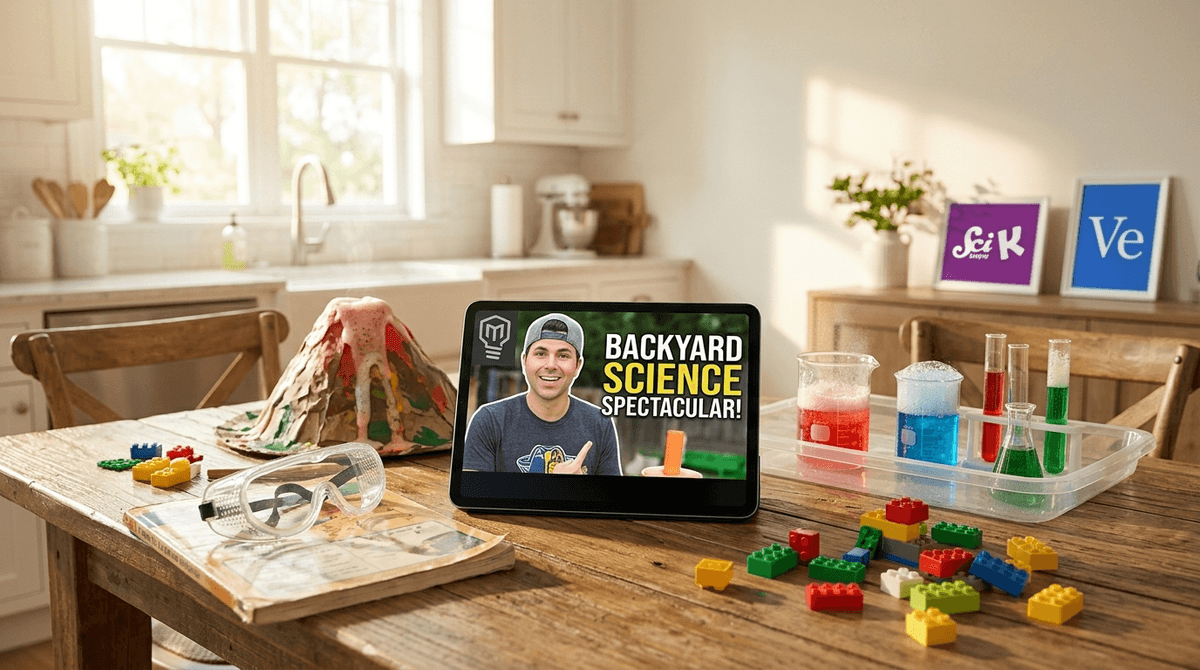
TL;DR: Watching science on YouTube isn't the same as doing science, but it’s a great hook. To move from passive "edutainment" to actual learning, you need to bridge the gap with hands-on mess.
Top Recommendations:
- The Gold Standard: Mark Rober
- Best for Little Kids: SciShow Kids
- Best for "I can actually do this at home": The Dad Lab
- Best High-Level Concepts: Veritasium
- Best Non-YouTube Alternative: Emily's Wonder Lab
We’ve all been there. You walk into the living room, see your kid glued to the iPad, and prepare to give the "screen time is over" speech. But then you see it: they’re watching a guy in a NASA shirt explain centrifugal force or build a giant squirrel obstacle course. You think, “Actually, this is fine. They’re learning. This is basically school.”
I call this the Mark Rober Effect. It’s that warm, fuzzy feeling parents get when "educational YouTube" justifies an extra hour of digital consumption. And don’t get me wrong—Mark Rober is a genius, and his content is lightyears better than the "brain rot" of Skibidi Toilet or those weirdly aggressive "Ohio" memes.
But there’s a catch.
Watching a professional engineer spend $50,000 and six months building a glitter bomb is entertainment. It’s "science-adjacent." It sparks curiosity, which is huge, but it doesn't actually build the neural pathways that come from failing at a real-life experiment, getting vinegar on the kitchen table, and wondering why the baking soda volcano didn't erupt the way it did on the screen.
According to Screenwise community data, roughly 65% of parents with kids aged 6-12 feel "good" about their children watching science-based YouTube channels. We categorize this as "High-Quality Passive Consumption."
The problem is the "passive" part. When kids watch Veritasium or SmarterEveryDay, they are receiving a polished, edited version of reality. They see the "Aha!" moment without the three weeks of boring data collection or the five failed prototypes.
In the real world, science is messy, frustrating, and often "mid" (as the kids would say) before it gets cool. If we only show them the high-production highlights, we’re accidentally teaching them that if an experiment doesn't work perfectly the first time, they're doing it wrong.
Learn more about the difference between active and passive screen time
Kids love these channels for the same reason we love HGTV. It’s satisfying to see a project go from start to finish in 15 minutes. Channels like Mark Rober use fast cuts, humor, and high stakes to keep dopamine levels high.
This matters because it lowers the barrier to entry. A kid who thinks science is just "boring textbooks" might realize it’s actually about solving puzzles and building cool stuff. The goal isn't to ban the videos; it's to use them as a launchpad.
If you're going to let them watch, let's make sure it's the good stuff. Here’s how to navigate the "educational" landscape without falling into the trap of clickbait "life hack" channels that feature fake science.
SciShow Kids (Ages 4-8)
This is the gold standard for the younger crowd. It’s hosted by people who actually understand pedagogy. They tackle "why" questions (like "Why is the sky blue?") in a way that doesn't talk down to kids. It’s colorful, fast-paced, and short enough that it doesn't melt their brains.
The Dad Lab (Ages 5-10)
If you want experiments you can actually do at home without a degree in mechanical engineering, this is it. Sergei (the dad) uses household items—forks, paper, water, balloons. This is the ultimate "bridge" channel because the experiments look doable, which encourages kids to say, "Can we try that?"
Emily's Wonder Lab (Netflix) (Ages 5-12)
Okay, it’s not YouTube, but it’s essential. Emily Calandrelli is a literal MIT-trained engineer who makes science feel like a party. Each episode is a specific experiment. If your kid is into this, check out how Emily's Wonder Lab encourages girls in STEM.
Veritasium (Ages 12+)
This is for the older kids who are starting to ask the big, existential questions. Derek Muller tackles counter-intuitive physics and math. It’s high-level, but he explains things so clearly that even a liberal arts major (me) can follow along. It’s great for building critical thinking.
NileRed (Ages 13+)
NileRed is fascinating but proceed with caution. He does hardcore chemistry—turning plastic gloves into grape soda (don't drink it) or dissolving gold. It’s mesmerizing, but it’s definitely "don't try this at home" territory. It’s great for teens who think chemistry class is a drag.
Check out our full list of recommended YouTube Science Channels
How do we turn a Mark Rober binge into a real-life discovery? It takes a little bit of parental effort, but it pays off in actual brain development.
- The "Pause and Predict" Method: When you’re watching a science video together, hit pause right before the big reveal. Ask: "What do you think is going to happen?" or "Why did that fail?" This moves them from "zombie mode" into "analyst mode."
- The "One-to-One" Rule: For every hour of science YouTube, they have to spend 20 minutes doing something tactile. It doesn't have to be a 12-step experiment. It can be as simple as playing with LEGO or mixing cornstarch and water (Oobleck).
- Invest in the "Mess Kit": Keep a bin with safety goggles, vinegar, baking soda, food coloring, magnets, and magnifying glasses. When a video sparks an idea, the friction of "we don't have the stuff" is gone.
- Embrace the Fail: When their real-life experiment inevitably fails (unlike the ones on YouTube), celebrate it. Ask, "What’s our next hypothesis?" That is where the actual science happens.
Let’s talk about the "No-BS" side of YouTube science.
- Ages 5-8: They should not be on "Main" YouTube. Use YouTube Kids or, better yet, cast specific videos from your phone to the TV. The algorithm is a beast, and it only takes three clicks to go from "How do bees make honey?" to some weird, AI-generated Elsa-and-Spider-Man nightmare.
- Ages 9-12: This is the age of the "Life Hack" scam. Channels like 5-Minute Crafts often feature "science" that is literally impossible or dangerous (like DIY electrical repairs). Teach them how to spot "fake science" by looking for cuts in the video.
- Ages 13+: At this point, they’re watching what they want. The concern here is "The Algorithm Hole." If they watch one video on rocket engines, YouTube might start serving them "Manosphere" content or political rabbit holes. Keep the conversation open.
Not all screen time is created equal, but let's be real: "Educational YouTube" is still a screen.
If your kid is using YouTube to avoid social interaction or because they’ve lost the ability to be bored, it doesn't matter if they’re watching NASA or MrBeast.
The "WISE" score for many of these channels is high because the content is great, but the delivery system (YouTube's infinite scroll) is designed to keep them addicted. Be the "intentional parent" and set a hard stop. "We're going to watch two Mark Rober videos, and then we're going to the garage to see if we can make a better paper airplane."
YouTube science is a fantastic appetizer, but it’s a terrible main course.
Use Mark Rober and SciShow Kids to get them excited about the world. But if you want them to actually learn science, you have to be okay with a little bit of mess in the kitchen and a lot of "it didn't work" moments.
Science isn't about the 4K slow-motion shot of the explosion. It’s about the kid who wonders why it exploded and isn't afraid to get their hands dirty finding out.
- Tonight: Watch one video from The Dad Lab with your kid.
- This Weekend: Pick one experiment from the video and try it. Expect it to fail. Laugh about it.
- Check the Data: Take the Screenwise Family Tech Survey to see how your kid’s YouTube habits compare to other families in your community.
Get a 5-minute science experiment using only stuff in my pantry