

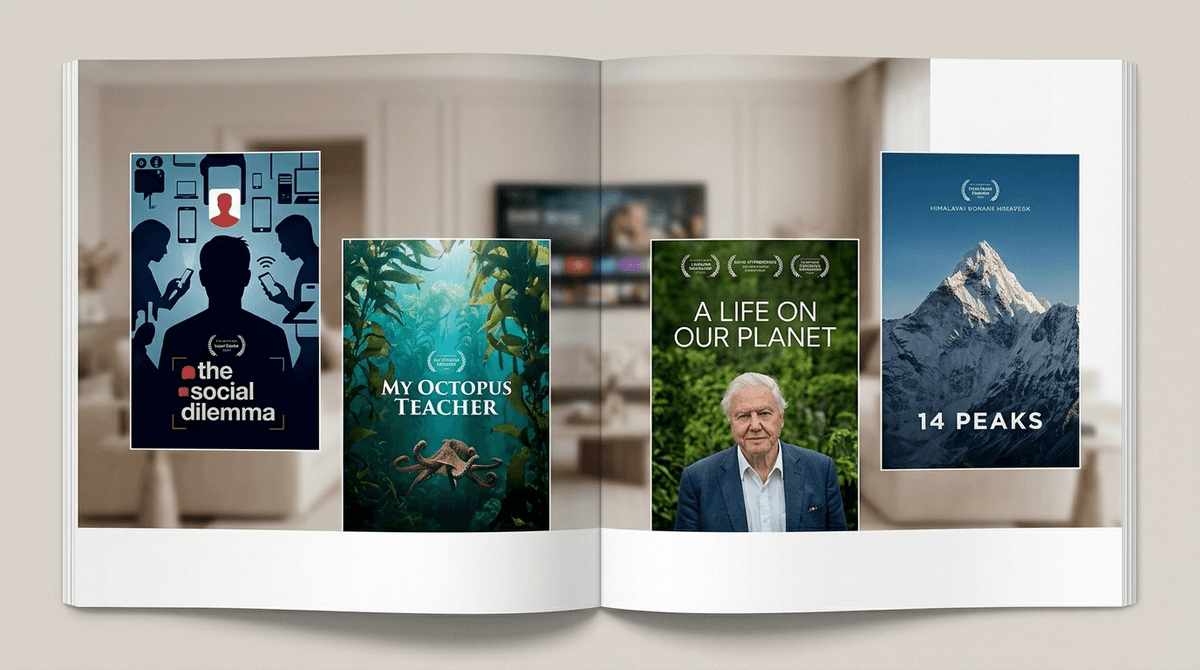
TL;DR: The Quick List If you’ve only got 30 seconds before someone starts yelling about a lost charger, here are the heavy hitters for your next family movie night:
- For the Digital Deep Dive: The Social Dilemma (Ages 12+) or Screenagers (Ages 10+).
- For the Nature Lovers: My Octopus Teacher (Ages 8+) or A Life on Our Planet (Ages 8+).
- For Grit and Resilience: 14 Peaks: Nothing Is Impossible (Ages 11+) or The Elephant Whisperers (Ages 6+).
- For Innovation and History: The Toys That Made Us (Ages 8+) or Apollo 11 (Ages 7+).
We’ve all been there. It’s Friday night, you’re exhausted, and the "Netflix Scroll" has been happening for twenty minutes. Your kids want to watch a YouTuber scream at a camera for 45 minutes, and you’re about two seconds away from banning electricity entirely.
The problem with most "family-friendly" content isn't that it's bad—it’s that it’s passive. It’s "brain rot" (to use the current middle-school vernacular) because it requires zero engagement. But documentaries are the ultimate parenting hack. They aren't just educational; they’re a bridge. They give us a way to talk about the big, scary, or complicated stuff—like climate change, AI, or why they can’t put their phone down—without it feeling like a lecture.
Here is a curated list of documentaries that actually hold a kid’s attention and, more importantly, get them talking long after the credits roll.
If your kid is currently obsessed with Roblox or spends their life trying to understand the latest TikTok trend, these are essential viewing. They pull back the curtain on the "why" behind the screen.
Ages 12+ This is the big one. It uses a mix of interviews with former tech execs and a dramatized story of a family falling apart due to social media. It explains "persuasive design"—the stuff that makes Instagram and Snapchat so addictive.
- The Discussion: Ask your kids, "Do you ever feel like the app is 'winning' when you can't stop scrolling?" It’s a great way to move from "I’m taking your phone because I’m mean" to "We’re fighting against an algorithm designed to keep you hooked."
Ages 10+ While The Social Dilemma focuses on the tech giants, Screenagers focuses on the dinner table. It looks at the friction tech causes in families and the science of the developing brain. It’s a bit more "educational" in tone, but highly relatable for kids who feel like their parents are constantly "nagging" them about tech.
- The Discussion: Check out our guide on setting tech boundaries to follow up after watching.
Our kids live in a world of instant gratification. Amazon delivers in two hours; YouTube gives them a dopamine hit in two seconds. These films show what happens when people (and animals) have to work incredibly hard for something.
Ages 11+ Nimsdai Purja attempts to climb all 14 of the world’s 8,000-meter peaks in seven months. The previous record was seven years. It is high-octane, visually stunning, and shows a level of mental toughness that is almost hard to comprehend.
- The Discussion: Talk about the "death zone." Not just the literal one on Everest, but the moments in life where you want to quit. What keeps Nims going?
Ages 8+ This one is a slow burn, but it’s a masterpiece. A filmmaker suffering from burnout starts diving in a kelp forest and befriends an octopus. It sounds weird, but it’s a profound look at vulnerability and our connection to the natural world.
- The Discussion: This is a perfect opening to talk about empathy. If we can feel this much for a mollusk, how should we be treating the people and environments around us?
Kids today are more aware of the climate than we ever were at their age. Sometimes that turns into "eco-anxiety." These documentaries help channel that concern into understanding.
Ages 8+ David Attenborough is the gold standard. In this "witness statement," he looks back at how the world has changed during his lifetime. It’s sobering, but it ends with a roadmap for how we can "rewild" the world.
- The Discussion: Instead of focusing on the scary parts, ask: "What’s one small thing our family can do to be better 'team members' for the planet?"
Ages 8+ A couple moves from the city to start a biodiverse farm. It’s beautiful, it’s messy (yes, animals die), and it shows the complex "circle of life" in a way that The Lion King never could. It’s a masterclass in problem-solving.
- The Discussion: Every time a new "pest" arrives on the farm, they have to find a biological solution. It’s a great way to talk about how everything in an ecosystem—and a community—is connected.
Sometimes you just want to spark a "hey, that's cool" moment. These are great for kids who love Minecraft or are starting to ask how things are made.
Ages 8+ Whether it’s LEGO, Barbie, or Star Wars, this series looks at the history of the world's biggest toy franchises. It’s fast-paced, funny, and surprisingly deep regarding business ethics and creative design.
- The Discussion: Learn more about how toys and games are designed to be "sticky"

Ages 7+ Constructed entirely from archival footage, this feels like you are actually there in 1969. There’s no narrator, just the raw tension of the mission. It’s a great antidote to the hyper-edited, CGI-heavy stuff they usually watch.
- The Discussion: Talk about the fact that the computers used to get to the moon had less power than the Nintendo Switch they’re holding.
When picking a documentary, keep these three things in mind:
- The "Sadness" Factor: Nature documentaries often involve "predator vs. prey." If you have a highly sensitive kid, maybe skip Our Planet and stick to something like A Beautiful Planet.
- Pacing: Kids raised on YouTube Shorts might find a 90-minute documentary "boring" at first. Don't be afraid to watch in chapters. Treat it like a limited series.
- The "Why": Tell them why you want to watch it. "I heard this show explains why TikTok is so addictive and I want to see if you think they’re right" is a much better hook than "We are watching this because it’s educational."
The fastest way to kill a family discussion is to make it feel like a school quiz. Instead of asking "What did you learn?", try these:
- "What was the most surprising part of that?"
- "Do you think the filmmakers were being fair, or were they trying to make us feel a certain way?"
- "If you were in that person's shoes, would you have quit?"
- "That part about The Social Dilemma and notifications... do you think that's actually true for your friends?"
Documentaries are a "high-yield" screen time choice. They provide the visual stimulation kids crave while delivering the intellectual substance parents want. You aren't just "watching TV"; you're building a shared vocabulary for the world’s most complex topics.
Next time the kids are asking for "just one more video," try swapping the 10-minute vlog for a chapter of a documentary. You might be surprised at who ends up asking the most questions.
- [Check out our full list of recommended movies for intentional parents](https://screenwiseapp.com/guides/best-movies-for-family-discussion)
- Learn how to manage screen time without the power struggles
- Get a documentary recommendation based on your kid's interests