

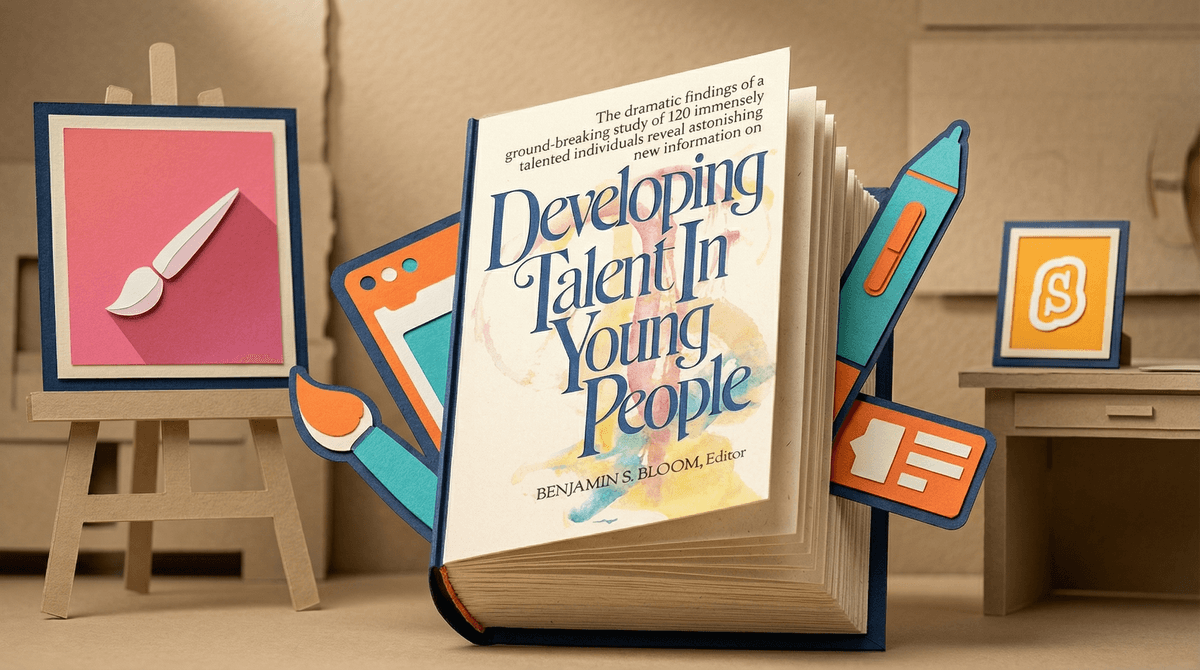
Developing Talent in Young People by Benjamin Bloom is one of those research books that doesn't get nearly enough attention in parenting circles. Published in 1985, Bloom and his team studied 120 world-class performers—Olympic swimmers, concert pianists, sculptors, mathematicians, research neurologists—and interviewed them plus their parents and teachers to figure out how they got there.
The surprising finding? Natural talent mattered way less than you'd think. What mattered was a very specific developmental process that looked remarkably similar across all these different fields. And here's the thing that makes this relevant to digital parenting in 2024: the principles apply whether you're raising a future tennis champion or just trying to help your kid develop genuine skills instead of doom-scrolling through TikTok for four hours.
We're living in an era where kids have unprecedented access to learning anything. Want to learn to code? Scratch and Roblox Studio are free. Digital art? Procreate and YouTube tutorials everywhere. Music production? GarageBand comes pre-installed.
But here's the tension: our community data shows that only 30% of families are using digital tools to help kids organize plans and develop independence. That means 70% of us are still figuring out how to channel screen time into actual skill development rather than just consumption.
Bloom's research gives us a roadmap. Not for creating prodigies (please, no), but for understanding how deep skill development actually works—and how to support it without becoming that parent.
Bloom identified three distinct phases, and understanding them changes everything about how we approach activities, screen time, and even those expensive lessons we're all hemorrhaging money on.
Phase 1: The Playful Years (Roughly Ages 5-11)
What it looks like: The focus is on fun, exploration, and falling in love with the activity. The best early teachers weren't the most accomplished—they were warm, encouraging, and made it enjoyable. Practice was playful. Parents were enthusiastic and supportive but not pushy.
The digital translation: This is when a kid discovers Minecraft and starts building elaborate worlds, or gets obsessed with making stop-motion animations, or wants to learn every Among Us strategy. The key is letting them play with the medium without immediately structuring it or turning it into "educational content."
What parents did: They provided access, showed interest, praised effort and enjoyment, and participated alongside their kids. They didn't worry about whether their 8-year-old was "serious enough" about piano.
Actionable lesson: If your kid is genuinely engaged with something digital—even if it's Gacha Life character design or Fortnite creative mode—that's not "brain rot." That's potential Phase 1 talent development. Your job is to notice what they're drawn to and provide time and space for it. Find out how to talk to kids about what they're creating rather than immediately setting screen time limits that kill the flow state.
Phase 2: The Precision Years (Roughly Ages 12-16)
What it looks like: The shift to more technical instruction, deliberate practice, and skill refinement. Teachers became more demanding. Practice became more structured and less immediately fun. Kids started competing or performing. This phase required significantly more parental support—driving to lessons, paying for better instruction, helping manage practice schedules.
The digital translation: This is when a kid moves from playing Roblox to actually learning Lua programming to make their own games. Or from watching YouTube art tutorials to taking a structured Skillshare course. Or from casual Discord chats to joining a competitive esports team.
What parents did: They helped establish practice routines, found better teachers/coaches, managed logistics, and provided emotional support through the "it's getting hard and not always fun anymore" phase. Critically, they didn't do the work for the kid, but they removed obstacles.
Actionable lesson: Only about 35% of families in our community use digital tools to help kids manage homework and responsibilities. If your kid is showing Phase 2 interest in something—they want to get actually good, not just mess around—this is where you help them set up systems. That might mean project management tools for their YouTube channel, or a Google Calendar for practice time, or budgeting their Robux earnings like a real business. You're teaching them how to organize their own development.
Phase 3: The Master Years (Late Teens+)
What it looks like: Working with master teachers, often requiring relocation or significant life restructuring. The young person takes ownership of their development. Practice is self-directed and highly sophisticated.
The digital translation: This is the 17-year-old who's built a Twitch following, or the teen who's contributing to open-source projects, or the young artist with a Patreon. Most of our kids won't reach this phase in any particular domain, and that's completely fine.
What parents did: They stepped back. Their role became primarily emotional support and occasionally logistical/financial help. The young person was driving their own development.
Actionable lesson: If your teen has reached this level with something digital, your job is mostly to not get in the way while ensuring basic health and balance. Have conversations about sustainable practices rather than imposing arbitrary limits.
Here's what's fascinating: across all these world-class performers, parents weren't exceptional themselves. They weren't professional athletes or concert pianists. But they did specific things:
1. They modeled valuing achievement and learning. Not obsessively, but they read books, worked on projects, and showed that developing skills mattered.
2. They provided resources without being pushy. When a kid showed interest, they found a teacher, bought the instrument, paid for the lessons. But they didn't force it.
3. They structured the home environment to support practice. This meant managing schedules, creating routines, and sometimes making sacrifices so the kid could pursue their interest.
4. They were enthusiastically supportive without being technically involved. Most parents couldn't play piano or swim at an elite level, but they showed up to recitals and meets and praised effort.
Digital age translation? This means noticing when your kid is genuinely interested in something digital, providing the tools and time, helping them structure their practice, and showing genuine interest in what they're creating—even if you don't understand Geometry Dash level design or Genshin Impact team composition.
Here's the uncomfortable truth: developing genuine talent in anything requires a lot of time. Bloom's subjects practiced for hours daily. If your kid is in Phase 1 or 2 of developing a digital skill—whether that's video editing, game design, digital art, or even strategic gaming—they might need significant screen time to develop it.
The question isn't "how do I limit screen time?" but "is this screen time building something or just consuming?" A kid spending three hours building a complex Minecraft redstone computer is in a completely different developmental space than a kid spending three hours watching YouTube Shorts.
Learn more about the difference between creative and consumptive screen time.
Bloom's research tells us that talent development is less about innate gifts and more about a supportive developmental process that looks remarkably similar across domains. For digital-age parents, this means:
- Phase 1 (ages 5-11): Let them play and explore. Notice what captures their genuine interest. Provide access and enthusiasm.
- Phase 2 (ages 12-16): Help them structure their practice. Find better instruction. Support them through the "getting good is hard" phase.
- Phase 3 (late teens+): Step back and let them drive while providing safety nets.
The real insight? You don't need to be an expert in Blender or Python or competitive Valorant to support your kid's development in those areas. You just need to provide resources, structure, and genuine interest in what they're building.
If your kid is in Phase 1: Stop worrying so much about whether their screen time is "productive enough." If they're genuinely engaged and creating (not just consuming), that's the foundation. Your job is to notice and nurture that interest.
If your kid is in Phase 2: Help them build systems. This is where our community data shows only 30-35% of families are actively using digital tools for organization and independence. Set up project management systems, create practice schedules, find online courses or mentors, and help them treat their interest like the serious pursuit it's becoming.
If your kid is in Phase 3: Have real conversations about sustainability, burnout, and long-term goals. And maybe start actually listening when they tell you about their Discord community or streaming schedule—they're building something real.
Not every kid needs to become world-class at anything. But understanding how talent development actually works helps us distinguish between screen time that's building skills and screen time that's just passing time. And in 2024, that distinction matters more than ever.