

TL;DR: Cozy Games That Build Empathy
Looking for games that actually teach emotional intelligence instead of just keeping kids quiet? These low-stakes, story-driven titles let kids practice perspective-taking, active listening, and kindness through gameplay:
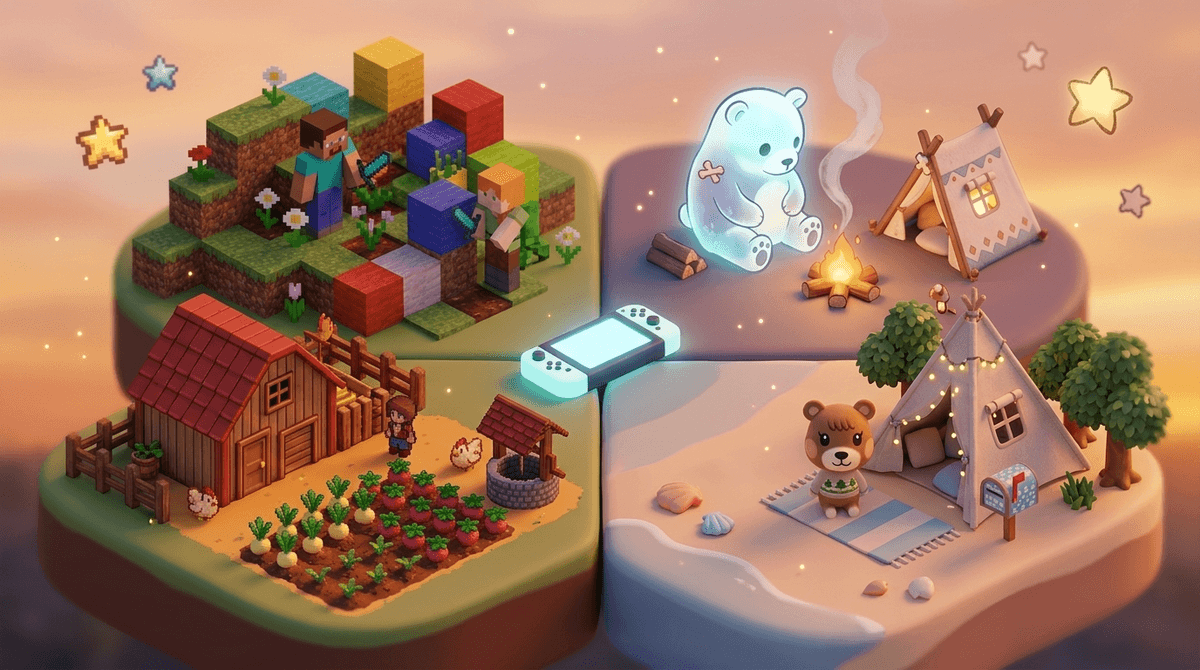
- Cozy Grove (Ages 7+) – Help bear spirits process their feelings on a haunted island
- Minecraft (Ages 8+) – Collaborative building that teaches resource-sharing and teamwork
- Stardew Valley (Ages 10+) – Build relationships with townspeople through conversation and gifts
- Animal Crossing: New Horizons (Ages 6+) – Create a community where kindness matters
About 55% of families in our community have kids who game regularly, and 25% of those are playing on multiplayer servers where social skills really matter. If your kid is going to spend time gaming anyway, these titles turn that screen time into genuine emotional practice.
Cozy games are the anti-Fortnite. No battle royales, no kill counts, no toxic voice chat screaming at your 9-year-old that they're trash. Instead, these games focus on everyday tasks, gentle storytelling, and building relationships with characters who actually have feelings.
Think farming, decorating, fishing, helping neighbors, and solving problems through conversation rather than combat. The art style tends toward warm colors and soft edges. The music is calming. The stakes are "will this NPC like my gift?" not "will I get eliminated in the first 30 seconds and feel like a failure?"
For kids who get overwhelmed by fast-paced competitive games—or for parents who want something that doesn't spike cortisol levels before bedtime—cozy games are a revelation.
Here's what makes cozy games different from a social-emotional learning perspective: they're designed around listening, responding, and caring about how your actions affect others.
In Cozy Grove, you can't just blast through quests. You have to talk to bear spirits, hear their stories about loss and regret, and complete small acts of service that help them process emotions. The game's developers deliberately wrote NPC dialogue to feel like real conversations with acquaintances opening up—it's literally a practice ground for perspective-taking.
Research backs this up. Games that give children choices affecting how characters feel or respond help develop the "4 Cs" of soft skills: communication, collaboration, critical thinking, and creativity—with empathy woven throughout. When kids play Minecraft cooperatively, they're constantly negotiating: Who gets the diamonds? Should we build defenses or explore? How do we keep everyone safe? Those aren't just gaming decisions—they're empathy exercises.
The key difference from passive media: kids make choices and see consequences. When an NPC in Stardew Valley responds warmly because you remembered their birthday, or coldly because you gave them a gift they hate, kids learn that paying attention to others' preferences matters.
Cozy Grove (Ages 7+)
You're a Spirit Scout camping on a haunted island populated by bear spirits stuck in limbo. Each day, you help one or two bears by completing errands, gathering items, and—most importantly—listening to their stories.
Why it works for empathy: The bears aren't just quest-givers. They're fully realized characters dealing with grief, regret, unfinished business, and complicated relationships. One bear might be processing a falling-out with a friend; another might be struggling with perfectionism. Your job is to show up, listen without judgment, and offer small acts of kindness.
The game moves slowly by design—you can only progress so much each real-world day. This pacing teaches patience and that emotional work takes time. It's also perfect for parent-child co-play; you can pause and talk about why a character is feeling sad or what you might say to help.
Sequel note: Cozy Grove: Camp Spirit follows the same format with new characters and stories.
Minecraft (Ages 8+)
Yes, Minecraft. While it's not marketed as a "cozy" game, its sandbox nature makes it one of the most versatile empathy-building tools out there—if kids are playing cooperatively rather than solo or on competitive servers.
Why it works for empathy: When kids build together, they're constantly practicing social negotiation. They have to share resources, coordinate plans, compromise on designs, and help each other when someone falls in lava or gets lost. The open-ended nature means there's no "right" way to play, which reduces performance anxiety and lets kids focus on collaboration.
Our community data shows 35% of families have kids playing Minecraft offline (solo or local multiplayer), while 25% are on multiplayer servers. If your kid is on servers, the empathy-building potential skyrockets—but so does exposure to other players' behavior, so parental controls matter.
Parent tip: Join them. Seriously. Playing Minecraft with your kid gives you a window into their problem-solving, frustration tolerance, and how they treat teammates. Plus it's genuinely fun.
Stardew Valley (Ages 10+)
You inherit a run-down farm and move to a small town where you slowly build relationships with 30+ townspeople, each with their own personalities, schedules, likes, dislikes, and storylines.
Why it works for empathy: Every NPC has a friendship meter that goes up when you talk to them, give them gifts they like, or complete quests for them. But here's the empathy piece: you have to pay attention. If you give someone a gift they hate, the relationship meter goes down. If you ignore someone for weeks, they comment on it. The game rewards noticing details—remembering that Haley likes sunflowers but hates clay, or that Shane is struggling with depression and needs support, not judgment.
The game also tackles some surprisingly mature themes (alcoholism, corporate greed, mental health) in age-appropriate ways that can spark real conversations.
Content note: Some mild romantic storylines and one character's depression arc. Most 10-year-olds can handle it, but preview if your kid is sensitive.
Animal Crossing: New Horizons (Ages 6+)
You move to a deserted island and gradually build a community with anthropomorphic animal neighbors. You decorate, fish, catch bugs, plant flowers, and help your neighbors with small requests.
Why it works for empathy: The game is built around kindness. There's no fail state, no combat, no way to "lose." Your neighbors send you letters, remember conversations, and react to how you treat them. If you ignore a neighbor, they get sad and might move away. If you give them gifts and talk to them daily, they become close friends.
It's also wildly popular—during the pandemic, it became a social lifeline for millions of families. The game's real-time clock (things happen based on actual time of day and season) teaches patience and delayed gratification.
Bonus: The game encourages generosity. Kids often get more joy from giving a rare item to a favorite villager than from keeping it for themselves.
Ages 6-8: Animal Crossing: New Horizons is perfect for this age. The reading level is accessible, there's no time pressure, and the worst thing that can happen is a wasp sting (which just makes your character's face puffy until you take medicine—kids find it hilarious).
Ages 8-10: Cozy Grove and Minecraft (in creative or peaceful mode) hit the sweet spot. Cozy Grove requires more reading comprehension but rewards emotional literacy. Minecraft works for a huge age range depending on how it's played.
Ages 10+: Stardew Valley becomes appropriate here because of the reading level and some mature themes. Kids this age can also handle more complex social systems and longer-term relationship building.
For more options: Check out Common Sense Media's empathy games list or browse cozy games for kids.
These games are slow. That's a feature, not a bug. If your kid is used to the dopamine hits of fast-paced games, cozy games might feel "boring" at first. Give it time. The slower pace is part of what makes them effective for emotional regulation.
Reading matters. Most cozy games involve a lot of reading dialogue. If your kid isn't a confident reader yet, co-play so you can read together, or choose games with voice acting or simpler text.
They're not "educational" in the worksheet sense. You won't get a report card showing your child's empathy score increased by 23%. But you might notice them being more patient with a sibling, or asking more questions about how someone is feeling, or showing more consideration when making decisions that affect others.
Multiplayer can enhance or undermine the empathy piece. Playing Minecraft with a friend or sibling amplifies the social-emotional learning. Playing on a public server with strangers introduces variables you can't control. Learn more about Minecraft server safety.
These games can be conversation starters. When a character in Cozy Grove is dealing with grief, you can pause and ask: "Why do you think they're feeling that way? Have you ever felt like that? What helps you when you're sad?" The game becomes a safe third thing to talk about feelings through.
Cozy games won't magically transform your kid into an empathy machine, but they offer something rare in the gaming world: low-stakes practice for high-stakes social skills.
In a digital landscape dominated by games that reward speed, aggression, and competition, cozy games create space for kids to slow down, pay attention to others, and practice kindness without the pressure of winning or losing. They're teaching perspective-taking, active listening, and emotional regulation—skills that transfer to real-world relationships.
If your kid is going to spend time gaming anyway (and with 55% of families in our community having kids who game, chances are decent they will), these titles turn that time into something genuinely constructive.
-
Start with one game based on your kid's age and interests. Animal Crossing for younger kids, Cozy Grove for middle elementary, Stardew Valley for older kids.
-
Play together for the first few sessions. Co-play dramatically increases the empathy-building potential because you can model emotional reasoning out loud: "Oh, that character seems sad. I wonder why? Should we try to help them?"
-
Talk about it. After play sessions, ask open-ended questions: "What did you learn about that character today? How do you think they're feeling? What would you do if you were in their situation?"
-
Check out more resources. Browse games that build social and emotional skills or Find cozy games that build empathy for your child
 .
.
The goal isn't to eliminate all competitive or action games—those have value too. But adding cozy games to the rotation gives kids a different kind of digital experience, one that exercises emotional muscles they'll need for the rest of their lives.