

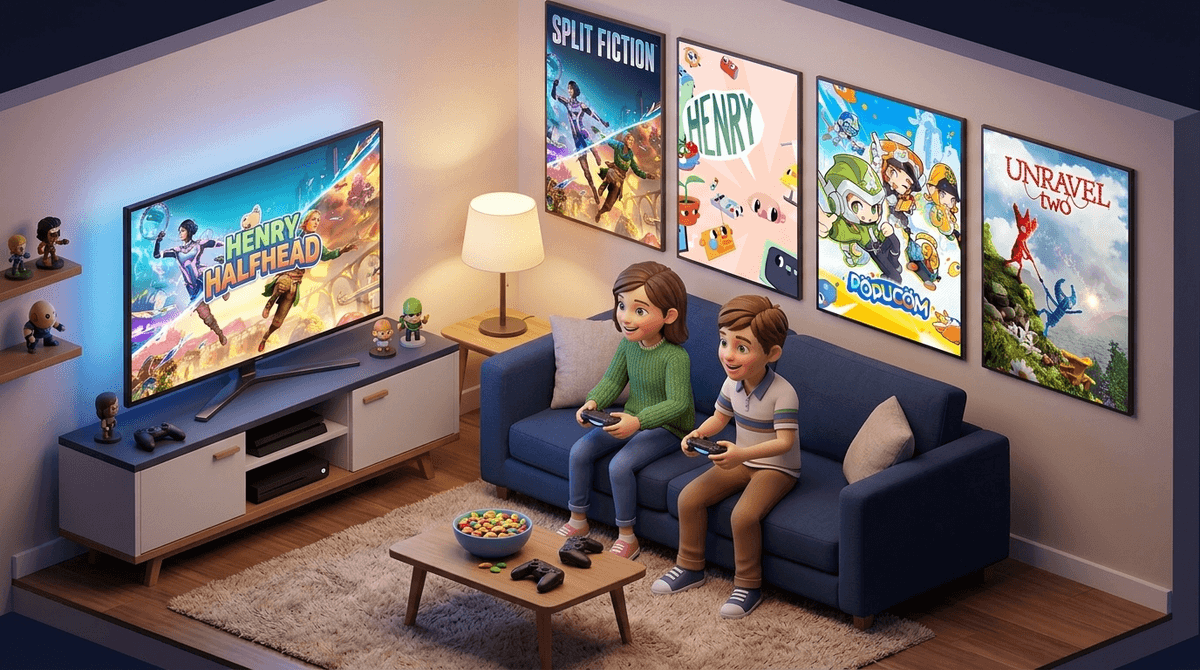
End the Controller Wars: The Best Sibling-Friendly Couch Co-Op Games
TL;DR: If your kids are currently screaming at each other over Mario Kart blue shells or "stolen" loot in Fortnite, it’s time to pivot. Couch co-op games—where you literally cannot win unless you work together—are the ultimate sibling bonding tool. Our top picks for 2026 are the mind-bending Split Fiction, the hilariously weird Henry Halfhead, and the color-coded chaos of Popucom.
Find more games that encourage teamwork
We’ve all been there. You just wanted fifteen minutes of peace to finish a coffee, but instead, the living room has turned into a miniature octagon because someone "accidentally" pushed someone else off a cliff in Roblox.
The problem usually isn't the kids; it’s the game design. Most popular games are built on competition or individual achievement. When you put two siblings in a competitive space, you're basically asking for a fight.
Couch co-op (local multiplayer) is the antidote. These are games designed specifically for two people sitting on the same sofa, looking at the same screen, and sharing a single goal. In these worlds, if your brother fails, you fail. It forces communication, empathy, and—dare I say it—actual teamwork.
If you played It Takes Two a few years ago, you know this studio (Hazelight) basically owns the co-op genre. Their new release, Split Fiction, is a total masterpiece for siblings.
The premise: Two writers—one who loves sci-fi and one who loves high fantasy—get trapped in their own stories. To escape, they have to mash their genres together. One kid might be playing a cyberpunk ninja while the other is a dragon-taming wizard.
Why it works for siblings: The game is "co-op only," meaning you literally cannot play it alone. The puzzles require perfect synchronization. It’s not just "I'll hit this switch while you run through the door"; it’s more like "I need to freeze time so you can platform across these floating books." It turns the "he's in my way" complaint into "I need you to help me."
This is the "chill" pick. You play as... well, the top half of a head named Henry. Your power? You can possess any object in the room.
In co-op mode, two players roam around a sandbox world possessing everything from toaster ovens to pencils to garden gnomes to solve mundane life tasks. It’s absurd, it’s funny, and it’s low-stakes.
Why it works for siblings: There’s no "winning" in the traditional sense, so there’s nothing to fight over. It’s about the "what if" factor. "What if I become the kettle and you become the teacup?" It’s basically digital pretend-play, making it perfect for younger siblings or kids who get easily frustrated by difficult combat.
Think of this as Splatoon meets a match-three puzzle game, but in a 3D platformer world. Players have "color guns" and have to match colors to defeat enemies and clear paths.
Why it works for siblings: It’s visually high-energy but mechanically cooperative. You have to constantly talk to each other about which colors you’re switching to. It’s great for the "Ohio" kids—the ones who love weird, vibrant, slightly chaotic energy but actually need a structured way to work together.
If you haven’t explored the back catalog, these are essential for any intentional parent’s digital library:
- Unravel Two: Two yarn creatures are literally tied together by a string. If one player falls, the other can pull them up. It’s the ultimate metaphor for sibling support.
- Untitled Goose Game: The co-op mode lets two geese ruin a village's day together. It’s "us vs. the world" (or "us vs. the gardener"), which is a great way to redirect sibling aggression toward a fictional NPC.
- Stardew Valley: The split-screen mode allows siblings to run a farm together. One can be the "entrepreneur" selling crops while the other explores the mines. It teaches division of labor better than any chore chart ever could.
Check out our full guide on the best "cozy" games for families
I get asked a lot if games like Roblox are teaching kids about business. Sure, there’s an economy, but let’s be real: most of it is just a sophisticated way to drain your bank account $10 at a time for "limited" digital hoodies.
Couch co-op games are usually a one-time purchase. No "battle passes," no "V-Bucks," no "loot boxes." When you buy a game like Split Fiction, you’re buying a complete experience.
More importantly, these games teach soft skills that actually matter:
- Communication: "I'm going left, you go right."
- Conflict Resolution: "That didn't work, let's try your idea this time."
- Shared Success: The "high-five" moment when a boss is finally defeated.
| Game | Best Age Range | Parent "Heads Up" |
|---|---|---|
| Henry Halfhead | Ages 6+ | Very safe, very silly. Great for beginners. |
| Lego Voyagers | Ages 7+ | Typical Lego humor. Low penalty for "dying." |
| Popucom | Ages 8+ | Requires quick reflexes and color-matching. |
| Unravel Two | Ages 8+ | Some "scary" moments with shadows/birds. |
| Split Fiction | Ages 10+ | Sophisticated puzzles; requires patience. |
| It Takes Two | Ages 12+ | Note: The plot is about divorce. It’s heavy. |
Not every "co-op" game is sibling-friendly.
Take Overcooked! All You Can Eat. It is a "cooperative" game, but it is also a stress simulator. If your kids already have a short fuse, Overcooked will turn your living room into a Gordon Ramsay nightmare. It’s a great game, but it’s high-pressure.
If you want peace, look for games with:
- No "friendly fire": You can't accidentally (or "accidentally") hit your partner.
- Infinite respawns: If one kid fails a jump, they just pop back up. No "Game Over" screens that lead to blaming.
- Asymmetrical roles: In Donkey Kong Bananza, one player can take a "lead" role while the other provides "support." This is perfect for an older sibling playing with a younger one.
Digital wellness isn't just about how much time your kids spend on screens; it’s about how they spend it.
Sitting in separate rooms on separate iPads is "digital isolation." Sitting on the same couch, arguing over how to build a bridge in Minecraft or how to possess a toaster in Henry Halfhead, is "social connection."
If you’re tired of the controller wars, stop giving them games where they have to beat each other. Give them a game where they have to be a team.
Next Steps:
- Audit the library: Look at what they’re playing. Is it mostly "Battle Royale" (competitive)?
- Try a "Friend's Pass": Games like Split Fiction often let you invite a second player for free or have a demo.
- Set the vibe: Make "Couch Co-Op Friday" a thing. Popcorn, one screen, two controllers, zero fighting. (Okay, maybe less fighting).
Learn more about setting up healthy gaming boundaries Check out our guide to the best Nintendo Switch 2 games for families