

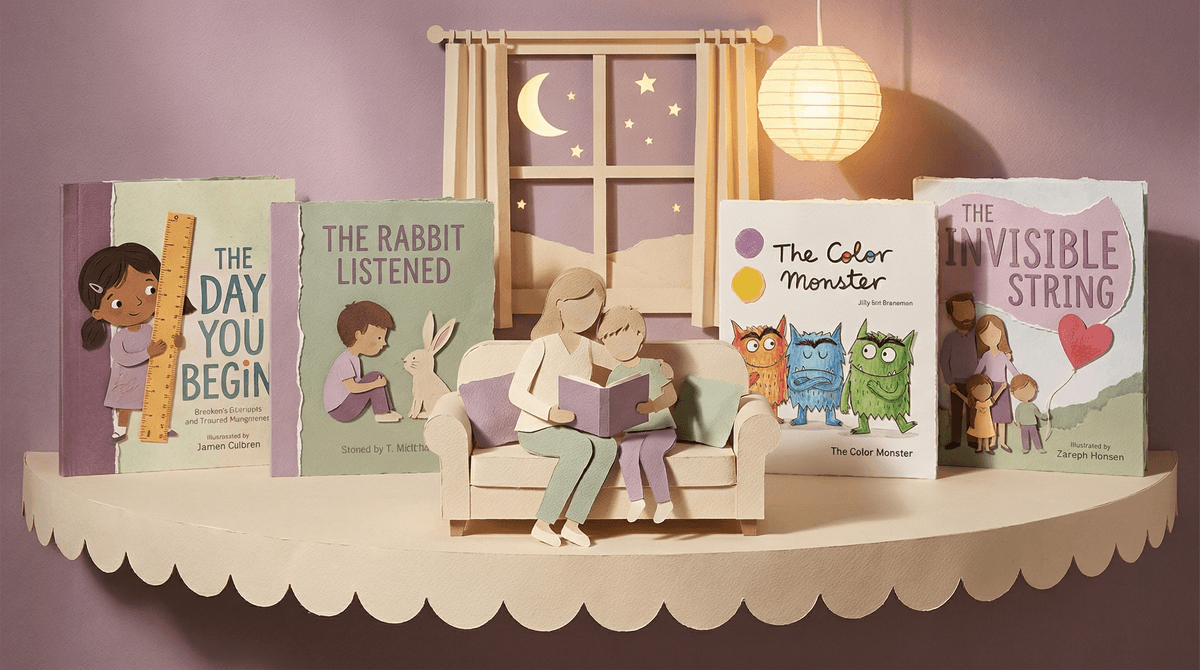
You know those nights when your kid can't sleep because they're worried about the first day of school? Or when they're processing something big—a move, a new sibling, or just the general weirdness of being a tiny human trying to figure out feelings? That's when you need books that do more than entertain. You need stories that say "hey, you're not alone in feeling this way."
Comforting books for little kids aren't just "nice" stories. They're emotional tools disguised as picture books. They help kids name feelings they don't have words for yet, normalize the scary stuff, and provide a safe distance to process big emotions. Think of them as training wheels for emotional intelligence.
And honestly? In an age where we're constantly worried about screen time and whether Bluey is doing all our parenting for us, books remain one of the most reliably good tools we have. No algorithms, no in-app purchases, just you, your kid, and some really smart storytelling.
Little kids experience emotions at full volume. They don't have the prefrontal cortex development to regulate feelings yet, so everything feels HUGE. A scraped knee isn't just pain—it's a catastrophe. Being left at preschool isn't just separation—it's abandonment.
The right book at the right time can:
- Give them language for what they're feeling ("Oh, I'm feeling frustrated, like that llama!")
- Normalize their experience (other kids feel scared of the dark too)
- Provide coping strategies (deep breaths, talking to a grown-up, having a comfort object)
- Create connection between you and your kid during the reading experience
Research shows that reading about characters experiencing and managing emotions actually helps kids develop their own emotional regulation skills. It's like a flight simulator for feelings—they get to practice in a safe environment.
The Kissing Hand by Audrey Penn (Ages 3-6)
This is THE separation anxiety book. A little raccoon doesn't want to go to school, so his mom kisses his hand and tells him whenever he feels lonely, he can press the kiss to his cheek. Is it a bit precious? Sure. Does it work? Absolutely. Kids love having a "secret" comfort strategy, and parents appreciate not crying in the preschool parking lot.
The Invisible String by Patrice Karst (Ages 4-8)
When kids are dealing with separation—divorce, deployment, or just missing someone—this book introduces the concept that people who love each other are connected by an invisible string. It's a concrete metaphor that little kids can actually grasp. Warning: you will cry the first time you read this.
The Rabbit Listened by Cori Doerrfeld (Ages 3-7)
This one's brilliant for teaching kids (and adults, tbh) about what people actually need when they're upset. Spoiler: it's usually not advice or solutions—it's just someone sitting with them. The rabbit doesn't try to fix anything, just listens. Revolutionary concept.
Llama Llama Red Pajama by Anna Dewdney (Ages 2-5)
Bedtime anxiety is real, and this book nails it. Baby Llama freaks out when Mama Llama leaves the room, but learns she's always nearby. The rhyming is actually good (not all picture book rhymes are created equal), and it's short enough that you won't lose your mind reading it for the 47th time.
Big Feelings & Emotional Regulation:
- The Color Monster (Ages 3-6) - Emotions as colors, helps kids sort and name feelings
- When Sophie Gets Angry (Ages 3-7) - Shows healthy ways to handle anger
- The Way I Feel (Ages 2-5) - Simple, clear emotions with relatable scenarios
Anxiety & Worry:
- Wemberly Worried (Ages 3-6) - For the anxious kid who worries about everything
- What Do You Do With a Problem? (Ages 4-8) - Reframes problems as opportunities
- The Huge Bag of Worries (Ages 4-8) - Visualizes worry and how to share it
Change & Transitions:
- The Day You Begin (Ages 4-8) - About feeling different and finding courage
- A Little Spot of Feelings (Ages 3-6) - Great for multiple situations, very practical
Timing matters. Don't wait until your kid is in full meltdown mode to introduce these books. Read them during calm times first, so when the hard moment comes, the book is already a familiar friend.
Repetition is your friend. Kids need to hear these stories multiple times. The first read might not click, but by the fifth time, they're finishing the sentences and applying the lessons.
Don't over-explain. Let the book do its work. You don't need to turn every page into a therapy session. Sometimes just reading and cuddling is enough.
Your reaction matters more than the book. If you're reading about big feelings while clearly uncomfortable with big feelings, your kid will notice. These books are as much for you as for them—they're teaching you how to talk about this stuff too.
Not every book will land. Some kids connect with certain stories and not others. That's fine. Build a small library and see what resonates.
Here's the thing: these books are doing work that screens often can't. Yes, Daniel Tiger has great emotional regulation content, and it's genuinely helpful. But there's something about the physical closeness of reading together, the ability to pause and talk, and the lack of stimulation that makes books uniquely powerful for emotional processing.
Think of comforting books as the analog tool in your digital parenting toolkit. They slow everything down in a world that's increasingly fast and overwhelming for little kids.
Comforting books aren't magic, but they're pretty close. They won't solve every emotional crisis or prevent every meltdown. But they give kids (and you) language, strategies, and most importantly, the message that feelings are normal and manageable.
Start with a few classics, add books that match your kid's specific challenges, and read them often. These books are investments in your child's emotional toolkit—and honestly, they're a lot cheaper than therapy down the road.
Build your starter library: Grab 3-5 books that match your kid's current stage and challenges. Libraries are your friend here—test before you buy.
Create a comfort reading spot: A cozy corner with pillows where these books live makes them feel special and accessible.
Read proactively: Don't wait for crisis mode. Make these books part of your regular rotation.
Talk about your own feelings: Use these books as springboards to share your own experiences with big emotions (age-appropriately, of course).
And if you're wondering whether your kid is spending too much time with screens and not enough time with books, that's a conversation worth having. But for now, just know that every page you read together is building something important.