The Huge Bag of Worries

The Huge Bag of Worries

book

2011, Children's Books, Growing Up & Facts of Life

WISE
87%

WISE Score

4.6

Amazon

A gentle picture book that turns anxiety into a big blue bag kids can actually talk about—therapeutic without being preachy.

Amazon4.6
Common Sense Media

Where to Read

Our reviews and ratings are 100% unbiased, but as an Amazon Associate, Screenwise earns an affiliate fee if you buy a book or game by clicking one of our links. We don't get any credit if you just Google it instead :)

Screenwise Verdict

This is the book you pull out when your kid is spiraling about school or friends or the dark, and you need a way to crack open the conversation that doesn't feel like an interrogation.

The metaphor works. Worries as a physical bag that gets heavier when you keep them secret? Kids get it immediately. And the resolution—that talking to someone helps empty the bag—is exactly the message anxious kids need without being patronizing about it.

It's not going to win awards for thrilling plot or stunning art. The illustrations are fine but feel like they're from a school guidance counselor's shelf circa 2005. And yes, it's earnest and therapeutic in a way that won't appeal to every kid every time.

But here's the thing: it works. Parents report actual breakthroughs. Kids start using 'worry bag' language unprompted. It normalizes anxiety without making it scary, and it gives both parent and child a shared vocabulary for something that's often hard to articulate.

If your kid is a worrier, this belongs on your shelf. If they're not, it's still useful for building emotional literacy before the big feelings hit. Just don't expect bedtime magic—expect a genuine tool that requires your participation.

Age Fit

Best for ages 3-10, with the sweet spot around 4-8. Younger kids need the concept explained, older elementary kids still benefit but might find the illustrations babyish. Not really for independent reading—this is a read-together, talk-together book.

WISE Breakdown
Wholesome
92

Models healthy emotional processing by showing a child learning to share worries rather than carrying them alone. The story normalizes anxiety without dramatizing it, and emphasizes seeking help from trusted adults. The tone is gentle and reassuring, with a clear message about emotional openness and connection.

Imaginative
78

The metaphor of worries as a physical bag that grows heavier is creative and makes abstract anxiety concrete for young minds. Illustrations by Frank Rodgers add visual interest. However, it's more of a therapeutic tool than a wildly imaginative story—the narrative is straightforward and focused on its message rather than world-building or whimsy.

Safe
98

Completely safe for young children. Addresses anxiety in an age-appropriate, non-scary way. No triggering content, violence, or inappropriate themes. The book is specifically designed to be comforting during stressful times. Amazon lists it for ages 2+, though most parent reviews suggest 3-10 is the sweet spot.

Enriching
88

Provides genuine emotional literacy by giving kids language and framework for understanding worry. Opens critical conversations about mental health and asking for help. The bag metaphor is something kids can reference later ('my worry bag is getting heavy'). Strong 4.6 Amazon rating suggests parents find it genuinely useful. This is a book with a job to do, and it does it well.

Parent Info

Why It Might Be Great

  • Gives kids concrete language for abstract feelings ('my worry bag is heavy today')
  • Models asking for help instead of suffering alone—critical mental health skill
  • The bag metaphor is simple enough for preschoolers but resonates with elementary kids too
  • Works as both preventive tool and comfort during actually stressful times (moves, divorce, school transitions)
  • Strong parent reviews (4.6 stars) suggest it genuinely opens conversations that were previously stuck

What to Watch For

  • This is a tool, not entertainment—don't expect giggles or adventure, expect feelings and processing
  • Some kids might worry MORE after reading if not followed up with conversation (the book literally introduces the concept of carrying worries)
  • Illustrations are pleasant but dated—originally published 1996, feels a bit like a school counselor's office book
  • Works best when read WITH a child, not handed off solo

Conversation Starters

  • "What would your worry bag look like? What color? How big?"
  • "Who could you talk to if your worry bag got too heavy?"
  • "Did Jenny do the right thing by telling someone? Why was that hard for her?"
  • "What's one worry in your bag right now? Want to take it out and look at it together?"

Deep Dive

The cultural shelf life of most picture books is about five minutes, yet Virginia Ironside’s 2011 release (a refresh of her 1996 original) remains a staple because it solves a very specific, very stubborn problem: how to make a kid’s internal monologue visible.

The "School Counselor" Aesthetic

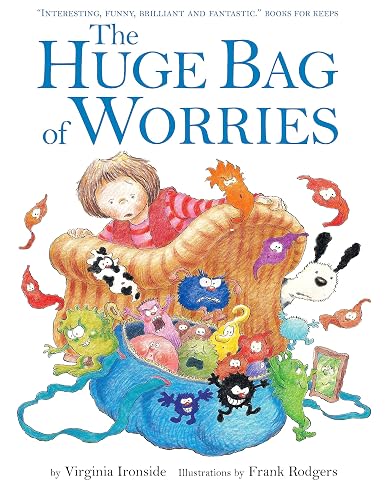
Let’s be honest about the art. If you’re used to the high-contrast, minimalist style of modern Caldecott winners, this book is going to look like a relic. The illustrations have a distinct "mid-90s health clinic" energy. They are cluttered, a bit literal, and definitely not something you’d buy for the aesthetic value alone.

But for a kid who is actually feeling the weight of anxiety, that literalism is a feature, not a bug. When Jenny is in the bathroom and that giant blue bag is taking up half the floor, kids don't care about the line work. They care that someone finally drew what their chest feels like on Sunday night. If you are looking for more modern-feeling options, you might check out our guide on comforting books for little kids, but don't let the dated look of this one scare you off. It’s a workhorse, not a showpiece.

Why the Metaphor Sticks

The genius of the "bag" is that it’s finite. When a seven-year-old is spiraling, their worries feel like a fog: infinite, blurry, and everywhere. By shoving those worries into a blue bag, Ironside gives the child a way to contain the mess.

The story follows a predictable path—Jenny tries to ignore the bag, it gets bigger; she tries to hide it, it gets heavier. It’s only when she meets an old lady who insists on opening the bag and looking at the worries one by one that they start to shrink. This is basic cognitive behavioral therapy (CBT) wrapped in a story about a girl and her luggage. It works because it doesn't just tell kids to "stop worrying." It tells them to categorize. Some worries are big, some are tiny, and some don't even belong to you.

Making it Work in 2026

We live in a much louder world than Jenny did in the original 1996 version. While the book focuses on "analog" fears like school and friends, the logic holds up perfectly for the modern age. We’ve found that unpacking 'The Huge Bag of Worries' in a digital world is actually easier because the bag metaphor translates so well to things like group chat drama or scary news headlines.

One move that helps: don’t just read the book and put it back on the shelf. When you’re done, ask your kid what’s in their bag today. Is it a "heavy" worry like a math test, or a "sticky" worry like something a friend said?

The Reality Check

This isn't a book for every night. If you try to read this when your kid is in a great mood and just wants to hear about dragons or space, they will probably find it boring. It’s a tool. Keep it in the "break glass in case of emergency" section of your library.

It’s also worth noting that some kids might find the idea of a physical bag following them around a little creepy at first. If your child is highly literal or prone to intrusive thoughts, you’ll want to emphasize the ending where the bag becomes manageable. The goal isn't to make them fear the bag: it's to make them realize they have the zipper.

Ask Anything

Get a personalized guide on any topic