

TL;DR: Disney Movie Night isn't as simple as it was in the 90s. Between the 2025 content advisories and the realization that some "classics" are actually kind of a slog, you need a game plan.
- Best for Preschoolers: The Many Adventures of Winnie the Pooh
- Best for 90s Nostalgia: The Lion King
- Best "Hidden Gem": The Great Mouse Detective
- The "Proceed with Caution" Pick: Peter Pan
We’ve all been there. You’ve had a long week, the kids are finally settled, and you want to share a piece of your childhood with them. You fire up Disney+, find Cinderella, and wait for that hit of pure nostalgia.
But then, the 12-second unskippable content advisory pops up. Or worse, you realize halfway through Dumbo that there’s a scene you completely blocked out that is, frankly, super racist.
Parenting in 2026 means navigating the "Disney Vault" with a map. We want the magic, the hand-drawn animation, and the catchy songs, but we also don't want to spend the whole movie explaining why a character is a harmful stereotype. This guide is about finding that balance—picking the films that actually hold up, knowing which ones need a "sidebar" conversation, and admitting which ones are just plain boring for kids raised on the fast-paced humor of The Mitchells vs. the Machines.
For most of us, these movies are "core memories." But for our kids, Peter Pan is competing with MrBeast and Roblox. If the movie is slow or culturally "cringe," they’re going to check out and ask for their iPad.
Choosing the right classic isn't just about avoiding "problematic" content; it’s about choosing a story that still resonates. We want to use movie night as a way to connect, not as a history lesson they didn't ask for.
Check out our guide on choosing the best family movies for different ages
These are the movies where you can mostly lean back and enjoy. The themes are universal, the animation is top-tier, and the "cringe factor" is low to non-existent.
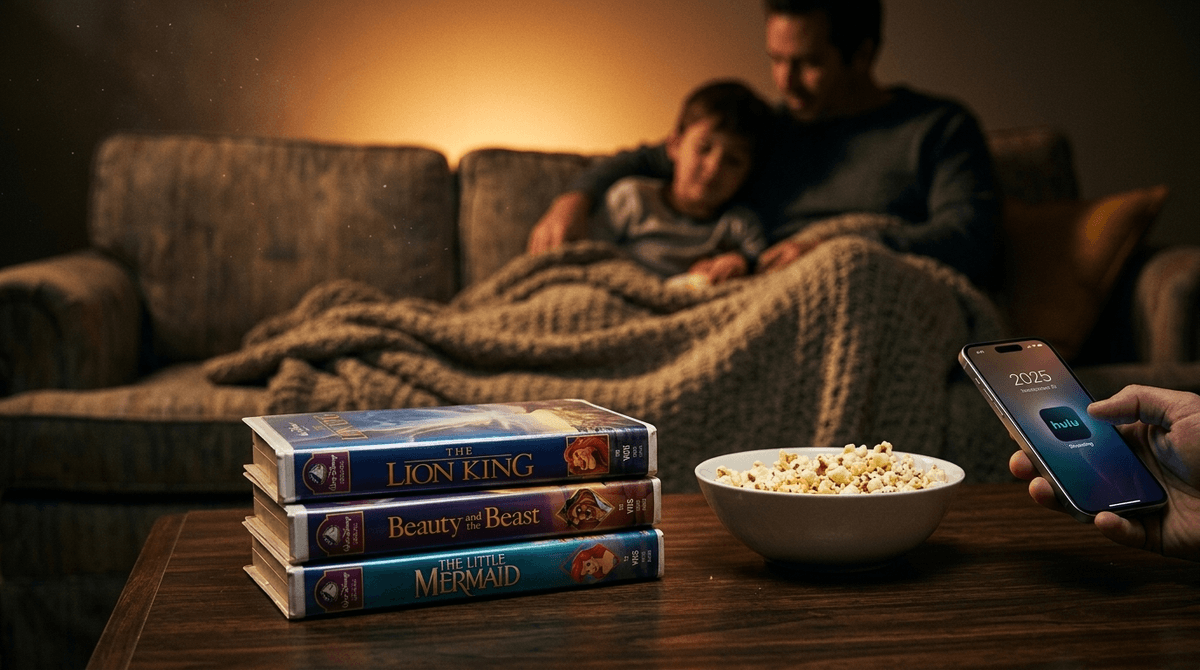
This is arguably the peak of the Disney Renaissance. The pacing is tight, the music is Broadway-level, and Belle is a protagonist who actually has hobbies (reading) and a backbone. Aside from the "Stockholm Syndrome" jokes we adults make, it holds up beautifully for ages 5 and up.
If your kids can handle the trauma of Mufasa (which, let’s be honest, is a rite of passage), this movie is nearly perfect. It’s Shakespeare for kids, and the soundtrack still hits. It’s a great entry point for talking about responsibility and the "Circle of Life" without it feeling like a lecture.
If you have toddlers or preschoolers, this is the ultimate "anti-brain rot" movie. It’s gentle, episodic, and doesn't have a terrifying villain. It’s the cinematic equivalent of a warm blanket. In a world of CoComelon, Pooh is the palate cleanser your kids need.
While we can have a whole conversation about Ariel giving up her voice for a guy she just met, the visual storytelling and Howard Ashman’s songs are undeniable. It’s vibrant enough to keep a 4-year-old’s attention but has enough "diva energy" from Ursula to keep parents entertained.
Disney+ now includes advisories for films like The Aristocats, Peter Pan, and Dumbo. These movies aren't "canceled," but they do require you to be an active parent rather than a passive observer.
The Issue: The depiction of Indigenous people is... bad. The song "What Makes the Red Man Red" is the definition of a "hard watch" in 2026. The Play: If you love the flight to Neverland and Captain Hook, don't feel like you have to ban the movie. Instead, use it as a talking point. Before the movie, you can say, "This movie was made a long time ago, and it shows people in a way that is disrespectful and not true to how they actually are. We’re going to watch it, but let's talk about that part when it comes up."
The Issue: The "Siamese Cat" scene features a heavy, mocking caricature of East Asian people. The Play: This one is tougher because the scene is meant to be "funny," which makes it more insidious. If your kids are younger (under 7), they might not even register it, but it’s better to be proactive. Honestly? There are better movies. If you want cats, maybe just watch Oliver & Company instead.
The Issue: Some of the lyrics in the opening song and the general "Middle Eastern" stereotypes have been criticized for years. The Play: Most kids are here for the Genie. Robin Williams’ performance is still a masterclass. This is a great time to talk about how movies can sometimes create a "fantasy" version of a culture that isn't accurate.
Ask our chatbot for a script on how to talk to kids about media stereotypes
Let's be honest: some Disney movies we remember fondly are actually... kind of mid. If you're trying to win over a kid who is used to the high-octane energy of Spider-Man: Across the Spider-Verse, some of these might fail the "boredom test."
- Sleeping Beauty: It is visually stunning. Like, every frame is a painting. But Aurora has about 18 minutes of screen time and the plot is thin. Unless your kid is an aspiring artist, they might start asking for Minecraft 40 minutes in.
- Alice in Wonderland: This is a trip. It’s surreal and non-linear. Some kids love the chaos; others find it frustrating because there’s no clear "goal."
- The Sword in the Stone: It’s a lot of Merlin turning Arthur into various animals. It’s charming, but the stakes feel very low until the last five minutes.
- Ages 2-4: Stick to the short, gentle stuff. The Many Adventures of Winnie the Pooh or the original Dumbo (with a skip over the "Pink Elephants" if they’re sensitive).
- Ages 5-8: The Renaissance era is your sweet spot. The Little Mermaid, Aladdin, and The Lion King.
- Ages 9-12: This is a great age for the "weirder" or darker classics. The Hunchback of Notre Dame (which is surprisingly heavy) or Hercules, which has a great sense of humor.
Classic Disney movies are generally "low-stimulation" compared to modern media. The shots are longer, the music is more orchestral, and the pacing is slower. This is actually a good thing for their brains. It trains them to pay attention to a story that doesn't provide a dopamine hit every 3 seconds like a TikTok feed.
However, be prepared for the "Why is the animation so shaky?" or "Why isn't it in 3D?" questions. Use it as a chance to talk about how art changes over time. You can even show them a "making of" clip of animators drawing by hand—it’s mind-blowing to a kid who thinks everything is made by AI.
If you decide to watch a movie with a content advisory, don't make it a "Big Serious Talk" that ruins the vibe. Keep it casual:
- Acknowledge the warning: "Hey, look, Disney put a note here saying some parts of this movie are old-fashioned and a bit mean. Let's see if we can spot them."
- Ask, don't tell: "Why do you think they drew the characters that way? Does that seem like how people actually look?"
- Focus on the "Why": Explain that we watch these because we love the music or the story, but we also know that people used to think differently about the world, and we’re glad we know better now.
Nostalgia is a powerful drug, but reality is a better teacher. You don't have to throw out your VHS tapes (or your digital equivalents), but you do have to be the "director's commentary" for your kids.
Classic Disney movie night is less about the movie itself and more about the shared experience. If Peter Pan feels too heavy for your Friday night, just put on Moana and call it a day. No one is grading your parenting based on how many 1950s musicals your kids have seen.
- Audit your watchlist: Check the Screenwise Media Page for specific movie ratings.
- Mix it up: For every "classic" you watch, try a modern masterpiece like Encanto to show how storytelling has evolved.
- Ask the kids: Give them two choices—one classic, one modern—and let them vote.
Check out our full list of family movie night recommendations