

Look, "depression" is a big word, and when we're talking about 8-year-olds, we're usually not looking for clinical DSM-5 criteria explained through picture books. What we're really after are books that help kids understand sadness, grief, anxiety, and those heavy feelings that sometimes stick around longer than a bad day.
Kids at this age are developing emotional vocabulary beyond "happy" and "sad." They're noticing that sometimes people (including themselves) feel down for reasons that aren't obvious. Maybe they have a friend who seems withdrawn, or they're processing their own big feelings, or they're just emotionally perceptive kids who pick up on the mood in a room.
The right books can be mirrors (helping kids see their own experiences reflected) or windows (helping them understand what others might be going through). And honestly? Sometimes a story about a character struggling with heavy feelings is just less scary than a direct conversation about "are you feeling depressed?"
Eight is a fascinating age emotionally. Kids are old enough to experience complex feelings but often lack the language to articulate them. They might say "I'm tired" when they mean "I feel overwhelmed" or "I'm bored" when they actually mean "I feel empty."
Here's what we know: Kids who develop emotional literacy early are better equipped to ask for help when they need it. They're more empathetic. They're less likely to internalize shame around mental health struggles. And reading about characters who experience depression or deep sadness normalizes the conversation in a way that feels safe and indirect.
Plus, let's be real—if your kid is asking about depression or seems drawn to these themes, that's actually a good sign. It means they're trying to understand something, either in themselves or in their world. Meeting them where they are with quality literature? That's solid parenting.
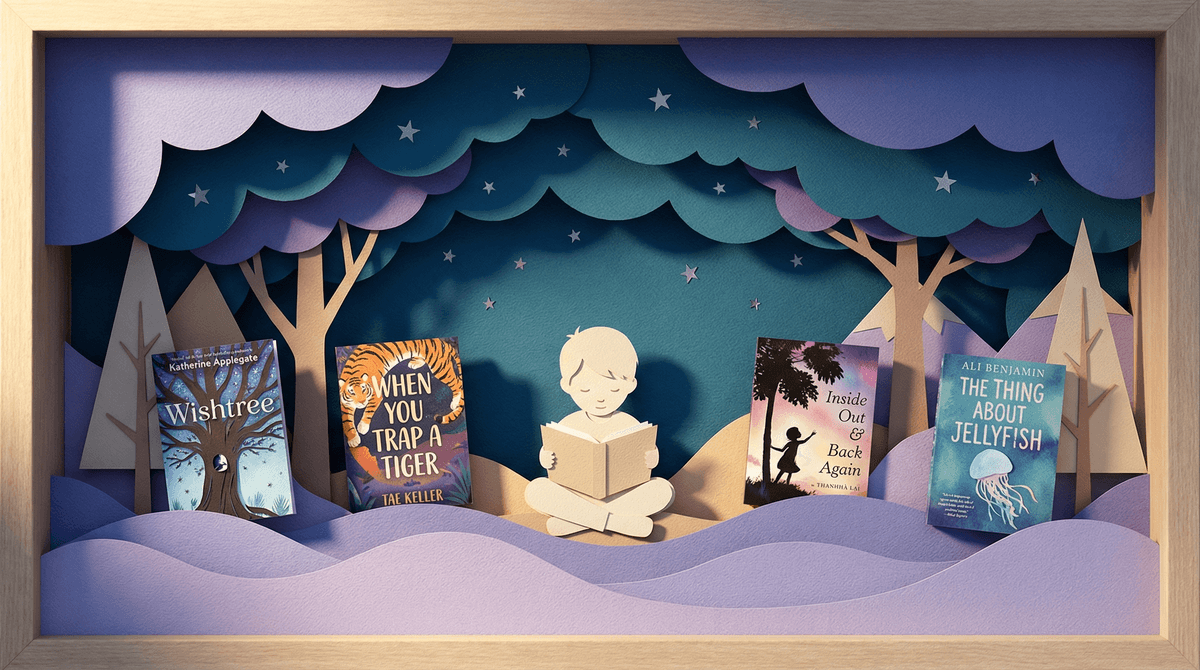
Inside Out and Back Again by Thanhha Lai
This verse novel follows Hà, a 10-year-old Vietnamese girl who flees Saigon and struggles to adjust to life in Alabama. The grief, displacement, and depression are palpable but age-appropriate. Hà's sadness isn't "fixed" quickly—it's a process, which is so important for kids to see. The verse format also makes it accessible for reluctant readers.
Why it works: It shows that depression can come from circumstances (trauma, loss, upheaval) and that healing isn't linear.
The Thing About Jellyfish by Ali Benjamin
Suzy's best friend dies suddenly, and she stops speaking. The book follows her obsessive quest to prove that a jellyfish sting caused her friend's death—which is really about her inability to process grief and guilt. This one tackles complicated grief that looks a lot like depression, complete with withdrawal, obsessive thoughts, and numbness.
Why it works: It's about a kid who can't talk about her feelings, which is SO relatable. Also, the science angle gives kids something concrete to grab onto while processing heavy emotions.
Crenshaw by Katherine Applegate
Jackson's family is facing homelessness, and the stress brings back his imaginary friend from when he was younger—a giant cat named Crenshaw. The book deals with anxiety, poverty-related stress, and the weight of worry that can feel crushing to a kid. Jackson's internal experience reads as depressive even if it's not labeled that way.
Why it works: It shows how external stressors affect kids' internal worlds, and how sometimes our minds create coping mechanisms.
Fish in a Tree by Lynda Mullaly Hunt
Ally has undiagnosed dyslexia and has spent years feeling "stupid," which has led to real depression, self-loathing, and acting out. This book is as much about the depression that comes from feeling different and misunderstood as it is about learning disabilities.
Why it works: Many kids experience depression tied to school struggles, and this book validates that while showing a path forward.
Wishtree by Katherine Applegate
Told from the perspective of an old oak tree, this gentle story deals with a Muslim family facing discrimination, a lonely girl, and the quiet sadness of feeling unwelcome. It's more about melancholy and isolation than clinical depression, but it's beautiful for discussing persistent sadness.
Why it works: The tree narrator creates emotional distance that makes heavy themes more digestible for younger readers.
When You Trap a Tiger by Tae Keller
Lily's grandmother is dying, and the book weaves magical realism with very real grief and the depression that comes with anticipatory loss. Lily feels invisible and powerless, which manifests as withdrawal and sadness.
Why it works: It addresses depression in the context of family illness and cultural identity, with a magical framework that feels safe.
Good depression books for this age:
- Show feelings as valid, not something to "fix" immediately
- Include supportive adults or friends
- Demonstrate coping strategies (even small ones)
- Don't tie up everything with a neat bow
- Use metaphor or indirect storytelling when helpful
Red flags:
- Books that romanticize suffering
- Stories where the "solution" is just "try harder" or "think positive"
- Content that's too graphic about self-harm or suicidal ideation (not age-appropriate for 8)
- Books that treat depression as a personality quirk rather than a real struggle
Don't force it. Some kids want to read heavy books alone and process privately. Others want to curl up with you and talk through every page.
Ask open-ended questions: "What do you think the character is feeling here?" or "Have you ever felt something like this?" But don't interrogate. If they're not ready to talk, that's okay.
Share your own experiences (age-appropriately): "I remember feeling really sad for a long time when..." Kids need to know adults have big feelings too.
Normalize getting help: If characters in books see therapists or talk to trusted adults, point that out. "It's really smart that she told her mom how she was feeling."
Watch for identification: If your kid is suddenly really into books about depression, that might be telling you something. Not necessarily that they're depressed, but that they're thinking about these themes. That's worth a gentle check-in .
.
Books about depression for 8-year-olds aren't about diagnosing or fixing—they're about building emotional vocabulary and reducing stigma. They help kids understand that big, heavy, persistent feelings are part of the human experience, and that there are ways to cope and people who can help.
The best books in this category don't preach. They tell honest stories about kids struggling with real things—loss, change, feeling different, family stress—and show that while these feelings are hard, they're not permanent or shameful.
If you're looking for more books that tackle mental health themes, check out books about anxiety for kids or books that help kids process grief.
And if your child's interest in these themes is making you wonder about their own mental health, that's worth exploring—not with panic, but with curiosity and care. Here's how to start that conversation.
You've got this. The fact that you're here, looking for the right books, already says everything about the kind of parent you are.