

Books for Toddlers: Building a Foundation for Lifelong Reading
Look, I know you clicked on this thinking "great, another list of board books" — and yes, we'll get to specific recommendations. But here's what this is actually about: those chunky little books you read 47 times a day are doing some seriously heavy lifting for your kid's brain development, language skills, and honestly, your sanity.
The toddler years (roughly 1-3) are when kids go from babbling to full sentences, from pointing at pictures to asking "why" about everything. Books are the secret weapon here. Not tablets with interactive stories, not educational TV (we'll get to screens in a sec), but actual physical books that you read together.
And before you roll your eyes at another "books are magic" take — the research backs this up hard. Kids who are read to daily in these early years enter kindergarten with vocabularies that are literally thousands of words larger than kids who aren't. That gap doesn't close easily.
Here's the thing about toddlers and screens: their brains aren't ready for them. Like, developmentally, they can't process digital content the same way older kids can. The American Academy of Pediatrics recommends basically no screen time for kids under 18 months (except video chatting with grandma), and very limited, high-quality content for kids 18-24 months.
But books? Books are different. Here's why:
The tactile experience matters. Toddlers need to touch, flip, sometimes chew (let's be real) the pages. That physical interaction helps them understand cause and effect, builds fine motor skills, and keeps them engaged in a way that swiping a screen just doesn't.
You're right there with them. When you read together, you're making eye contact, pointing at pictures, doing silly voices, answering their weird questions. That back-and-forth conversation is where the language development magic happens. A tablet can't do that, even with the fanciest AI.
Books don't have notifications. There's no algorithm trying to keep your 2-year-old engaged for one more video. A book ends, and you move on with your day. This is teaching attention span and delayed gratification in tiny, age-appropriate doses.
Not all board books are created equal. Here's what actually works:
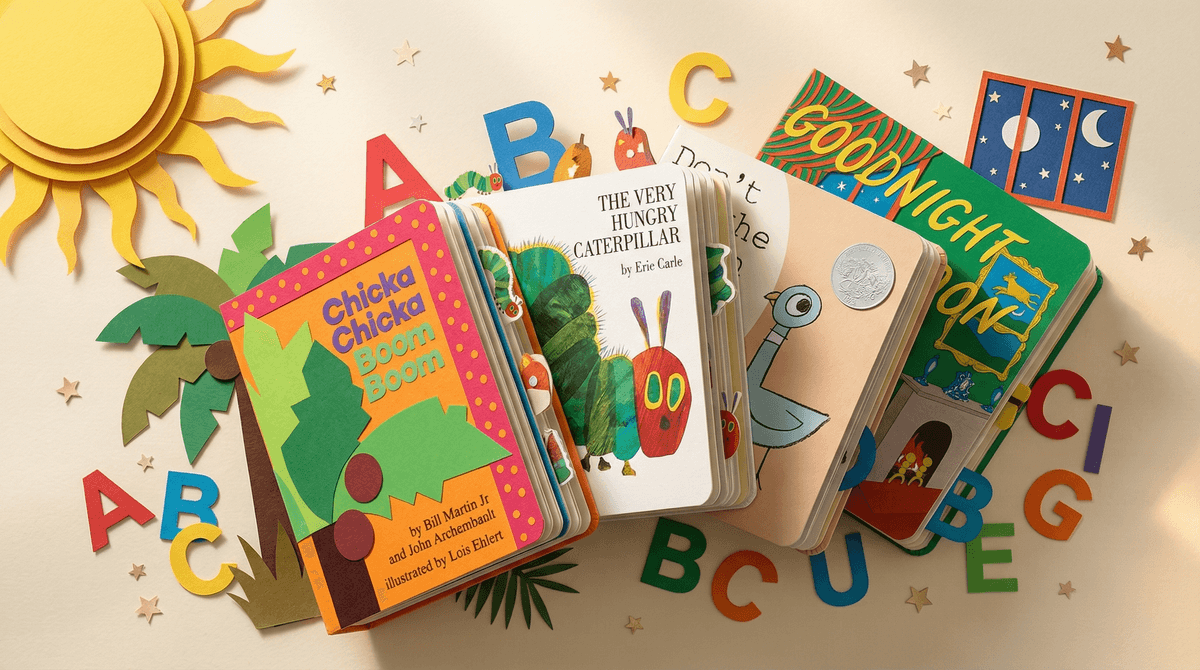
Repetition and rhythm. Toddlers LOVE predictability. Books with repeated phrases (Brown Bear, Brown Bear, What Do You See?) or strong rhythm (Chicka Chicka Boom Boom) let them "read" along with you, which builds confidence and phonemic awareness.
Clear, simple illustrations. Busy pages overwhelm toddler brains. Books like Goodnight Moon or anything by Byron Barton have clean, recognizable images that help kids connect words to objects.
Interactive elements (but not too many). Touch-and-feel books, lift-the-flap books like Dear Zoo — these keep little hands busy and engaged. Just don't go overboard with bells and whistles; the book itself should be the star.
Emotional intelligence building. Books like The Feelings Book or Llama Llama Red Pajama help toddlers identify and name emotions, which is huge for this age group.
Representation matters. Make sure your toddler sees different families, different skin colors, different abilities in their books. Everywhere Babies does this beautifully.
Ages 1-2: Keep it short and sturdy
At this age, books are as much a toy as a reading experience. Go for:
- Indestructible books (yes, the brand is literally called Indestructibles)
- Very short board books with one or two words per page
- Books about daily routines (getting dressed, eating, sleeping)
- Animal sounds and vehicle noises are HUGE hits
Moo, Baa, La La La! by Sandra Boynton is perfect for this age. Also, anything by Leslie Patricelli — those books are hilarious and get read approximately 8,000 times.
Ages 2-3: Story time gets real
Now we're talking actual narratives, more complex vocabulary, and books that are 20-30 pages long. Try:
- Books with simple plots and problems to solve
- Counting and alphabet books that go beyond the basics
- Books that prepare them for new experiences (potty training, new sibling, preschool)
- More sophisticated humor
Don't Let the Pigeon Drive the Bus! is comedy gold for this age. The Very Hungry Caterpillar teaches days of the week, counting, and metamorphosis without being preachy.
Here's your actual homework: read to your toddler every single day. Doesn't have to be long — 10-15 minutes is plenty. But make it consistent.
Best times:
- Before nap/bedtime (obviously, this is when most families do it)
- After meals when they're fed and calm but not sleepy yet
- During that witching hour before dinner when everyone's losing it — books can reset the energy
Pro tips:
- Let them choose the book (even if it's the same one for the 47th day in a row)
- Don't worry about reading every word — follow their lead and interests
- Ask questions: "Where's the dog?" "What color is that?" "What do you think happens next?"
- Do the voices. Yes, even if you feel ridiculous. Especially if you feel ridiculous.
I know, I know — you've got a tablet, your toddler knows how to unlock your phone, and there are approximately 10 million "educational" apps out there.
Here's my take: save the digital reading for later. Like, age 4 or 5 at the earliest.
The research is pretty clear that toddlers learn better from physical books. They remember more, their comprehension is better, and the parent-child interaction is richer. E-books with all their bells and whistles actually distract from the story and the learning.
If you do use digital books occasionally (long car ride, doctor's office waiting room), look for ones that are basically just the book on screen — no games, no random animations, no auto-play next video. And read it together, just like you would a physical book.
You don't need 500 books. Quality over quantity. But here's how to build a solid collection without spending a fortune:
- Library card (duh, but seriously — this is your best friend)
- Little Free Libraries in your neighborhood
- Used bookstores and thrift stores (board books hold up well)
- Book swaps with other parents
- Birthday/holiday gifts — tell relatives you want books instead of more plastic toys
Aim for maybe 20-30 books that you rotate through. Keep some out, store others away, and swap them every few weeks so they feel "new" again.
Reading to your toddler isn't just a nice thing to do — it's one of the highest-impact activities you can do for their development. It builds vocabulary, attention span, emotional intelligence, and a love of learning. It's also one of the few totally screen-free, brain-building activities that actually feels good for both of you.
Start now, make it a habit, and don't stress about doing it "right." Even if you're exhausted and half-reading while thinking about tomorrow's meetings, you're still doing something really important.
- Hit up your library this week and grab 5-10 books to try
- Set a daily reading time that actually works for your schedule
- Explore our guide to screen-free activities for toddlers for more ideas
- If you're dealing with a toddler who won't sit still for books, learn strategies for active readers

Your toddler's future teacher will thank you. More importantly, you're building something really special together — even if it involves reading about a pigeon who really, really wants to drive a bus for the 800th time.