

Let's be real: books about diversity and inclusion aren't a separate genre you need to treat like vegetables hidden in mac and cheese. They're just... books. Good books. Books where kids see themselves, and books where they see people who aren't like them. Books that reflect the actual world we live in, which is beautifully varied and complex.
These are stories featuring characters of different races, ethnicities, abilities, family structures, gender identities, religions, and socioeconomic backgrounds. They're books that help kids understand that different doesn't mean wrong, and that everyone deserves to be seen, heard, and valued.
The thing is, you don't need to make a big announcement about reading "diversity books" tonight. That's weird. You're just... reading good books. Books that happen to feature a kid in a wheelchair, or two dads, or a family celebrating Diwali, or a character questioning their gender identity.
Here's what we know from research: kids start noticing race and difference as early as 6 months old. By age 4, they're already forming opinions about who belongs where and what's "normal." If we don't actively expose them to diverse perspectives, they'll fill in the gaps with whatever messages they're absorbing from their environment—and those messages aren't always great.
Books are one of the safest, most accessible ways to introduce kids to experiences outside their own. They build empathy. They normalize differences. They give kids language for things they might not know how to talk about yet.
And for kids who are part of marginalized groups? Seeing themselves reflected in stories isn't just nice—it's essential. It tells them they matter. That their stories are worth telling.
Ages 3-5: Keep It Simple and Concrete
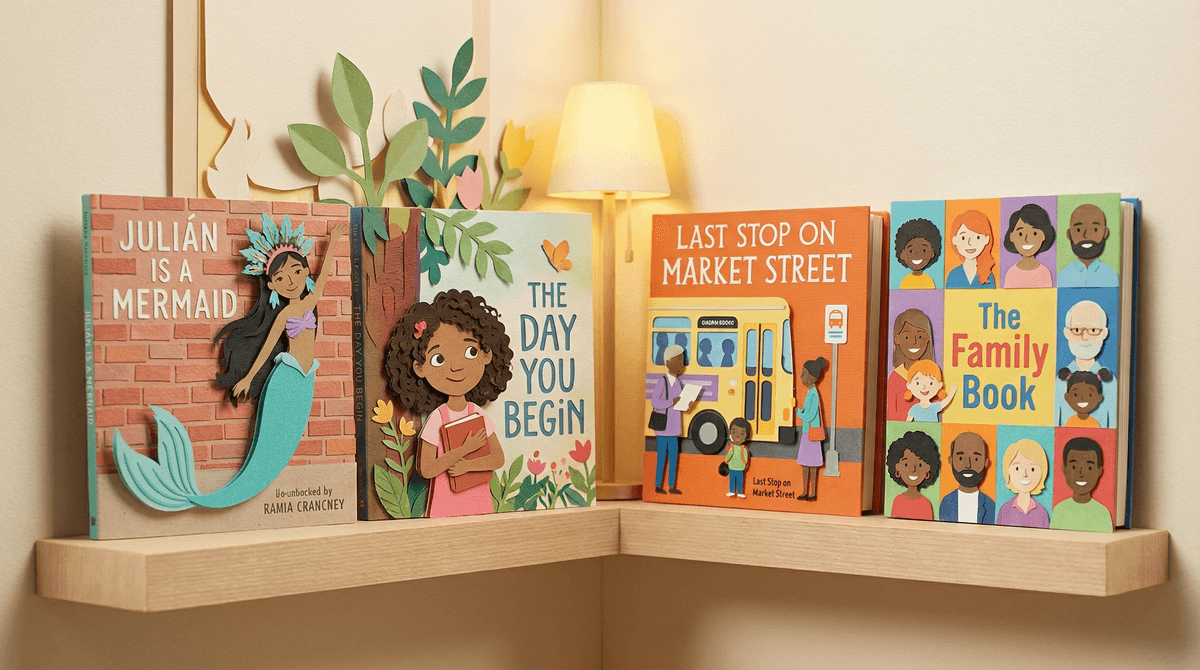
Little kids are literal thinkers. They need books that show diversity as a normal part of life, without heavy-handed messaging. Think: The Family Book by Todd Parr, which celebrates different family structures without making it A Thing. Or Julián Is a Mermaid by Jessica Love, which is just a gorgeous story about self-expression and a supportive abuela.
At this age, you're building the foundation. You want books where the diverse elements are just... there. Part of the story, not the entire point.
Ages 6-8: Starting Real Conversations
Early elementary kids can handle more nuance. They're starting to notice fairness and unfairness. Books like Last Stop on Market Street by Matt de la Peña introduce economic diversity and finding beauty in unexpected places. The Day You Begin by Jacqueline Woodson tackles feeling different and finding connection.
This is also when you can introduce books that gently address harder topics—like Each Kindness, also by Woodson, which doesn't shy away from the pain of exclusion and missed opportunities for kindness.
Ages 9-12: Getting Real
Upper elementary and middle school kids are ready for stories that don't tie everything up in a neat bow. New Kid by Jerry Craft is brilliant for discussing microaggressions and code-switching. Front Desk by Kelly Yang deals with immigration, poverty, and resilience. Wonder by R.J. Palacio explores disability and difference from multiple perspectives.
These kids can also handle nonfiction that tackles history head-on. Stamped: Racism, Antiracism, and You by Jason Reynolds is accessible and doesn't sugarcoat anything.
Ages 13+: No More Training Wheels
Teens need books that respect their intelligence and lived experience. The Hate U Give by Angie Thomas doesn't pull punches about police violence and systemic racism. All Boys Aren't Blue by George M. Johnson is a powerful memoir about being Black and queer. They Both Die at the End by Adam Silvera features LGBTQ+ characters in a story that's really about mortality and connection.
Let them read books that might make them uncomfortable. That's kind of the point.
Don't Overthink the "Talk"
You don't need to turn every book into a teachable moment. Sometimes you just read the book. Let it sit. The conversation will come naturally—maybe immediately, maybe weeks later when something reminds them of the story.
When questions do come up, answer them honestly and age-appropriately. "Why does that kid have two moms?" "Because some families have two moms, some have two dads, some have one parent, some have grandparents raising them. Families look different, and that's normal."
Check Your Own Discomfort
If you feel awkward reading books about race, disability, or LGBTQ+ identities with your kids, sit with that. Where's it coming from? Kids pick up on our discomfort, and it sends a message that these topics are somehow shameful or taboo.
Representation Isn't Enough
It's not just about having diverse characters—it's about who's telling the story. Seek out #OwnVoices books (though that term is evolving) where authors are writing from their own lived experience. There's a difference between a book about a trans kid written by a trans author and one written by someone who did some research.
Your Library Is Your Friend
You don't need to buy every book. Librarians are literally trained to help you find diverse, age-appropriate books. Tell them what you're looking for. They'll hook you up.
Reading diverse books with your kids isn't about checking a box or proving you're a "good" parent. It's about preparing them to live in the actual world—a world that's always been diverse, even if their immediate circle isn't.
Start where you are. Pick one book that features a perspective different from your family's experience. Read it. Talk about it if it comes up. Then pick another one.
And remember: this isn't a one-time conversation or a month-long unit. It's just... life. Keep diverse books in regular rotation. Make it normal, because it is.
Not sure where to start? Your local library likely has curated lists of diverse books by age. Common Sense Media also has solid recommendations if you want to preview content first.
And if you're wondering about specific titles you've heard about—whether they're actually age-appropriate or if the controversy is overblown—See if a specific book is appropriate for your kid and get personalized guidance based on your kid's age and your family's values.
The hardest part is starting. After that, it's just reading good books with your kids. You've got this.