

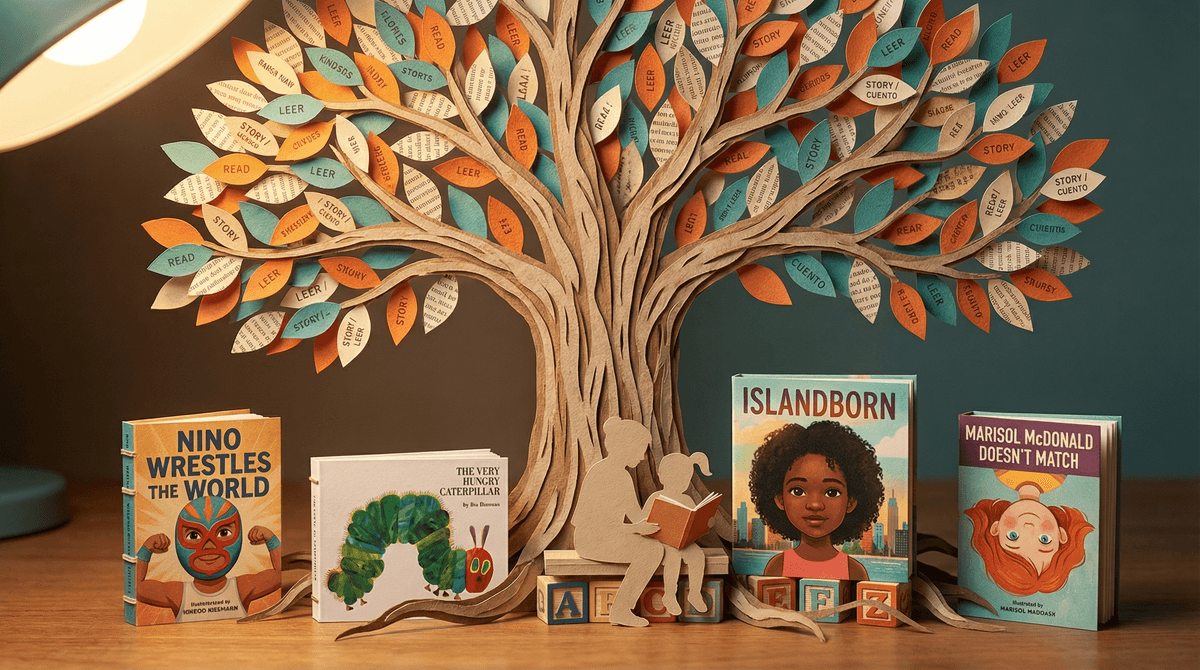
Bilingual books are exactly what they sound like: books that present text in two languages simultaneously, typically with English on one side and Spanish on the other, or sometimes alternating languages within the same page. They're designed to help kids (and honestly, adults too) develop literacy skills in both languages while enjoying a story.
These aren't just English books with a Spanish translation slapped on—the best bilingual books are thoughtfully crafted to flow naturally in both languages, maintaining the rhythm, humor, and emotional impact of the story regardless of which language you're reading.
You'll find bilingual books across every genre and age range: board books for toddlers, picture books for early readers, chapter books for middle grades, and even young adult novels. Some classics like Goodnight Moon and The Very Hungry Caterpillar have bilingual editions, and there's a growing number of books written specifically as bilingual texts from the start.
Here's the thing: we're living in a time when being bilingual isn't just "nice to have"—it's increasingly essential. And for families raising kids in Spanish-English households, bilingual books aren't just educational tools, they're cultural lifelines.
For heritage speakers (kids whose families speak Spanish at home), these books validate both parts of their identity. They send a clear message: both your languages matter. Both your cultures count. When a kid sees their home language in a "real book," it elevates Spanish from "the language abuela speaks" to "a language that belongs in libraries and schools and bookstores."
For English-dominant kids learning Spanish, bilingual books provide scaffolding. They can read the English to understand the story, then use that context to decode the Spanish. It's like training wheels for language learning—supportive without being limiting.
For parents trying to maintain Spanish at home (and let's be real, this is HARD when English dominates school, friends, and screens), bilingual books are a practical tool. You can read in Spanish while your kid follows along in English, or switch back and forth, or let them choose which language to read that night.
And here's something that doesn't get talked about enough: bilingual books help English-speaking parents support their kids' Spanish learning even when they don't speak Spanish themselves. You can still do storytime. You can still bond over books. You just might learn some Spanish along the way.
Kids don't inherently love or hate bilingual books—they love good stories, period. The format matters less than the content.
The best bilingual books work because they:
Don't feel like homework. Nobody wants to read a vocabulary lesson disguised as a story. Books like Niño Wrestles the World by Yuyi Morales or Islandborn by Junot Díaz (which has a bilingual edition) are just fantastic stories that happen to be in two languages.
Respect both languages equally. Some bilingual books clearly favor one language, with the other feeling like an afterthought. Kids notice this. The good ones treat both languages as equally important to the storytelling.
Let kids feel competent. There's something empowering about being able to read a book in two languages. It makes kids feel smart and capable, especially when they can help translate or explain words to siblings or friends.
Connect to their actual lives. Books that reflect code-switching (mixing languages naturally, like many bilingual families actually speak) feel authentic. Books like Marisol McDonald Doesn't Match/Marisol McDonald no combina capture this beautifully.
Ages 0-3: Board Books and Simple Picture Books
Start with basic vocabulary and repetitive text. Books like My First Book of Spanish Words or bilingual versions of classics like Brown Bear, Brown Bear, What Do You See? work great. At this age, you're just building familiarity with sounds and rhythms in both languages.
Ages 4-7: Picture Books
This is the sweet spot for bilingual picture books. Kids are developing reading skills and can start to recognize cognates (words that are similar in both languages, like "animal/animal" or "family/familia"). Look for books with engaging illustrations that support comprehension in both languages.
Ages 8-12: Chapter Books and Graphic Novels
Older kids might resist bilingual books if they feel "babyish," so format matters. Graphic novels like Efrén Divided (which has bilingual elements) or chapter books that weave Spanish naturally into an English narrative work better than side-by-side translations at this age.
Ages 13+: Young Adult
Teens often prefer books that use code-switching authentically rather than full bilingual texts. Books by authors like Elizabeth Acevedo or Erika L. Sánchez capture how bilingual teens actually speak and think.
You don't need to be fluent to use these books. Seriously. If you're worried about pronunciation, there are apps that can help, or you can learn alongside your kids . Kids are remarkably forgiving of imperfect accents when you're making an effort.
Quality varies wildly. Some bilingual books are beautifully crafted; others feel like someone just ran an English book through Google Translate. Look for books published by reputable publishers like Lee & Low, Piñata Books, or Cinco Puntos Press. Check reviews from actual bilingual families.
The goal isn't perfection. You don't need your kid to master both languages simultaneously. Some nights you'll read in English. Some nights in Spanish. Some nights you'll mix it up. All of it counts.
Libraries are your friend. Most public libraries have bilingual sections now, and you can request specific titles through interlibrary loan. This lets you try books before committing to purchases.
Don't sleep on digital options. While physical books are wonderful, apps like Epic! and platforms like Vooks have growing collections of bilingual books, often with audio in both languages. Learn more about reading apps for kids.
Consider audiobooks too. Hearing proper pronunciation from native speakers is valuable, especially for parents who aren't confident in their Spanish. Services like Audible and Libro.fm have bilingual options.
Bilingual books aren't just about language learning—they're about identity, connection, and opening up worlds. In a digital landscape where English dominates and screens threaten to crowd out reading entirely, bilingual books offer something precious: a way to preserve language, honor culture, and still compete with the pull of YouTube and Roblox.
They're not a magic solution. Your kid won't become fluent just from reading bilingual books at bedtime. But they're a tool—a really good one—for keeping Spanish alive in your home, for building bridges between generations, and for showing kids that being bilingual isn't a burden to manage but a gift to celebrate.
Start small. Pick one book. Read it however works for your family. And remember: the best bilingual book is the one your kid actually wants to read.
Ready to build your bilingual library? Start by visiting your local library's bilingual section or searching online retailers for "bilingual picture books Spanish English." Look for books by authors like Yuyi Morales, Carmen Agra Deedy, or Duncan Tonatiuh.
Want recommendations tailored to your kid's age and interests? Get bilingual book suggestions.
Struggling to maintain Spanish at home? Learn strategies for raising bilingual kids in an English-dominant environment.