

TL;DR
If you’re tired of the "zombie stare" and the inevitable nuclear meltdown that happens the second you turn off Cocomelon, you aren't alone. Most parents in our community report that Cocomelon acts like "digital candy"—high-speed, high-dopamine, and zero nutritional value.
The fix? Swapping to "slow-paced" media. Here are the top picks to save your sanity:
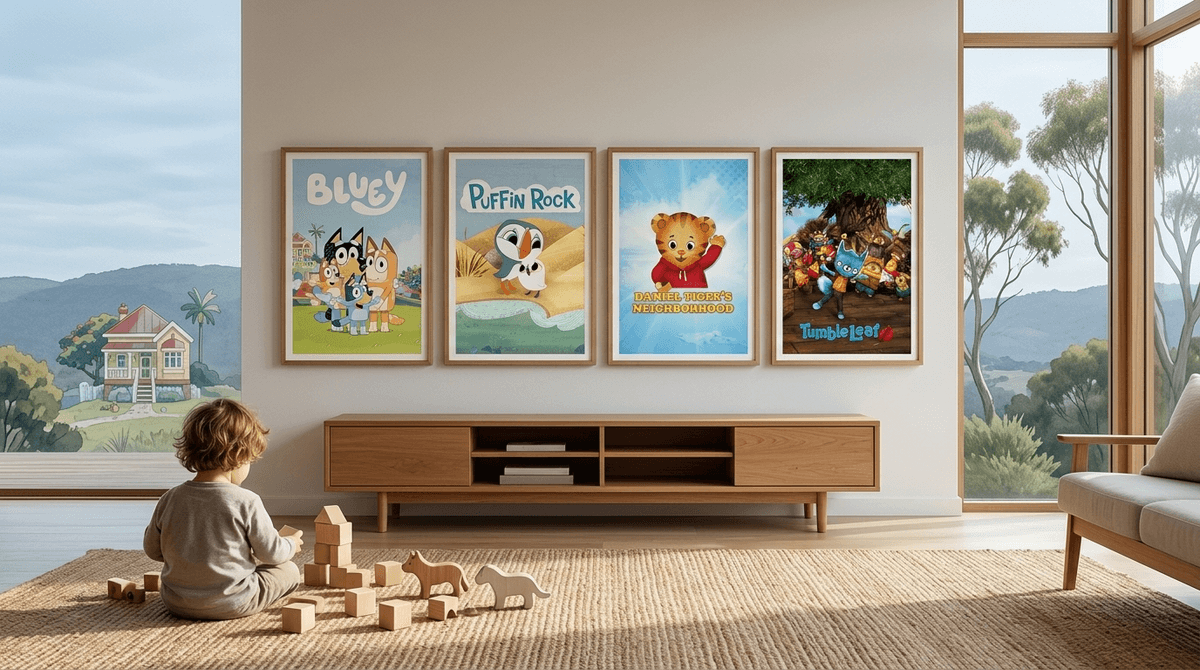
- The GOAT: Bluey (Disney+)
- The Calming Choice: Puffin Rock (Netflix)
- The Emotional Anchor: Daniel Tiger's Neighborhood (PBS Kids)
- The Visual Masterpiece: Tumble Leaf (Amazon Prime)
- The Gentle Giant: Trash Truck (Netflix)
Get a plan to transition your toddler off Cocomelon
We’ve all seen it. Your kid is usually a sweet, functioning human, but ten minutes into Cocomelon, they look like they’ve been hypnotized by a neon-colored cult leader. When the TV goes off, they lose their absolute minds.
There’s actual science behind this. Cocomelon is engineered for maximum stimulation. The camera cuts happen every 1 to 3 seconds. The colors are oversaturated, the music is constant, and the pacing is roughly 10x faster than real life. For a developing brain between ages 2 and 5, this is sensory overload. It’s like feeding them Pixy Stix for breakfast and then wondering why they’re crashing at 10:00 AM.
In the Screenwise community, 68% of parents with toddlers reported that "fast-paced" shows led to significantly worse behavior post-screen time compared to "slow-paced" alternatives. We’re looking for media that mimics the pace of actual play—shows that allow a child’s brain to process a scene before jumping to the next one.
There is a reason Bluey is the undisputed king of modern preschool TV. It isn't just "not bad"—it’s actually good. Like, "I might keep watching this after the kids go to bed" good.
- Why it works: It focuses on imaginative play. The pacing is natural, the humor is genuinely funny for adults, and it models realistic family dynamics (including parents who get tired and frustrated).
- Pro-tip: Use Bluey to transition into real-world play. Most episodes are basically tutorials for games you can play with your kids afterward.
These shows are the equivalent of a warm glass of milk. If your kid is currently "addicted" to high-stim content, these might feel "boring" to them at first. Stick with it. Their brains need to recalibrate.
Narrated by Chris O'Dowd, this show follows a family of puffins on an Irish island. The color palette is muted, the music is acoustic and gentle, and the stories focus on nature and sibling relationships. It is arguably the most soothing show ever made. Read our full guide on why Puffin Rock is the ultimate Cocomelon antidote
Don't let the name fool you. Trash Truck is incredibly sweet. It follows a 6-year-old boy and his best friend (a giant, honking trash truck). The scenes are long, the dialogue is sparse, and the vibe is pure childhood wonder. It’s the visual equivalent of a deep breath.
Based on the "Zen Shorts" book series, this Apple TV+ show features a giant panda who teaches three siblings about mindfulness and emotional regulation. If your kid is prone to "big feelings," this is the one.
If you want the screen to actually do some heavy lifting in the "teaching" department without the "brain rot" factor, look here.
The direct descendant of Mister Rogers' Neighborhood. It uses catchy "strategy songs" to help kids navigate things like sharing, using the potty, or being angry. It’s essentially a social-emotional toolkit disguised as a cartoon. Check out our guide on how to use Daniel Tiger songs for toddler discipline
This is stop-motion animation, which naturally has a slower, more tactile feel than CGI. Fig the Fox discovers an object in a "Finding Place" and explores how it works (physics, shadows, reflections). It’s brilliant, beautiful, and encourages curiosity rather than just passive consumption.
Sometimes the best way forward is to go back. Before the era of "retention editing" and "dopamine loops," kids' shows were just... quiet.
- Little Bear: Maurice Sendak’s masterpiece. No villains, no loud noises, just a bear and his friends.
- Mister Rogers' Neighborhood: The GOAT of slow pacing. Fred Rogers famously spoke directly to the camera, giving kids time to think and respond.
- Frog and Toad: The new Apple TV+ series captures the slow, melancholy, and heartwarming vibe of the original books perfectly.
For the 2-5 age bracket, the American Academy of Pediatrics (AAP) suggests limiting screen time to about one hour of high-quality programming per day. But let's be real: some days you're sick, or you're trying to cook dinner without someone setting the rug on fire, and that hour becomes two.
The "quality" of that hour matters more than the "quantity." One hour of Cocomelon is going to cost you more in behavioral "interest" later than two hours of Puffin Rock.
Community Norms:
- Ages 2-3: Most parents in the Screenwise community stick to 30-45 minutes, usually in the late afternoon "witching hour."
- Ages 4-5: The window often expands to 60-90 minutes, often incorporating more "interactive" or "educational" content like Khan Academy Kids.
If you try to swap Cocomelon for Stillwater cold turkey, your toddler might stage a coup. Here is the play-by-play for a successful detox:
- The "Slow Fade": Start by mixing in one episode of a "slow" show for every episode of the "fast" show.
- The "Bridge" Show: Use Bluey as the transition. It’s engaging enough to keep their attention but slow enough to avoid the "zombie stare."
- Talk About the "Vibe": Say things like, "We’re going to watch a quiet show today because our brains need a rest."
- Remove the Shortcut: Delete the YouTube or YouTube Kids app from your main screen. If they don't see the icon, they're less likely to demand it.
Learn more about the neurobiology of toddler screen addiction
The goal isn't to be a "No Screen Time" parent (unless that's your thing, in which case, godspeed). The goal is to be an intentional parent.
When you choose Tumble Leaf over Cocomelon, you aren't just picking a "better" show. You are choosing to protect your child's attention span. You are choosing a peaceful evening over a post-TV tantrum. You are choosing content that respects your child's intelligence rather than just exploiting their biology for views.
Cocomelon is the "junk food" of the digital world. It’s okay in tiny, rare doses, but as a daily staple, it’s wrecking your kid’s ability to focus and regulate their emotions.
Switching to "slow-paced" media like Puffin Rock, Trash Truck, or Bluey isn't just a "wellness" move—it’s a survival move for you. You’ll get a kid who is more creative, less irritable, and actually knows how to play without a screen in front of them.
- Audit your queue: Go into your Netflix/Disney+/Prime profiles and "Like" the slow-paced shows mentioned above so they show up in the "Recommended" bar.
- Set a "Hard Stop": Use a visual timer so the end of screen time isn't a surprise.
- Take the Survey: Walk through the Screenwise habits survey to see how your family's media use compares to your local community.