

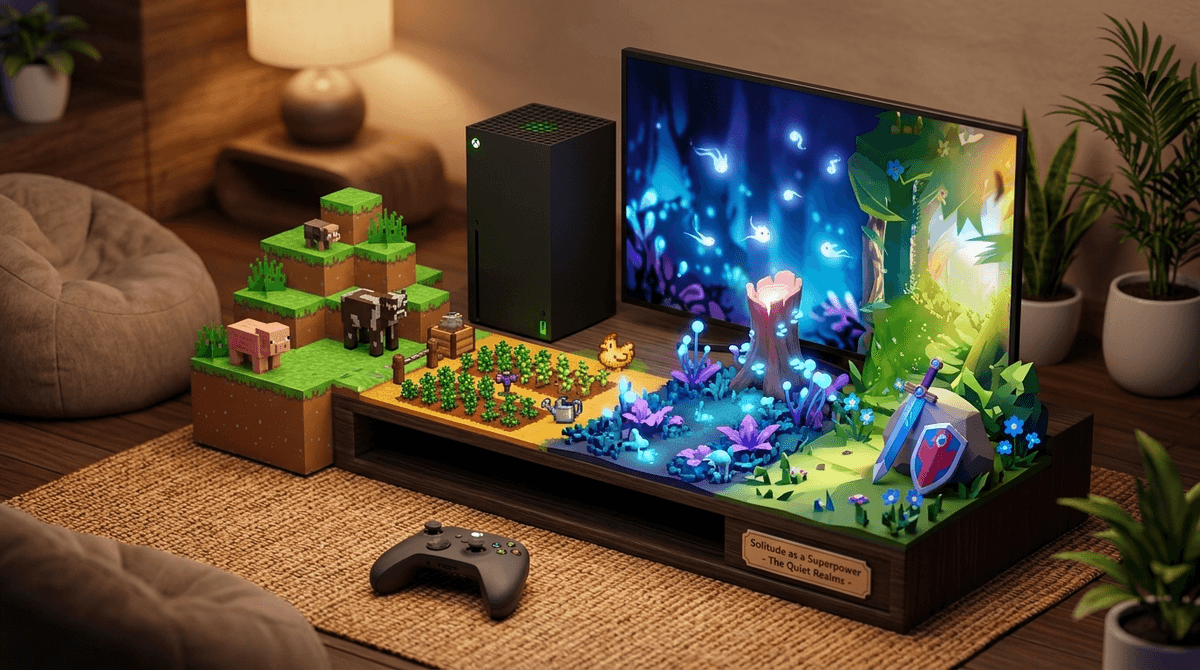
TL;DR: The Quick List
If you're looking to reclaim your living room from the sounds of 12-year-olds yelling "skibidi" in a Fortnite lobby, these are the best solo experiences on Xbox right now:
- Best for Creativity: Minecraft (Creative Mode)
- Best for "Cozy" Vibes: Stardew Valley
- Best for Movie Fans: Lego Star Wars: The Skywalker Saga
- Best for Problem Solving: Tunic
- Best for Pure Joy: Super Lucky's Tale
- Best for Racing: Forza Horizon 5
We’ve all been there. You finally get the kids settled with their Xbox, hoping for twenty minutes of peace to fold laundry or stare into the middle distance, only to hear a string of "trash talk" coming through the headset that would make a sailor blush.
The move toward "Live Service" games—think Roblox or Apex Legends—has turned gaming into a social club. That's fine sometimes, but those games are designed to keep kids in a state of high-arousal FOMO. They are stressful, they are loud, and they are impossible to pause.
Single-player games are the antidote. They allow kids to enter a "flow state"—that focused, quiet immersion where they actually learn to solve problems without the pressure of a ticking clock or a teammate screaming in their ear. Plus, you can actually pause them when dinner is ready.
The Creative Sandbox: Minecraft
I know, it’s the obvious choice. But specifically, Minecraft in Creative Mode (Single Player) is a different beast than the chaotic multiplayer servers. In solo play, it’s basically a bottomless bucket of digital Legos. No one is going to "grief" their house or steal their diamonds. It’s pure architecture and resource management. If your kid is getting burnt out by the social drama of Minecraft, suggest a "Solo World" project.
- Ages: 6+
- Why it works: It fosters spatial awareness and planning.
The Interactive Movie: Lego Star Wars: The Skywalker Saga
The Lego games are the gold standard for stress-free gaming. You can’t really "lose"—if your character breaks, they just pop back up. This specific title covers all nine movies, it’s genuinely funny (even for adults), and it’s massive. It’s a great way for kids to engage with a story they love at their own speed.
- Ages: 7+
- Why it works: It’s low-stakes but high-reward. Great for building confidence in younger gamers who find "Game Over" screens discouraging.
The Cozy Life Sim: Stardew Valley
If your kid likes the idea of Animal Crossing on the Switch, this is the Xbox equivalent (and, honestly, it’s better). They inherit a farm, plant crops, talk to villagers, and explore a cave. There is a day/night cycle, but no one is rushing them. It teaches delayed gratification—you have to plant the seeds and water them for days before you get the payout.
- Ages: 10+ (there is a fair amount of reading involved)
- Why it works: It’s incredibly grounding. It’s the ultimate "wind down" game after a long day of school.
Learn more about why "cozy games" are a parent's best friend

The Epic Adventure: Ori and the Blind Forest
This is one of the most beautiful games ever made. Period. It looks like a hand-painted Disney movie. It’s a platformer, meaning there’s a lot of jumping and navigating obstacles. It can be challenging, but it rewards persistence. It’s a great "intro to art" in gaming.
- Ages: 8+ (it can get a bit emotional/sad in the beginning—think The Lion King vibes)
- Why it works: It builds "grit." Some of the levels require multiple tries, teaching kids that failure is just a step toward winning.
The "Just for Fun" Platformer: Super Lucky's Tale
Think of this as the Xbox version of Mario. You’re a cute fox jumping through colorful worlds. It’s bright, it’s cheerful, and it’s completely devoid of the "edginess" that creeps into so many modern games. It’s pure, old-school platforming fun.
- Ages: 6+
- Why it works: It’s intuitive. Even kids who are new to a controller can pick this up and feel like a pro within ten minutes.
The Logic Puzzle: Tunic
You play as a little fox in a green tunic (very Legend of Zelda). The cool part? The "instruction manual" for the game is scattered throughout the world in pieces. You have to find the pages to learn how to play. It’s a brilliant way to encourage reading and deductive reasoning.
- Ages: 9+
- Why it works: It treats the player like they’re smart. It doesn’t hold their hand, which makes the "Aha!" moments feel incredible.
We need to talk about the physiological difference between Fortnite and a single-player game like Forza Horizon 5.
In a multiplayer lobby, your child’s nervous system is on high alert. They are being judged by peers, they are reacting to unpredictable human behavior, and—most importantly for your sanity—they cannot stop. When you yell "Dinner!" and they scream "I can't pause it!", they aren't actually lying. If they leave, they let their team down or lose "rank."
In a single-player game, the child is in control of the pace. They can explore a corner of the map for an hour, or they can rush through the story. When you say it's time to turn it off, they can hit "Save" and "Quit." It lowers the friction of transitions, which is where 90% of screen-time arguments happen.
Check out our guide on managing screen time transitions without the meltdown
Xbox Game Pass: The Parent's Cheat Code
If you have an Xbox, you probably already know about Xbox Game Pass. If you don't, it’s basically Netflix for games. For a monthly fee, you get access to hundreds of titles. The Pro-Tip: Use Game Pass to let your kids "audition" games. If they download a game and it’s too hard or too boring, they can just delete it and try another without you wasting $60. Most of the games I mentioned above (like Ori, Minecraft, and Forza) are usually on there.
The "Offline" Setting
Even in single-player games, the Xbox might show your kid as "Online" to their friends. This can lead to friends spamming them with "Join my party!" invites while they’re trying to enjoy their solo adventure. Next Step: Go into the Xbox settings and set their status to "Appear Offline." This gives them the "social permission" to just play by themselves without feeling like they’re snubbing their friends.
You’d think single-player games would be safe from the "Can I have $10 for a skin?" requests. Usually, they are. However, some games (especially sports titles or games like Minecraft) still have "Marketplaces."
- Minecraft: Has a store for maps and skins.
- Ubisoft Games: Often have "time-saver" packs you can buy. The best defense here is a locked-down Microsoft account. Ensure your credit card requires a passkey for every single purchase, no matter how small.
If your kid is used to the high-octane world of Roblox, they might initially find single-player games "boring." That's actually the point. Their dopamine receptors are a bit fried.
Try framing it as a "Deep Work" challenge: "Hey, I noticed that you get really frustrated when people leave your lobby in Among Us. Why don't we try a game where you're the boss of the whole world? Check out Planet Coaster and see if you can build a theme park that actually makes money."
Single-player games aren't just "not bad"—they are actively good for developing focus and autonomy. They turn the Xbox from a loud, social pressure cooker into a tool for quiet exploration and creative problem-solving.
If your home feels like it’s being held hostage by the "online lobby," it might be time to steer the ship toward a solo adventure. It’s quieter, it’s more creative, and—blessedly—it has a pause button.
Find Xbox games for a 10-year-old who loves animals and building