

Look, we all want our kids to read good books. But when you're standing in the library or scrolling through Amazon at 11pm trying to find something that'll actually hold your kid's attention, "good" feels pretty vague.
That's where book awards come in. The Newbery Medal, Caldecott Medal, Coretta Scott King Award, and others aren't just shiny stickers—they're signals that librarians, educators, and children's literature experts think a book is genuinely excellent.
But here's the thing: award-winning doesn't automatically mean your kid will love it. A Newbery winner might be brilliant literature and also make your 8-year-old want to fake a stomachache to avoid reading time. And that's okay! The goal is finding the sweet spot between quality and "actually wants to read it."
Awards matter because they help you cut through the noise. There are literally thousands of kids' books published every year. The Newbery, Caldecott, and other major awards do the heavy lifting of identifying books with:
- Strong writing that doesn't talk down to kids
- Important themes handled thoughtfully
- Diverse perspectives and authentic representation
- Staying power beyond whatever's trending on BookTok
But awards don't matter because your kid doesn't care about a shiny sticker. They care if the book is funny, exciting, relatable, or has a dragon in it. Some award winners are absolute page-turners (The One and Only Ivan, New Kid). Others are more "eat your vegetables" reading that's good for you but kind of a slog.
The sweet spot? Use awards as a starting point, not a mandate.
Newbery Medal (Chapter Books & Middle Grade)
Given to the most distinguished American children's book each year. These tend to be for ages 8-12, though some skew older or younger.
Recent winners that actually slap:
- The Last Cuentista by Donna Barba Higuera (sci-fi + folklore, ages 9-13)
- When You Trap a Tiger by Tae Keller (magical realism, ages 8-12)
- Merci Suárez Changes Gears by Meg Medina (realistic fiction, ages 9-12)
Classic Newberys that hold up:
- Bridge to Terabithia (yes, it's sad, no, you can't skip it)
- The Giver (dystopian before dystopian was everywhere)
- Holes (genuinely fun to read)
Caldecott Medal (Picture Books)
For the most distinguished picture book art. These are typically ages 3-8, but honestly, good picture books are ageless.
Recent standouts:
- The Undefeated illustrated by Kadir Nelson (stunning art, powerful text)
- Hello Lighthouse by Sophie Blackall (wordless wonder)
- Last Stop on Market Street illustrated by Christian Robinson (everyday beauty)
Coretta Scott King Awards
Celebrating outstanding books by African American authors and illustrators. These consistently deliver both quality and representation.
Must-reads:
- Genesis Begins Again by Alicia D. Williams (colorism, self-love, ages 10+)
- The Undefeated by Kwame Alexander (also a Caldecott winner)
- Anything by Jacqueline Woodson—seriously, she's incredible
Pura Belpré Award
Honoring Latinx authors and illustrators. Essential for building a diverse home library.
Start here:
- Efrén Divided by Ernesto Cisneros (immigration, family, ages 9-12)
- Islandborn by Junot Díaz (picture book about memory and home)
National Book Award for Young People's Literature
Often more literary, sometimes more challenging, always thought-provoking.
Recent winners:
- The Poet X by Elizabeth Acevedo (YA novel in verse, ages 13+)
- The Kingdom of Back by Marie Lu (historical fantasy about Mozart's sister)
Picture Books (Ages 3-8)
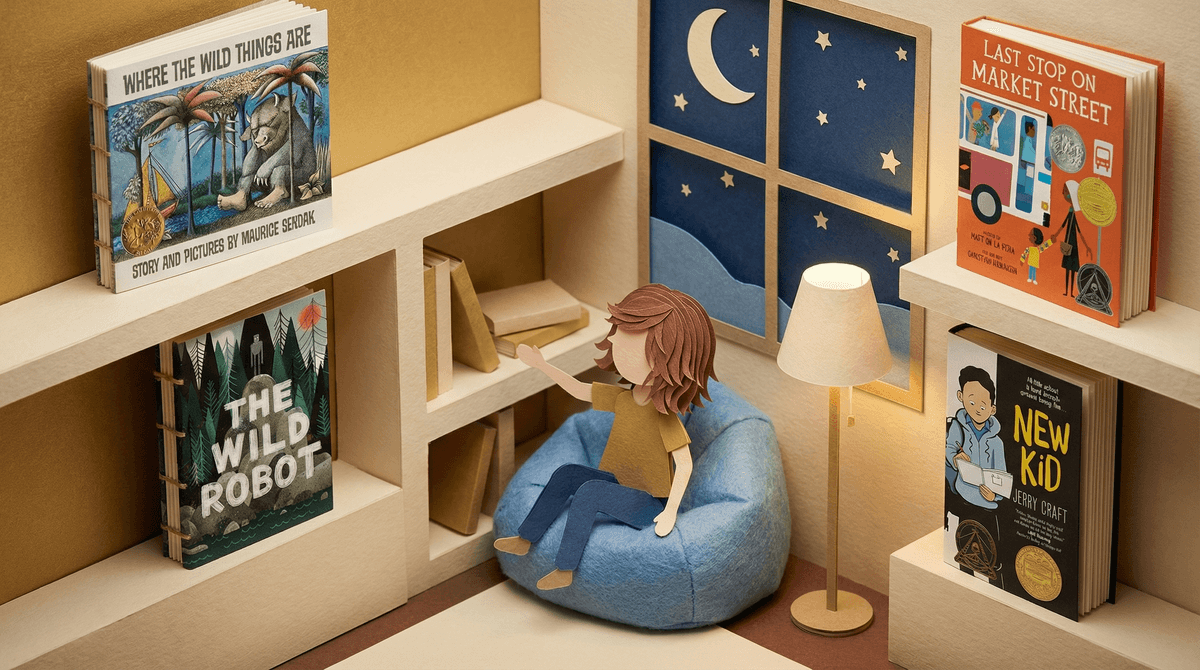
Start with Caldecott winners and honor books. The art is guaranteed to be gorgeous, and most have themes worth discussing. Where the Wild Things Are is a Caldecott winner for a reason—it's about anger and imagination and coming home, all in 48 pages.
Early Chapter Books (Ages 6-9)
Look for Newbery Honor books (the runners-up) in this age range. Ramona Quimby, Age 8 is a classic honor book that's actually funny and relatable.
Middle Grade (Ages 8-12)
This is where Newbery winners really shine. But pay attention to themes—some tackle heavy stuff like death, racism, or war. That's not bad! But you want to know what you're getting into. Number the Stars is an incredible Holocaust story for this age, but it's not light bedtime reading.
Young Adult (Ages 12+)
National Book Award and Printz Award winners are your friends here. But YA award winners can get dark and deal with mature themes (abuse, sexual assault, addiction). Again, not bad—just be aware. The Hate U Give is essential reading, but it deals with police violence.
Award-winning ≠ easy reading. Many award winners are chosen for literary merit, which sometimes means challenging vocabulary, complex themes, or slower pacing. If your kid is a reluctant reader, you might need to balance award winners with high-interest books that aren't winning any prizes but get them turning pages.
Representation matters, and awards are catching up. For decades, award-winning books were overwhelmingly white. That's changing, but slowly. If you want diverse books, specifically seek out the Coretta Scott King, Pura Belpré, and Asian/Pacific American Awards. Don't just grab random Newberys from the 1970s and hope for the best.
Honor books are often more accessible than winners. The medal winner is chosen as the most distinguished, which can mean "most literary" or "most ambitious." Honor books (the runners-up) are often just as good but more kid-friendly.
Your library's list is your best friend. Most libraries have curated lists of award winners by age range. Librarians are genuinely excited to help you find books your kid will actually read—use them!
You don't need every award winner. But having a mix of award-winning books alongside whatever your kid is obsessed with (Dog Man, Wings of Fire, whatever) sends the message that reading is both fun and important.
Start with these crowd-pleasers:
- Where the Mountain Meets the Moon by Grace Lin (Newbery Honor, fantasy adventure)
- The Wild Robot by Peter Brown (not an award winner but beloved, and the sequels are great)
- Brown Girl Dreaming by Jacqueline Woodson (Newbery Honor, memoir in verse)
- The Girl Who Drank the Moon by Kelly Barnhill (Newbery Medal, magical and weird)
For reluctant readers:
- New Kid by Jerry Craft (Newbery Medal, graphic novel)
- El Deafo by Cece Bell (Newbery Honor, graphic memoir)
- Front Desk by Kelly Yang (Asian/Pacific American Award, page-turner)
Award-winning books are a fantastic tool for building a quality home library, but they're not a requirement for raising readers. The best book for your kid is the one they'll actually read.
Use awards as a filter to find well-written, thoughtfully crafted books. Then let your kid's interests guide you from there. If they love the Newbery-winning When You Reach Me, great! If they'd rather read Diary of a Wimpy Kid for the 47th time, that's also fine. Reading is reading.
And hey, if you want to dig deeper into specific awards or get personalized recommendations based on what your kid already loves, check out our book recommendation tool—because nobody has time to read every award winner to figure out which ones are actually good.
- Ask your librarian for a list of award winners in your kid's age range and reading level
- Read together for the first chapter or two of a new award winner to see if it hooks them
- Mix it up—balance award winners with high-interest books, graphic novels, and whatever they're genuinely excited about
- Talk about what makes a book "good" beyond just being fun—help them develop their own taste
Explore our full guide to building a home library for more practical tips on creating a reading culture at home.