

Let's talk about something that matters more than we sometimes realize: who kids see on screen. And specifically, whether Asian kids (and all kids, really) are seeing authentic, nuanced Asian characters in their media diet—or just the same tired stereotypes that have been recycled since the 90s.
This isn't about being the "representation police" or making sure every show ticks diversity boxes. It's about the fact that what kids watch shapes how they see themselves and others. When Asian kids only see themselves as the nerdy sidekick or the martial arts expert, that's limiting. When non-Asian kids only see those portrayals, that's how stereotypes get reinforced for another generation.
The good news? There's been real progress in the last few years. The not-so-great news? You still have to be intentional about finding it, because Netflix's algorithm isn't exactly prioritizing diverse storytelling over whatever gets the most clicks.
Here's the thing: representation isn't just feel-good stuff. Research shows that kids who see themselves reflected in media have higher self-esteem and better cultural identity development. And kids who see diverse characters in non-stereotypical roles? They develop more nuanced understanding of people different from them.
But here's what makes this tricky: not all representation is created equal. A show can have an Asian character and still be serving up harmful stereotypes. The difference between authentic representation and tokenism matters—and as parents, we need to be able to spot the difference.
Some things to watch for:
- Are Asian characters the main character, or always the sidekick?
- Do they have personality traits beyond "good at math" or "strict parents"?
- Are they voiced by Asian actors? (This matters more than you might think)
- Is their Asian identity part of their story, or their entire story?
The sweet spot is characters who are Asian AND fully realized people with their own arcs, flaws, and interests.
Let's get specific, because "good representation" can feel abstract.
For younger kids (Ages 4-8):
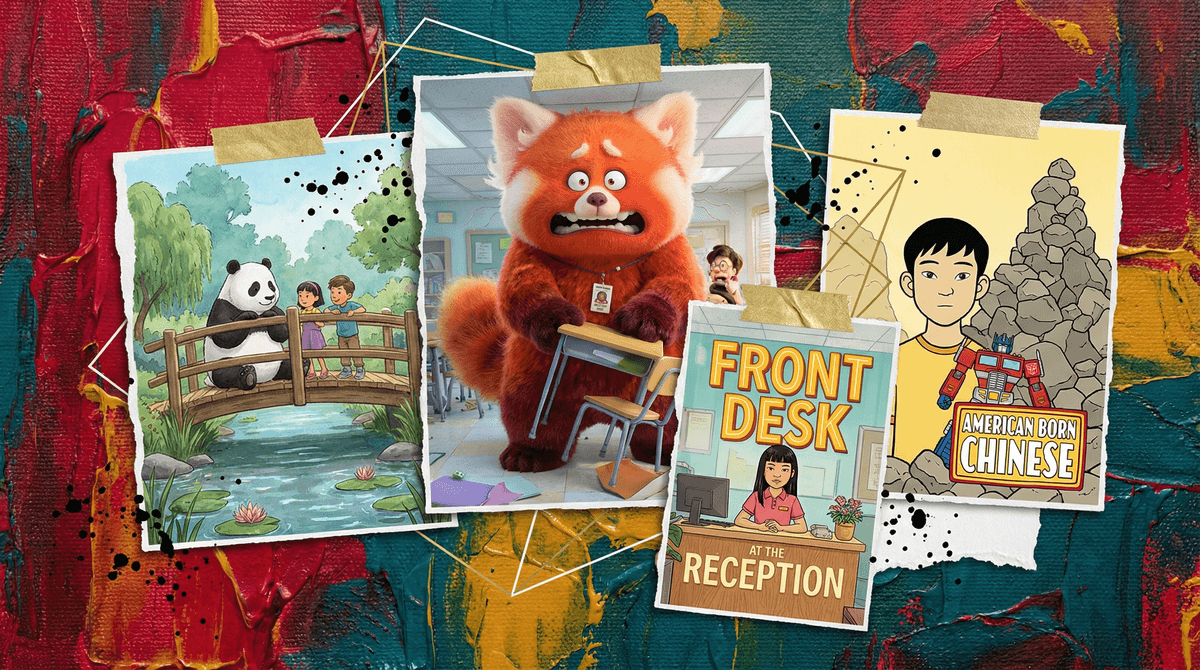
Turning Red is basically the gold standard here. Meilin Lee is a Chinese-Canadian girl dealing with puberty, family expectations, and turning into a giant red panda. Her Asian identity is central to the story, but she's also just... a kid. A messy, complex, fully realized kid. The cultural details are specific and authentic (the movie is set in Toronto's Chinese community), and the themes are universal.
Raya and the Last Dragon draws from Southeast Asian cultures and gives us a badass female protagonist on a hero's journey. Is it perfect? No—some critics noted it blends multiple cultures in ways that feel more "pan-Asian" than specific. But it's visually stunning and centers Asian characters in an adventure story, which matters.
For shows, Stillwater on Apple TV+ is quietly excellent—a gentle panda who teaches mindfulness to a diverse group of kids. It's based on Jon J Muth's books and incorporates Zen philosophy without being preachy.
For middle grade kids (Ages 8-12):
Shang-Chi and the Legend of the Ten Rings gives us a Marvel superhero origin story centered on a Chinese-American family, with actual depth to the father-son relationship and martial arts sequences that aren't just "Asian people know kung fu."
The Percy Jackson Disney+ series cast Leah Sava Jeffries (who's Black) as Annabeth, and while that sparked some predictable internet drama, it's exactly the kind of casting that shows kids that heroes can look different from the books. The show also features diverse casting throughout that feels natural, not forced.
For something lower-stakes, The Ghost and Molly McGee features Molly, a Thai-American protagonist whose ethnicity is just part of who she is—not her entire personality.
For teens (Ages 13+):
Everything Everywhere All at Once is rated R but many families with older teens watched it together. It's a wild multiverse adventure that's also a deeply specific story about a Chinese immigrant family running a laundromat. It won Best Picture for a reason.
Never Have I Ever centers on an Indian-American teen (South Asian representation matters too!), and while it's primarily a comedy, it deals with grief, cultural identity, and the immigrant experience with real nuance.
Let's be real about what we're trying to avoid:
The "Model Minority" trap: The character who's only defined by academic success, plays violin, has tiger parents. This seems positive but it's limiting and puts pressure on Asian kids to fit this mold.
Martial arts as personality: Not every Asian character needs to know karate. Shocking, I know.
The perpetual foreigner: Characters with heavy accents who are always explaining their "exotic" culture to white characters. Or worse, characters who are Asian-American but treated as if they just arrived yesterday.
Lack of romantic storylines: Asian characters (especially Asian men) are often desexualized in media. Teens notice this.
The tech genius/nerd sidekick: Again, seems positive, but when it's the ONLY role Asian characters get, it's a problem.
The conversation looks different depending on age:
For younger kids (under 8): Keep it simple. "Have you noticed that Meilin's family is Chinese? What do you think about her relationship with her mom?" You're just planting seeds of media literacy.
For elementary age (8-12): Start asking questions. "Who are the main characters in this show? What do you notice about them? Do you think this character is realistic?" You can introduce the concept of stereotypes in age-appropriate ways.
For teens: Have real conversations. "Do you think this portrayal feels authentic? Why or why not? How does this compare to other Asian characters you've seen?" Teens can handle nuance and critique.
One thing that helps: talk about representation across different groups , not just Asian representation. It's all connected—when kids understand why diverse storytelling matters broadly, they get better at spotting problems and appreciating good representation.
Don't sleep on books, where representation has actually been ahead of screen media in some ways:
- Gene Luen Yang's graphic novels (American Born Chinese, Dragon Hoops) are incredible for middle grade and up
- Kelly Yang's Front Desk series for elementary readers
- Chloe Gong's These Violent Delights for teens who want fantasy/romance
- Marie Lu's Legend series for dystopian sci-fi fans
The advantage of books? Kids can imagine the characters however they want, and Asian authors are telling their own stories without Hollywood gatekeepers.
Here's what matters: representation is getting better, but you still need to be intentional about seeking it out. The default algorithm isn't going to serve you the most diverse content—it's going to serve you what's popular, and what's popular still skews pretty white.
But when you do find authentic, nuanced Asian characters and stories? Watch them with your kids. Talk about them. Support them. Because every time a movie like Turning Red succeeds, it makes it easier for the next one to get made.
And if you're not Asian? This still matters for your family. Your kids are growing up in a diverse world, and they need to see that diversity reflected in their media. They need to see Asian kids as main characters, as heroes, as complex people—not as stereotypes or sidekicks.
Start here:
- Audit what your kids are currently watching—are there Asian characters? Are they main characters or sidekicks? Are they fully realized people?
- Add one new show or movie from this list to your family rotation
- Have a casual conversation about representation the next time you watch something together
- Follow diverse creators and critics—they'll point you toward good content and call out problems faster than any algorithm will
Want to dig deeper? Learn more about talking to kids about stereotypes in media or explore more diverse family-friendly content.
The goal isn't perfection—it's progress. And it's making sure that all kids, regardless of their background, see themselves as the heroes of their own stories.