

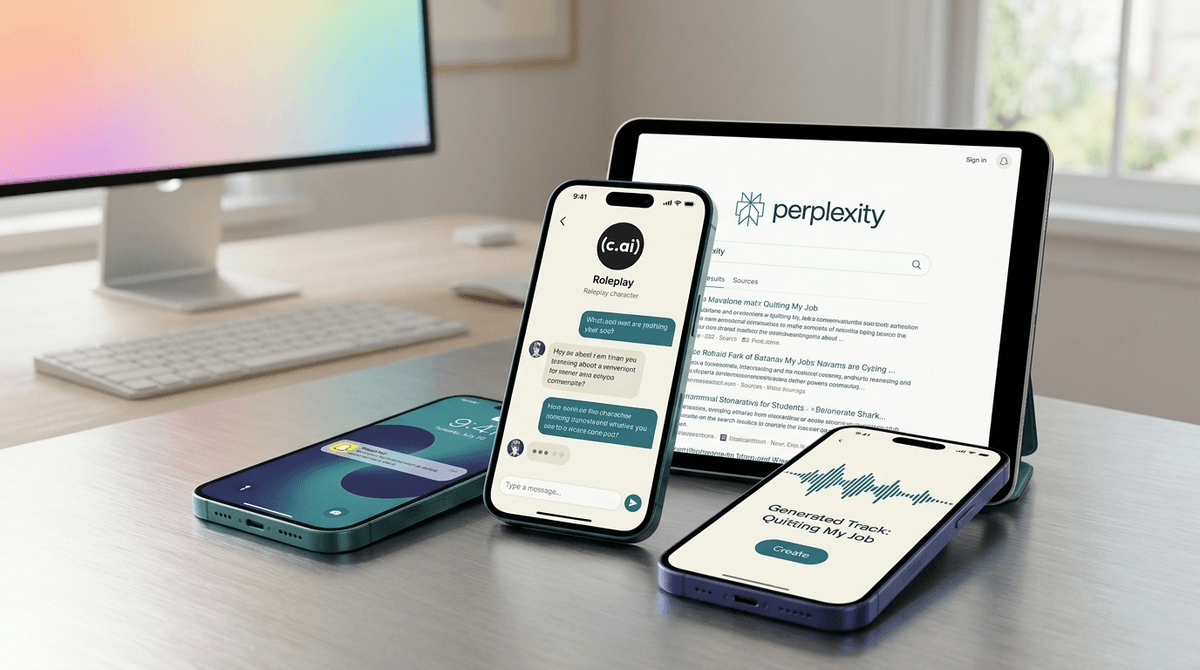
TL;DR: While we’ve been worrying about ChatGPT writing their history essays, kids have moved on to much weirder, more immersive AI. They’re roleplaying with fictional characters on Character.ai, treating Snapchat MyAI like a digital therapist, and using Perplexity to replace Google entirely.
Quick Links to what they're actually using:
- The Roleplay King: Character.ai
- The Built-in Bestie: Snapchat MyAI
- The "New Google": Perplexity
- The Homework Helper: Photomath
- The Creative Powerhouse: Canva Magic Studio
- The Instant Hit-Maker: Suno AI
If you think AI is just a chatbot that writes poems or summarizes Wikipedia, you’re looking at the 2023 version of the world. For kids today, AI isn't a tool they "use"—it's an environment they live in. It’s the NPC in Roblox that actually talks back, the "friend" at the top of their Snapchat feed, and the creative partner that helps them make a viral TikTok edit in thirty seconds.
We’ve moved from "Generative AI" (making stuff) to "Relational AI" (talking to stuff). This shift is where things get interesting—and a little complicated—for parents.
Ask our chatbot about the difference between generative and relational AI
It’s not just about laziness or "cheating." Kids are drawn to these tools because they offer three things the physical world often doesn't:
- Infinite Patience: An AI doesn't get annoyed if you ask "why" 400 times.
- Zero Judgment: You can practice a difficult conversation or explore a niche hobby without a peer (or a parent) making it "weird."
- Total Customization: They can build a world where they are the main character, literally.
This is the one you probably haven't heard of, but your teen definitely has. It allows users to chat with "characters" created by other users. These range from Harry Potter to "Toxic Boyfriend" personas to historical figures like Napoleon.
- Why they use it: It’s digital fanfiction come to life. They aren't just reading about their favorite characters; they’re "texting" them.
- The Screenwise Take: It’s incredibly addictive because the AI is designed to be high-emotion. It’s not "smart" like ChatGPT; it’s "dramatic."
- Age Range: 13+ (but heavily used by middle schoolers).
If your kid is on Snapchat, they have a chatbot pinned to the top of their chat list. They can't delete it (unless they pay for Snapchat+), and it knows their location if they’ve shared it with the app.
- Why they use it: It’s convenient. They’re already in the app. They ask it for gift ideas, to settle bets, or just to vent when friends aren't responding.
- The Screenwise Take: It’s the "gateway drug" to AI companionship. It’s mostly harmless but can give questionable advice on sensitive topics.
Google is increasingly full of ads and SEO-optimized junk. Perplexity is a "search engine" that just gives you the answer in a clean paragraph with citations.
- Why they use it: It’s faster for homework research. Instead of clicking five links, they get one cohesive answer.
- The Screenwise Take: This is actually a great tool for digital literacy because it shows its sources. It teaches kids to verify where information comes from.
This isn't new, but its AI has become terrifyingly good. You point your camera at a math problem—even a word problem—and it solves it step-by-step.
- Why they use it: To get through math homework in 5 minutes.
- The Screenwise Take: It’s a double-edged sword. Great for when they’re stuck and you don't remember algebra; terrible if they’re just copy-pasting answers without learning the "why."
You type "A 90s grunge song about a cat who lost its hat," and thirty seconds later, you have a radio-quality track.
- Why they use it: For memes, birthday messages, and creative projects.
- The Screenwise Take: It’s pure creative play. It’s the GarageBand of the AI era, making music production accessible to everyone.
Learn more about how AI is changing homework
Ages 8-12: The Explorers
At this age, AI should be a collaborative tool, not a solo activity.
- Focus on: Creative tools like Canva or Scratch.
- The Boundary: Avoid "companion" bots like Character.ai. Kids this age are still developing the cognitive ability to distinguish between simulated empathy and real human connection.
Ages 13-15: The Power Users
This is when they’ll start using AI for social and academic heavy lifting.
- Focus on: Efficiency and Ethics. Talk about "hallucinations" (when AI lies confidently).
- The Boundary: Privacy. Remind them that anything they tell Snapchat MyAI is being recorded and used to train models. It is not a "private" diary.
Ages 16+: The Professionals
Teens are using AI to build resumes, edit videos, and even code simple apps.
- Focus on: Critical thinking. If they use ChatGPT to draft a cover letter, is it actually "them"?
- The Boundary: Academic integrity policies at their specific school.
Let’s be real: the biggest risk isn't "The Terminator." It’s much more subtle.
- Privacy is Dead (Almost): These companies are data-hungry. If your kid is pouring their heart out to a roleplay bot, that data is living on a server somewhere.
- The Hallucination Problem: AI is a "vibe" machine, not a fact machine. It will lie to your child’s face about the Great Depression if it thinks that’s what they want to hear.
- Emotional Displacement: If a kid spends 4 hours a day talking to a bot that is programmed to never disagree with them, real-life friendships (which involve conflict and compromise) start to feel "hard."
Check out our guide on AI and teen mental health
Don't start with "I heard you're using AI to cheat." That’s a conversation killer.
Instead, try these:
- "I saw this song made by Suno and it's actually kind of a bop. Have you tried making anything with it?"
- "I’m trying to use Perplexity instead of Google because the ads are getting annoying. What do you use when you need to find something fast?"
- "I read that people are roleplaying with characters on Character.ai. Is that actually fun or is it just weird?"
The Goal: You want to be the person they come to when the AI says something creepy or when they aren't sure if using it for a project is "allowed."
AI isn't a "phase" like Fidget Spinners or Among Us. It’s the new electricity.
Our job isn't to ban it—that’s impossible and honestly, it puts them at a disadvantage. Our job is to be the "human in the loop." We need to provide the context, the ethics, and the emotional reality that a large language model simply cannot simulate.
Next Steps:
- Audit the Phone: Check if Snapchat MyAI is active and what your kid has been asking it.
- Play Together: Sit down and try to make a song on Suno or a silly image on Canva.
- Set the Standard: Talk about your own use of AI at work. Are you using it to be more creative, or just to do less work? They’re watching you.
Ask Screenwise for a personalized AI safety plan for your family