

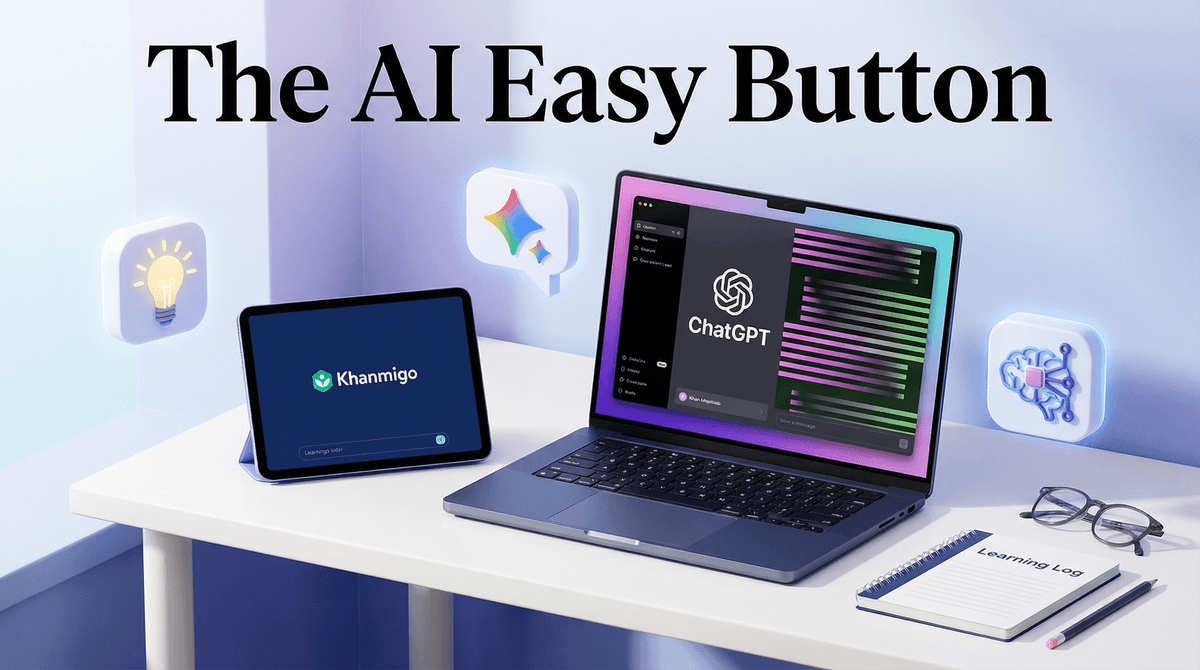
TL;DR: AI in elementary school is moving faster than school board policies. It’s not just about cheating on a book report for The Wild Robot; it’s about kids using ChatGPT as a 24/7 tutor, a creative partner, and sometimes, a way to bypass the hard work of thinking. The goal isn't to ban it (spoiler: you can't), but to move from "Easy Button" to "Learning Partner."
Quick Links for AI & Learning:
If you feel like AI came out of nowhere and hit elementary schools like a freight train, you’re not alone. We went from "no calculators in math class" to "here is a chatbot that can write a 5-paragraph essay on the life cycle of a frog in six seconds."
When we talk about AI for 3rd-5th graders, we’re mostly talking about Generative AI. These are tools like ChatGPT or Microsoft Copilot that don't just "search" the internet; they create content based on patterns they’ve learned.
Think of it like a super-powered version of the autocomplete on your phone. It’s not "thinking," but it’s incredibly good at predicting what words should come next. In a school context, this means it can brainstorm ideas for a story, explain long division in five different ways, or—if we’re not careful—just do the homework for them.
If you’ve heard your kid call something "Ohio" (meaning weird or cringe) or talk about "Sigma" energy, they are already swimming in a digital culture that moves at the speed of light. AI fits right into that.
Kids love AI because it provides instant gratification.
- The "Stuck" Solver: If they’re staring at a blank page for a creative writing assignment, ChatGPT can give them ten ideas for a story about a taco that goes to space.
- The Weirdness Factor: They can use Character.ai to "talk" to a fictional version of Harry Potter or a sentient piece of cheese.
- The Power Dynamic: For the first time, kids have a "servant" that knows everything and never gets tired of their questions.
But here’s the reality: about 30% of upper elementary students have already experimented with some form of AI, often without their parents even realizing it. They aren't necessarily trying to "cheat"—they're just using the most efficient tool available to them.
The biggest risk in elementary school isn't "Skynet" taking over; it’s cognitive atrophy.
If a 4th grader uses AI to summarize a chapter of Percy Jackson instead of reading it, they aren't building the "reading muscles" they need for middle school. This is the "Easy Button" trap.
However, AI can also be a "Learning Partner."
- Scenario A (Easy Button): "Write a poem about a cat for me."
- Scenario B (Partner): "I wrote this poem about a cat. Can you give me three suggestions to make it sound more mysterious?"
Learn more about the difference between AI assistance and AI cheating
If you're going to let your kid explore AI, steer them toward tools designed with guardrails.
This is the gold standard for AI in education. Unlike ChatGPT, which just gives the answer, Khanmigo acts like a Socratic tutor. If a kid asks, "What's the answer to 12 x 15?" Khanmigo says, "Well, let's break it down. What's 12 x 10?" It’s brilliant, it’s safe, and it’s built for learning.
Elementary kids love making posters and presentations. Canva’s AI tools allow them to generate images from text prompts. It’s a great way to talk about AI bias (e.g., "Why does the AI always draw a scientist as an old man with white hair?") and creative prompting.
While not a "chatbot," Scratch is essential for AI literacy. It teaches the logic of "If/Then" statements. Understanding how code works helps kids realize that AI isn't "magic"—it’s just math and instructions.
If your kid is doing a research project, Perplexity is a "search engine" style AI that actually cites its sources. It’s a great way to teach them to double-check facts.
Most AI tools (including ChatGPT and Gemini) have an official age limit of 13+. However, many school districts are integrating these tools via "walled garden" versions.
Privacy is the #1 concern. Elementary kids should never put personal information into an AI. No names, no school names, no "my teacher Mrs. Smith is mean" rants. AI models "learn" from what you tell them, and that data can be stored indefinitely.
The "Hallucination" Factor. AI lies. A lot. It will confidently tell your 5th grader that George Washington invented the iPad if the prompt is weird enough. We have to teach kids that AI is a confident bullsh*tter.
You don't need to be a computer scientist to guide your kid through this. You just need to be curious.
- The "Under the Hood" Talk: Explain that the AI is just a very fast guesser. It doesn't "know" things; it predicts words.
- The "Work vs. Shortcut" Talk: Ask them, "If you use AI to do this, what part of your brain are you skipping?"
- The "Fact-Check" Challenge: When the AI gives an answer, make it a game to find a "real" source (like a book or a trusted website) that proves it’s right.
There is a lot of talk about "brain rot" content on YouTube (looking at you, Skibidi Toilet). AI can fall into this category if it's used for mindless consumption. If your kid is just generating endless AI images of "Sigma Wolves," that’s digital junk food.
But if they are using it to build a world for their Dungeons & Dragons campaign, that’s high-level creative play. The "Wise" move is to focus on the intent of the usage.
AI is the new calculator. In the 80s, teachers were terrified kids would forget how to do math. Instead, we just started doing harder math.
In elementary school, our job isn't to block the AI "Easy Button," but to make sure our kids know they are still the ones in the driver's seat. We want them to be AI Literate, not AI Dependent.
Next Steps for Intentional Parents:
- Play with it together. Sit down and ask ChatGPT to write a story in the style of Dog Man. Talk about what it got right and what it got wrong.
- Check school policies. Ask your child’s teacher how they are handling AI. Many schools are still in "wait and see" mode.
- Set boundaries. Use AI for brainstorming and explaining, but keep "final drafts" as human-only zones.