

TL;DR: The Quick Hits
If you’re just looking for the "Gold Standard" games that won't make you regret buying the console, here are the top picks for each:
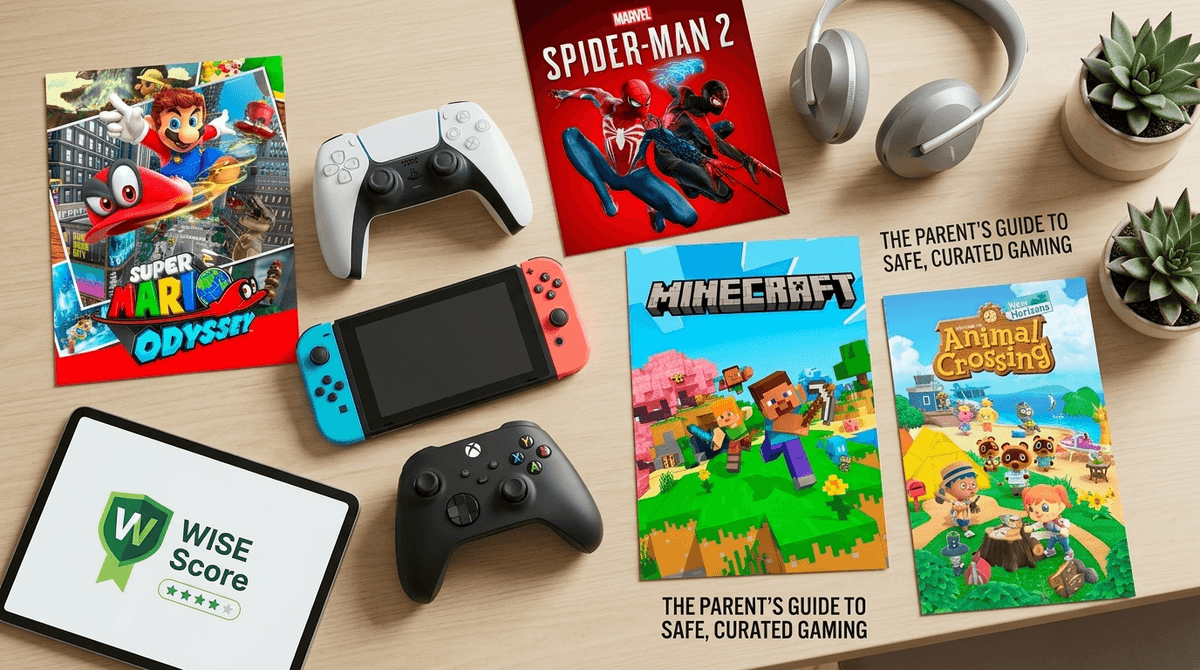
- Nintendo Switch: Super Mario Odyssey (Ages 6+), Animal Crossing: New Horizons (Ages 7+), and Bluey: The Videogame (Ages 4+).
- PlayStation 5: Ratchet & Clank: Rift Apart (Ages 10+), Astro’s Playroom (Ages 6+), and Spider-Man 2 (Ages 12+).
- Xbox Series X/S: Minecraft (Ages 8+), Forza Horizon 5 (Ages 7+), and Sea of Thieves (Ages 11+ with supervision).
Ask our chatbot for a custom list based on your kid's specific interests
The "console wars" used to be about which hardware was more powerful, but for parents in 2026, the war is really about which ecosystem is going to be the biggest headache to manage.
One day you’re buying a "cute" game about a goat, and the next day your seven-year-old is asking why the goat is performing a ritual to summon a demon. Or worse, they’ve discovered Roblox and suddenly your credit card statement looks like a venture capital fund for a nine-year-old’s digital "entrepreneurship" (read: buying hats for a pixelated avatar).
Choosing the right games isn't just about checking the ESRB rating on the box. It’s about understanding the vibe, the social pressure, and whether the game is actually "quality" or just interactive brain rot designed to keep them clicking for dopamine hits.
The Switch is the undisputed king of the family room. It’s built for kids, but that doesn't mean everything on the eShop is sunshine and rainbows.
This is arguably the best "first real game" for a kid. It’s creative, it’s forgiving, and it actually rewards exploration rather than just fast reflexes. If your kid finds it too hard, there’s an "Assist Mode" that literally points them where to go. It’s the antithesis of brain rot—it’s pure, high-budget joy.
If your kid wants a "cozy" experience, this is it. It teaches patience (because things happen in real-time) and basic economics. Warning: If they start visiting other people's islands online, that's where the social safety stuff kicks in. Keep the "Best Friends" list limited to people you actually know.
For the 10+ crowd, this is basically a physics and engineering degree disguised as an adventure. They have to build machines to solve puzzles. It’s brilliant. If your kid is saying their creations are "Ohio" (meaning weird or cringe), it usually means they tried to build a flying car and it ended up looking like a pile of wood.
The PS5 is usually what kids want when they start feeling "too old" for Nintendo (even though they aren't). It’s the home of cinematic, high-intensity games.
This comes pre-installed on every PS5. It’s free, it’s short, and it’s genuinely one of the best platformers ever made. It’s a great litmus test: if they can handle the controls here, they’re ready for the bigger titles.
Think of this as playing through a Pixar movie. It’s high-action but stays within the "cartoon violence" realm. It’s a great bridge for kids who want something that looks "realistic" without the gritty trauma of M-rated games.
This is the "cool" game. It’s rated Teen, and for good reason—there’s some heavier emotional themes and more intense combat. But for a middle-schooler, it’s a masterclass in storytelling. Just be prepared for them to spend three hours just swinging around the city instead of doing the missions.
Xbox’s biggest selling point is Xbox Game Pass. For a monthly fee, they get access to hundreds of games. It’s great for the "I’m bored" syndrome, but it requires more curation because they can download anything in the library.
You already know Minecraft. It’s digital LEGOs. On Xbox, it runs beautifully. The main concern here isn't the game itself—it's the "Marketplace" where they can spend real money on skins and maps, and the "Servers" where they might encounter older players.
The best racing game on the market, period. It’s beautiful, it’s open-world, and it’s surprisingly educational about cars and geography (it’s set in Mexico). It’s a "safe" game that still feels incredibly high-tech and adult.
This is a pirate simulator. It’s gorgeous and hilarious, but heads up: it is strictly an online multiplayer game. You will run into other players who might be "toxic" (gaming speak for "being a jerk"). Nintendo is safer for solo play; Xbox is where the social complexity ramps up.
We hear the term "brain rot" thrown around a lot (usually in reference to Skibidi Toilet or infinite scroll TikToks). In gaming, brain rot looks like low-effort, ad-heavy mobile ports or games that use "dark patterns" to keep kids addicted to a loop of earning virtual currency.
High-quality console games—like Hogwarts Legacy or Stardew Valley—are different. They require sustained attention, problem-solving, and emotional investment. When we guide kids toward these "prestige" titles, we're actually helping them develop a more sophisticated palate for media, moving them away from the "junk food" of the digital world.
Every console has parental controls, but they only work if you actually turn them on.
- Spending Caps: Both PlayStation and Xbox allow you to require a password for any purchase. Do this immediately. The "accidental" $100 Fortnite V-Bucks charge is a rite of passage we’d all like to skip.
- Communication Settings: This is the big one. By default, most consoles allow "Friends of Friends" to message your kid. Narrow this down to "Friends Only" or "No One" for younger kids.
- The "M" Rating: In 2026, an "M" rating usually means one of three things: extreme gore, frequent F-bombs, or sexual content. Unlike a PG-13 movie which is often fine for a 10-year-old, an "M" rated game like Grand Theft Auto V is a whole different beast. It’s not just watching; it’s participating.
No matter which console you buy, your kid will eventually ask for Roblox. It’s now available on Switch, PlayStation, and Xbox.
Is it teaching them entrepreneurship? Maybe a little bit if they are actually coding in Scratch or Roblox Studio. But for 95% of kids, it’s a social hang-out spot that is constantly trying to sell them something. It’s the digital equivalent of the mall in the 90s, but the mall is owned by a corporation that gets a cut of every soda you buy.
If they’re playing Roblox, treat it like social media, not just a game.
Gaming isn't the enemy; unmonitored gaming is.
The Nintendo Switch remains the best entry point for families who want to play together. The PS5 and Xbox are better for older kids who want more "serious" experiences. But regardless of the plastic box under your TV, the most important "feature" is you sitting down and playing with them for 20 minutes.
When you see them struggle with a boss in Cuphead (which is notoriously hard, by the way) and finally beat it, you’re seeing resilience in action. That’s the "entrepreneurship" we actually want to see.
- Audit the library: Go through your kid's current games and check their Screenwise WISE Scores.
- Set the timer: Use the console's built-in "Play Timer" to avoid the "just five more minutes" battle.
- Talk about it: Ask them what their favorite part of the game is. If they say "the skins," it might be time to find a game with a better story.