

So your 8-year-old has moved past The Magic Tree House and Wings of Fire, and now they're asking for "real stories about real kids." Or maybe they never got into the fantasy stuff to begin with, and you're running out of ideas that don't involve wizards, dragons, or talking animals.
This is actually a really common shift around third and fourth grade. Some kids start craving stories that feel closer to their actual lives—friendship drama, family dynamics, school challenges, and everyday adventures that don't require a map of an imaginary kingdom to follow along.
The good news? There's a whole universe of realistic fiction for this age group that's just as engaging as any fantasy series. The challenge? Finding books that hit that sweet spot of being age-appropriate, genuinely interesting, and not just "problem books" that feel like homework.
Around age 8, kids are developing a more sophisticated understanding of their social world. They're navigating friendship groups, dealing with teachers who aren't their parents, and starting to notice that life can be complicated in ways that have nothing to do with magic spells.
Realistic fiction lets them:
- Process their own experiences through characters facing similar situations
- Develop empathy by seeing different perspectives and family structures
- Feel validated that their problems (friend drama, sibling rivalry, feeling left out) are universal
- Practice problem-solving for real-world scenarios
- See themselves reflected in stories, especially if they haven't connected with fantasy
Some kids are also just wired to prefer stories that "could really happen." They want to know the rules make sense, and they're not interested in suspending disbelief for dragons.
Ramona Quimby by Beverly Cleary (Ages 7-10)
Yes, these books are old (1950s-1990s), but Ramona's feelings about being misunderstood, annoying her older sister, and trying to be good but messing up anyway? Timeless. The family dynamics are warm and realistic.
Junie B. Jones by Barbara Park (Ages 6-9)
Fair warning: Junie B. has questionable grammar and can be a bit bratty. But she's hilarious, and kids love her. Great for reluctant readers who need something funny and fast-paced. The situations are very relatable—new glasses, losing a tooth, kindergarten anxiety.
Ivy and Bean by Annie Barrows (Ages 6-9)
Perfect for the younger end of this age range. Two very different girls become best friends and get into low-stakes neighborhood adventures. Great illustrations, short chapters, and genuinely funny.
Clementine by Sara Pennypacker (Ages 7-10)
Clementine is creative, impulsive, and struggles with attention and impulse control in ways that feel authentic, not preachy. Her friendship with Margaret and her relationship with her parents are beautifully written.
Diary of a Wimpy Kid by Jeff Kinney (Ages 8-12)
The gateway drug for reluctant readers. Greg Heffley is not always a great person, which some parents find concerning, but he's realistic about middle school social dynamics. The humor and comic format keep kids hooked.
Wonder by R.J. Palacio (Ages 8-12)
The modern classic about Auggie, a boy with facial differences starting mainstream school. Told from multiple perspectives, it's honest about bullying, friendship, and kindness without being preachy. Have tissues ready.
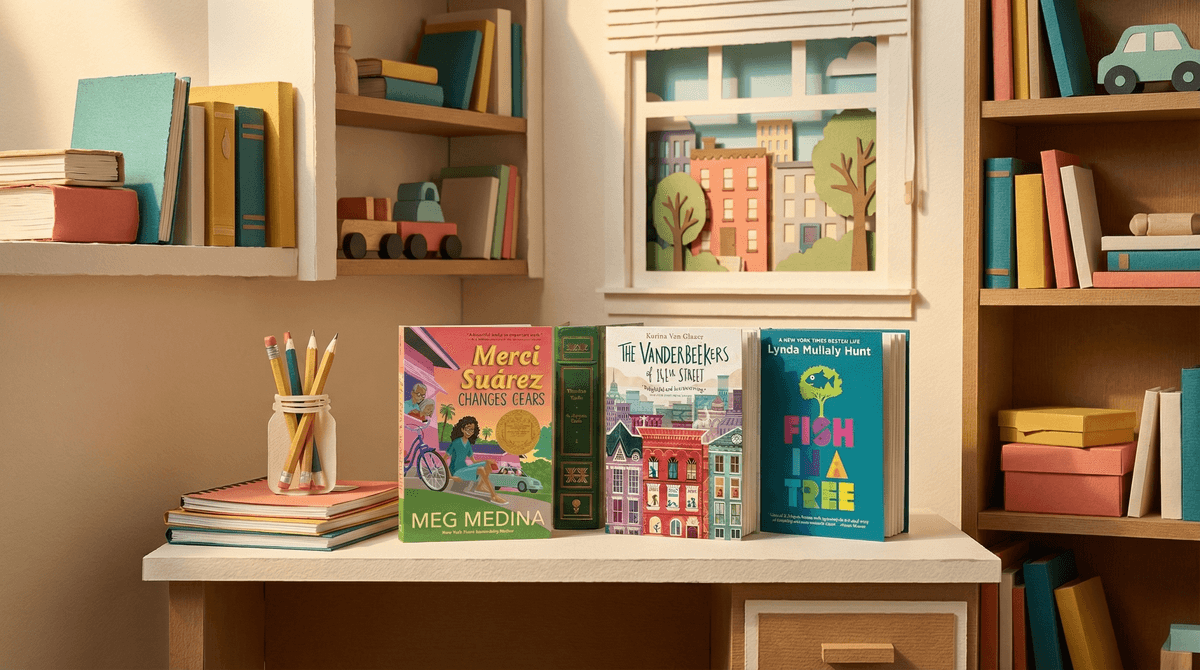
Fish in a Tree by Lynda Mullaly Hunt (Ages 8-12)
About a girl with undiagnosed dyslexia who's been hiding her reading struggles through behavior problems. Great for any kid who's felt "different" or struggled in school.
The Vanderbeekers series by Karina Yan Glaser (Ages 8-12)
A biracial family of five kids in Harlem facing everyday challenges—trying to save their apartment, helping neighbors, dealing with grief. Warm, diverse, and full of heart.
Merci Suárez Changes Gears by Meg Medina (Ages 8-12)
Merci navigates a new private school on scholarship, her grandfather's declining health, and figuring out who she is. Beautiful portrayal of a Cuban-American family.
The Terrible Two series by Mac Barnett and Jory John (Ages 7-10)
Two pranksters team up at a new school. Fast-paced, funny, and surprisingly thoughtful about friendship and creativity.
Wayside School by Louis Sachar (Ages 7-11)
Technically the school is a bit weird (it's 30 stories tall with one classroom per floor), but the stories are about real kid problems told in an absurdist, hilarious way.
Reading level vs. interest level: An 8-year-old might be reading at a 5th-grade level but still emotionally an 8-year-old. Diary of a Wimpy Kid works across a huge range because the humor and situations appeal to different maturity levels.
Representation matters: Kids benefit from seeing families and experiences like theirs AND different from theirs. Look for books with diverse characters, family structures, and cultural backgrounds.
"Problem books" can be great: Some realistic fiction tackles tough topics—divorce, death, learning differences, bullying. These aren't depressing; they're validating and help kids process big feelings. Just preview if you're concerned.
Graphic novels count: Books like Smile by Raina Telgemeier or New Kid by Jerry Craft are real literature, not "cheating." They're perfect for visual learners and reluctant readers.
If your kid is over dragons and ready for "real" stories, you're not limiting their imagination—you're expanding it into the complex, messy, beautiful world of human relationships and everyday life. Realistic fiction at this age builds empathy, validates their experiences, and shows them they're not alone in whatever they're navigating.
Start with what they're dealing with: Friend drama? Try Ivy and Bean. New school? Merci Suárez. Feeling different? Wonder or Fish in a Tree.
Hit the library: Librarians are wizards (see what I did there?) at matching kids with books. Tell them your kid wants realistic fiction, mention a book they loved, and watch the magic happen.
Read together or separately: Some 8-year-olds still love read-alouds; others want independence. Both are great. If you're reading separately, ask questions about the characters and plot—it keeps you connected to what they're experiencing.
And if they circle back to dragons in a few months? That's fine too. Reading preferences aren't linear, and the goal is just to keep them reading.