

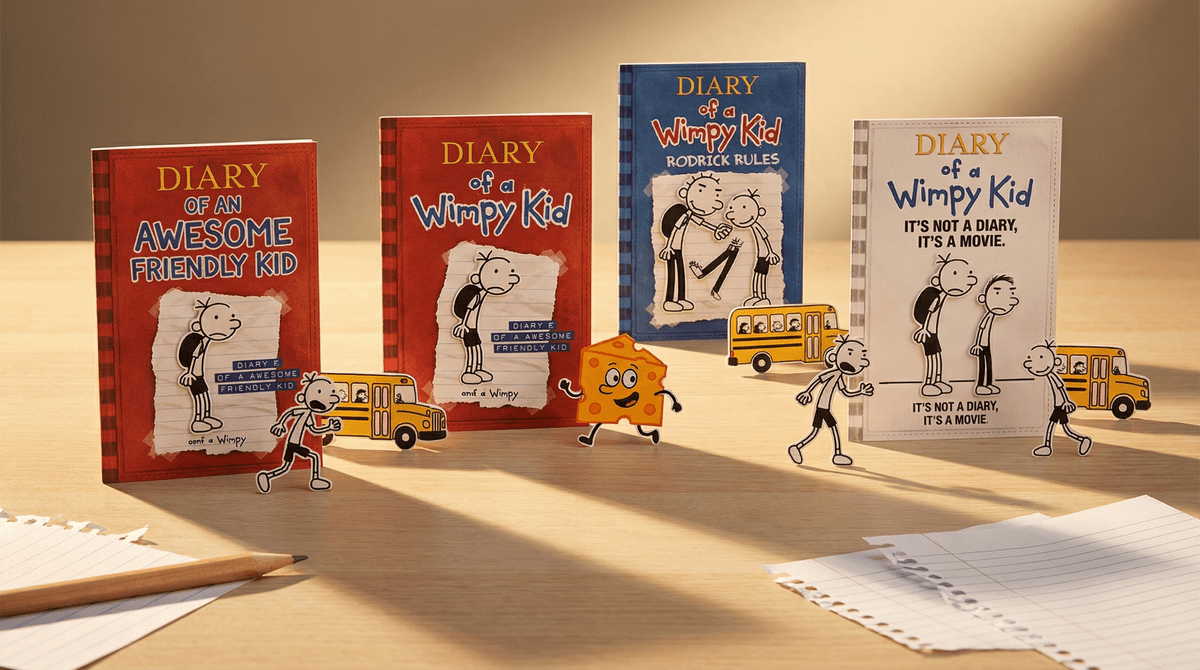
Okay, so if you've got kids between ages 7-14, you've probably seen these books everywhere. The ones with the stick-figure kid on the cover looking perpetually stressed out?
Diary of a Wimpy Kid is a massively popular book series by Jeff Kinney that follows Greg Heffley, a middle school kid just trying to survive the absolute chaos that is growing up. The books are written as Greg's journal (though he's very clear it's NOT a diary), mixing handwritten text with simple cartoon illustrations.
Since the first book dropped in 2007, the series has exploded into 18+ books, multiple movies (both live-action and animated), an online game called Poptropica Island, and basically every piece of merchandise you can imagine. We're talking lunchboxes, Halloween costumes, the works.
The format is genius, honestly. Short chapters, tons of illustrations, and the kind of humor that makes kids actually want to read. For reluctant readers? This series is often the gateway drug that gets them hooked on books.
Let's be real about why this series has such staying power with kids:
It Gets Middle School Right
Greg isn't a hero. He's not particularly brave, kind, or even likable all the time. He's self-centered, often makes terrible choices, and cares way too much about being "cool."
And that's exactly why kids love him.
He's dealing with the same stuff they are: embarrassing parents, friendship drama, trying to figure out where you fit in the social hierarchy, and the general horror show that is middle school. The books don't sugarcoat how awkward and uncomfortable this age can be.
The Humor Actually Lands
The comedy is pretty sophisticated for a kids' book. There's physical humor (yes, there's a piece of cheese on the playground that everyone avoids touching), social satire, and running gags that pay off across multiple books.
Kids pick up on the fact that Greg is often the butt of the joke, even when he doesn't realize it. That self-aware humor hits different when you're navigating your own social world.
It's Actually Readable
Can we talk about how these books look approachable? The illustrations break up the text every few sentences. The handwritten font feels casual. Each book is around 200 pages but reads super fast.
For kids who feel intimidated by thick chapter books, this format says "you can totally do this." And then suddenly they've read 10 books in the series.
The Family Dynamics Feel Real
Greg's family is chaotic in a relatable way. His older brother Rodrick torments him. His little brother Manny gets away with everything. His parents are trying their best but are often clueless about what's actually going on. His mom is always starting projects that embarrass him.
It's not a perfect TV family, and kids recognize their own lives in that messiness.
Here's where it gets interesting, because the age range for this series is wider than you might think.
Ages 7-9: Early Readers
These kids are often drawn to the format and illustrations. They can handle the reading level, and they think middle school sounds exotic and interesting.
What to know: They might not catch all the social nuances or understand why Greg's behavior is sometimes problematic. They're mostly in it for the surface-level humor and the pictures.
Parent move: This is actually a great age to read together and talk about what's happening. "Why do you think Greg did that? How do you think Rowley felt?"
Ages 10-12: The Sweet Spot
This is the target audience, and they're LIVING it. They're either in middle school or about to be, and everything hits harder.
What to know: They're going to relate hard to the social anxiety, the friendship complications, and the desperate desire to be popular. They'll also start noticing that Greg isn't always a great friend.
Parent move: These books can actually open up conversations about their own social situations. "Have you ever felt like Greg does in this scene?"
Ages 13-14: Aging Out But Still Attached
Some kids stick with the series even as they're moving past the target age, especially if they've been reading since elementary school.
What to know: They might be reading more out of nostalgia and habit than genuine engagement. Or they're genuinely enjoying the humor and quick read between heavier books.
Parent move: Let them enjoy it without judgment. Not everything needs to be a literary challenge.
Alright, let's talk about the stuff that might concern you, because there's definitely some nuance here.
Greg Is Kind of a Jerk Sometimes
This is the big one. Greg is selfish. He uses people. He lies to his parents. He's obsessed with popularity. He treats his best friend Rowley pretty badly sometimes.
The thing is: The books are written from Greg's perspective, but the reader is meant to see through him. Jeff Kinney has said he's writing Greg as an "unreliable narrator." The joke is often on Greg, even if Greg doesn't get it.
Your move: This is actually a feature, not a bug. These books are perfect for teaching media literacy and critical thinking. Ask your kid: "Do you think Greg made a good choice there? What would you have done differently?"
The Humor Can Be Mean-Spirited
There's definitely some cringe humor, embarrassment comedy, and social hierarchy stuff that might make you uncomfortable. Characters get made fun of. There's bathroom humor. The "Cheese Touch" is basically about contamination anxiety.
Reality check: This is the actual social currency of middle school. The books are reflecting what kids are already experiencing, not creating it.
Your move: If something in the book bothers you, that's actually a perfect conversation starter about kindness, empathy, and how we treat people.
There's Not a Ton of Diversity
The main cast is pretty homogeneous, which has been a valid criticism of the series. Kinney has added more diverse characters in recent books, but it's not the most representative series out there.
Your move: Balance it with other books that show different perspectives and experiences. Diary of a Wimpy Kid doesn't need to be the only series your kid reads.
The Movies Are Hit or Miss
There are four live-action movies and one animated movie on Disney+. The live-action ones are... fine? They're not terrible, but they also lose some of the nuance of the books.
The 2021 animated movie on Disney+ is actually pretty solid and stays truer to the book's humor and art style.
Your move: If your kid wants to watch, go for it. But the books are definitely better, and that's a great thing to point out.
If your kid is deep in the Wimpy Kid phase, here are some conversation starters that don't feel like you're assigning homework:
"What would you do differently than Greg?" This opens up discussions about choices and consequences without being preachy.
"Which character do you relate to most?" You might be surprised. Some kids see themselves in Rowley (the loyal friend), or even Rodrick (the chaotic older sibling).
"Have you ever been in a situation like this?" Let them share their own middle school drama. Sometimes they just need to vent about their day.
"Why do you think Greg cares so much about being popular?" This can lead to really interesting conversations about social pressure and self-worth.
"What makes someone a good friend in this story?" Especially relevant when Greg is being a questionable friend to Rowley.
The key is to be genuinely curious, not interrogating them. You're having a conversation about a book they enjoy, not conducting a moral assessment.
Here's my honest take as a parent: Diary of a Wimpy Kid is not going to win literary awards, and Greg Heffley is not a role model.
But that's okay.
These books get kids reading. They reflect the genuine awkwardness and social complexity of middle school. They're funny, accessible, and they've created countless readers who might not have connected with other books.
Are there things to critique? Absolutely. Greg's behavior, the mean-spirited humor, the lack of diversity – these are all valid concerns.
But these books also give you an incredible window into your kid's world and amazing opportunities for conversations about friendship, choices, empathy, and navigating social situations.
The series works because it's honest about how hard it is to be a kid. It doesn't pretend middle school is fun or that growing up is easy. And sometimes kids need to see their struggles reflected back at them, even in stick-figure form.
If your kid hasn't discovered the series yet:
- Start with the first book (just called "Diary of a Wimpy Kid")
- Don't force it – these books work because kids choose them
- Try the audiobook if they're auditory learners
If your kid is already obsessed:
- Read one of the books yourself so you can actually talk about it
- Ask them which book is their favorite and why
- Use it as a bridge to other similar series (Big Nate, Dork Diaries, Middle School: The Worst Years of My Life)
If something in the books concerns you:
- Talk about it directly rather than banning the books
- Use specific examples: "I noticed Greg did X. What did you think about that?"
- Remember that kids are smarter than we give them credit for – they can usually tell when a character is making bad choices
To extend the reading:
- Check out Jeff Kinney's other series "Row