

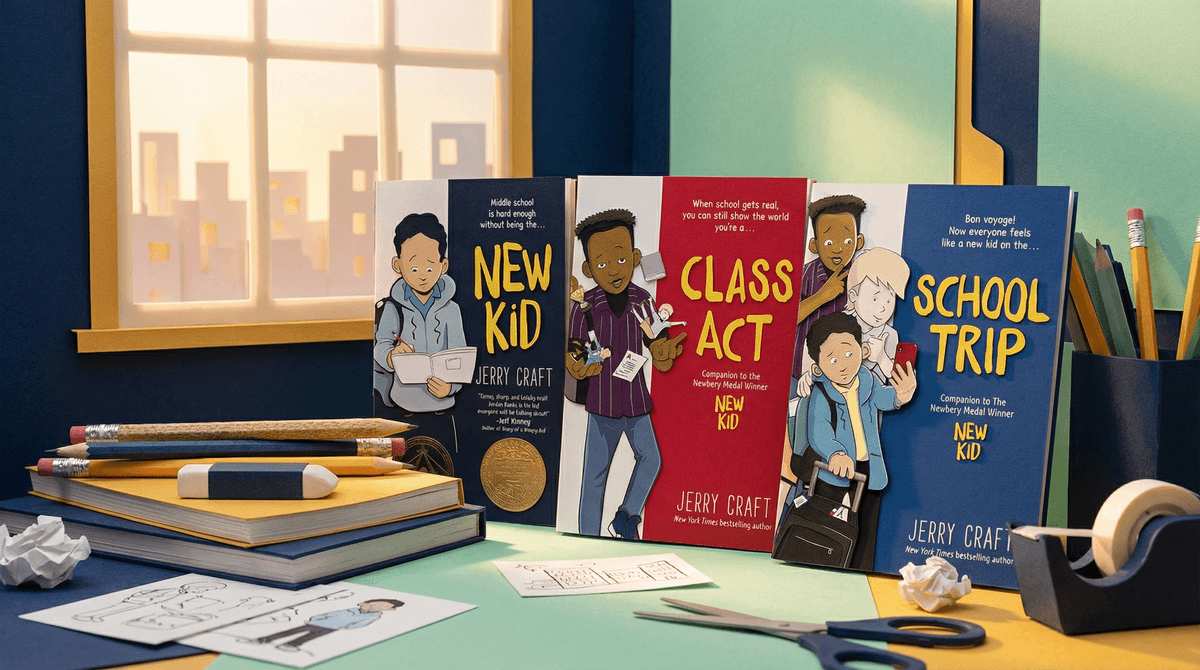
New Kid by Jerry Craft is a graphic novel that won the Newbery Medal in 2020—the first graphic novel to ever receive this honor. It follows Jordan Banks, a seventh grader who loves art and wants to go to art school, but instead finds himself at a prestigious private school where he's one of the few kids of color.
The book deals with microaggressions, code-switching, fitting in, and finding your identity when you're straddling different worlds. It's funny, honest, and incredibly relatable—not just for kids navigating similar situations, but for any middle schooler who's ever felt like they don't quite belong.
The story continues in two sequels: Class Act and School Trip, both of which expand on the world and characters Craft created.
It's actually funny. Jordan's internal monologue and his comics-within-the-comic keep the tone light even when dealing with heavy topics. Kids aren't getting lectured—they're laughing while learning.
The graphic novel format is accessible. For reluctant readers or kids who struggle with dense text, this is a gateway. The illustrations carry so much of the emotional weight and humor that kids who might bounce off a traditional novel will devour this in a sitting or two.
It validates real experiences. For kids of color, especially those in predominantly white spaces, seeing Jordan's experiences reflected back is powerful. For white kids, it's an eye-opening window into what their classmates might be experiencing.
It's not preachy. The book doesn't stop to explain every lesson. It trusts readers to pick up on the nuances of Jordan being asked to "speak for all Black people" or having teachers constantly mix up his name with the only other Black kid in class.
Best for ages 8-13, though honestly, high schoolers and adults get a lot out of it too.
The book deals with racism, but not in a traumatic or graphic way. There's no violence or inappropriate content—just honest portrayals of what many kids experience: being followed in stores, having people touch their hair without permission, being treated as a spokesperson for their entire race.
For younger readers (ages 8-10): They'll connect with the friendship dynamics, the humor, and Jordan's love of drawing. Some of the more subtle racial themes might go over their heads, which is fine—they'll pick up more on a reread as they get older.
For middle schoolers (ages 11-13): This is the sweet spot. They're living Jordan's experience of navigating social hierarchies, figuring out who they are, and dealing with the pressure to fit in.
This is a conversation starter, not a conversation ender. The book opens doors to talk about race, privilege, code-switching, and belonging—but you'll want to be ready to have those conversations.
Some questions to explore together:
- "Have you ever felt like Jordan, like you had to act differently in different places?"
- "What do you think about how the teachers treated Jordan differently than other students?"
- "Jordan loves drawing. What's something you wish you had more time to do?"
The book doesn't villainize anyone. Jordan's classmates aren't portrayed as evil—they're just clueless sometimes. His teachers mean well but make assumptions. This nuance is actually helpful for kids learning to navigate these situations themselves. Want to dive deeper into talking about race and identity with kids?
It pairs well with other diverse middle grade books. If your kid loves this, consider Roller Girl by Victoria Jamieson, The Crossover by Kwame Alexander, or Ghosts by Raina Telgemeier.
Jerry Craft's other work is worth exploring too. His Mama's Boyz comic strip has been running for decades, and kids who love Jordan's story will enjoy seeing more of Craft's humor and perspective.
While New Kid isn't about screens or social media, it's incredibly relevant to digital citizenship. The same skills Jordan uses to navigate different social worlds—reading the room, understanding context, code-switching—are exactly what kids need online.
Jordan's experience of being hypervisible (as one of few Black students) and invisible (when teachers ignore his actual interests) mirrors what many kids experience on social platforms. The book can open conversations about online identity and authenticity.
New Kid is one of those rare books that works on multiple levels. Kids read it for the humor and the story. Parents appreciate the conversations it opens up. Teachers love it as a teaching tool.
If you have a middle schooler—especially one navigating questions of identity, belonging, or what it means to be themselves in different spaces—this book is a gift. And if your kid isn't much of a reader? The graphic novel format makes it accessible in a way that a traditional novel might not be.
Read it together or separately, then talk about it. Some families love reading aloud together. Others prefer everyone reads on their own then discusses. Either works.
Check if your school or library has it. New Kid is wildly popular and usually available. Many libraries also have the audiobook, which is excellently narrated.
Consider the sequels. Class Act shifts perspective to Jordan's friend Drew, exploring class and economic differences. School Trip takes the characters to Paris and explores belonging on an even bigger stage.
Follow Jerry Craft. He's active on social media and often shares insights into his creative process and the themes in his books. It's a nice way for kids to see the person behind the story.
This isn't just a book about a kid at a new school. It's about finding your voice, staying true to yourself, and learning to navigate a world that doesn't always make space for you. Pretty relevant stuff for any kid growing up today—online or off.