

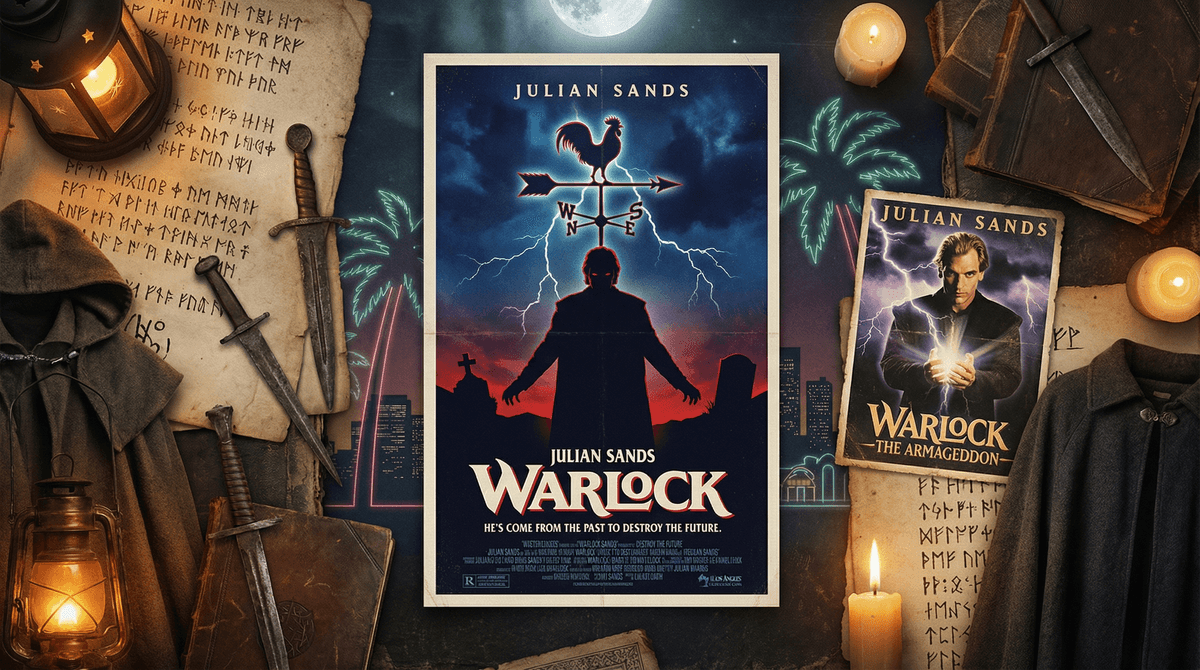
Warlock (1989): The Cult Classic That Blends Time Travel, Witch Hunters, and R-Rated Scares
TL;DR: Warlock is a wild 1989 fantasy-horror film that's way too intense for kids but fascinating for mature teens (16+) and nostalgic parents who want something different from the usual '80s fare. It's got genuine scares, creative mythology, and Richard E. Grant chewing scenery as a witch hunter. Think The Terminator meets The Omen, but with more finger-severing and backwards-aging curses.
Released in 1989 (technically making it an '80s movie by three years, but spiritually it's very '90s), Warlock follows a genuinely evil sorcerer (Julian Sands, being deliciously menacing) who escapes execution in 1691 Boston by jumping forward in time to 1989 Los Angeles. His mission: collect the three pieces of the "Grand Grimoire" to unmake Creation itself. Hot on his trail is Giles Redferne (Richard E. Grant), a 17th-century witch hunter who's basically if a Puritan had an energy drink and anger management issues.
They're joined by Kassandra (Lori Singer), a modern woman who gets cursed to age 20 years per day after the Warlock steals her youth. The trio races across America to stop the Warlock from ending the world, and it's bonkers in the best way.
The movie flopped at the box office but became a cult classic on VHS and cable, spawning two increasingly weird sequels that have nothing to do with the original.
It's genuinely creative. The mythology around the Grand Grimoire—scattered pages that can only be found through supernatural means—creates a compelling treasure hunt structure. The Warlock uses weather vanes to divine locations, flies using rendered fat from unbaptized children (told you this wasn't for kids), and speaks backwards to curse people. It's the kind of specific, weird world-building that makes horror memorable.
The fish-out-of-water dynamics actually work. Watching a 17th-century witch hunter navigate 1989 America should be comedy gold, and the movie does mine some humor from it (Redferne's confusion about cars, his absolute bafflement at modern women), but it never becomes a joke. Grant plays it deadly serious, which makes it funnier AND scarier.
Julian Sands is terrifying. The Warlock isn't camp or over-the-top—he's cold, calculating, and genuinely evil. He manipulates, murders, and curses his way across the country with zero remorse. In an era of wisecracking horror villains (hello, Freddy Krueger), the Warlock's icy menace stands out.
The practical effects hold up. This is pre-CGI filmmaking at its finest. The aging makeup, the flying sequences, the grotesque spell components—it all feels tangible and real in a way that modern horror often lacks.
Let's be clear: Warlock is rated R for very good reasons, and honestly, it probably deserves a hard R. Here's what you're dealing with:
Intense violence and gore: People get their fingers cut off (and the stumps are shown in detail). There's a tongue-nailing scene. Characters are murdered in creative and disturbing ways. The violence isn't gratuitous for its own sake, but it's definitely graphic.
Genuinely disturbing themes: The Warlock renders fat from an unbaptized child (off-screen, thank god, but the implication is crystal clear). He buries a psychic alive. He ages a woman to death. These aren't jump scares—they're deeply unsettling concepts.
Sexual content: There's nudity and sexual situations, including the Warlock seducing women to gain information or advantages. It's not exploitative, but it's definitely there.
Religious horror: If your family is sensitive about depictions of Christianity, witchcraft, or the supernatural, this movie goes hard on all three. The Grand Grimoire contains the "true name of God," and speaking it backwards will unmake Creation. It's high-concept religious horror.
Nightmare fuel: The aging curse subplot is genuinely horrifying. Watching Kassandra deteriorate day by day, knowing she'll die of old age in less than a week, creates real dread.
Ages 16-17+: If you've got a teen who's already into horror and fantasy—someone who's watched Stranger Things, The Conjuring, or Supernatural—Warlock could be a great introduction to '80s/'90s practical horror. It's intense but not torture-porn, creative but not incomprehensible.
For parents: If you grew up on Evil Dead, Hellraiser, or Pumpkinhead, Warlock scratches that same itch—imaginative horror with real stakes and practical effects that make you go "how did they DO that?"
Watch-together potential: This could be a solid co-viewing experience with older teens. The time-travel culture clash provides natural conversation starters about how much has changed (and hasn't) since 1989. The mythology is fun to unpack. And honestly, Richard E. Grant's performance is so committed that it's worth watching just for him.
Warlock came out in a weird moment. It was too late to ride the '80s fantasy wave (Labyrinth, The Dark Crystal, Legend) and too early for the '90s self-aware horror boom (Scream, The Faculty). It's sincere when sincerity wasn't cool, and it's weird when weird wasn't marketable yet.
But that's exactly why it's worth revisiting. It's a movie with a clear vision, committed performances, and genuine creativity that doesn't feel focus-grouped or committee-designed. Director Steve Miner (who also did Friday the 13th Part 2 and Part 3) understood how to balance horror and adventure, and screenwriter David Twohy (who'd go on to write The Fugitive and direct the Riddick films) crafted a genuinely clever script.
If you're watching with older teens, here are some things worth discussing:
Time travel mechanics: The movie doesn't explain HOW the time travel works, which is actually refreshing. But it's fun to talk about—is this a branching timeline? Can they change the past? Why doesn't Redferne just kill the Warlock as a baby?
Religious horror vs. supernatural horror: The movie treats Christianity and witchcraft as equally real and powerful. How does that compare to modern horror, which often leans more psychological or scientific?
Practical effects vs. CGI: Show your teen what horror looked like before computers. Talk about whether practical effects are "better" or just different. Want to explore more about practical effects in horror?
Gender dynamics: Kassandra starts as a damsel but becomes increasingly capable. Redferne is a 17th-century man dealing with a 20th-century woman. The movie has some dated elements but also some surprisingly progressive moments for 1989.
Warlock cycles through various streaming services but is often available to rent on Amazon Prime, Apple TV, or Vudu. It's also frequently on Tubi or other free streaming platforms (with ads). The Blu-ray from Vestron Video has a gorgeous transfer and fun special features if you want the full experience.
Skip the sequels unless you're really committed. Warlock: The Armageddon (1993) has some cool moments but loses the fish-out-of-water dynamic. Warlock III: The End of Innocence (1999) is direct-to-video and... just don't.
Warlock isn't going to replace The Princess Bride or Labyrinth in your family's fantasy rotation—it's too dark, too violent, and too weird for that. But for parents with mature teens who want something genuinely different, or for nostalgic adults who want to revisit a creative cult classic, it's absolutely worth 103 minutes of your time.
It's the kind of movie that reminds you why practical horror was special, why committed performances matter even in "silly" genre films, and why sometimes the best fantasy-horror comes from filmmakers who just go for it without worrying about broad appeal.
Just remember: this is a hard R. If you wouldn't show your teen The Terminator or Aliens, Warlock isn't ready for them yet. But when they're ready? It's a hell of a ride.
Curious about other underrated '80s and '90s horror films? Or looking for fantasy movies that blend horror and adventure? The Screenwise list maker can help you find your next cult classic.