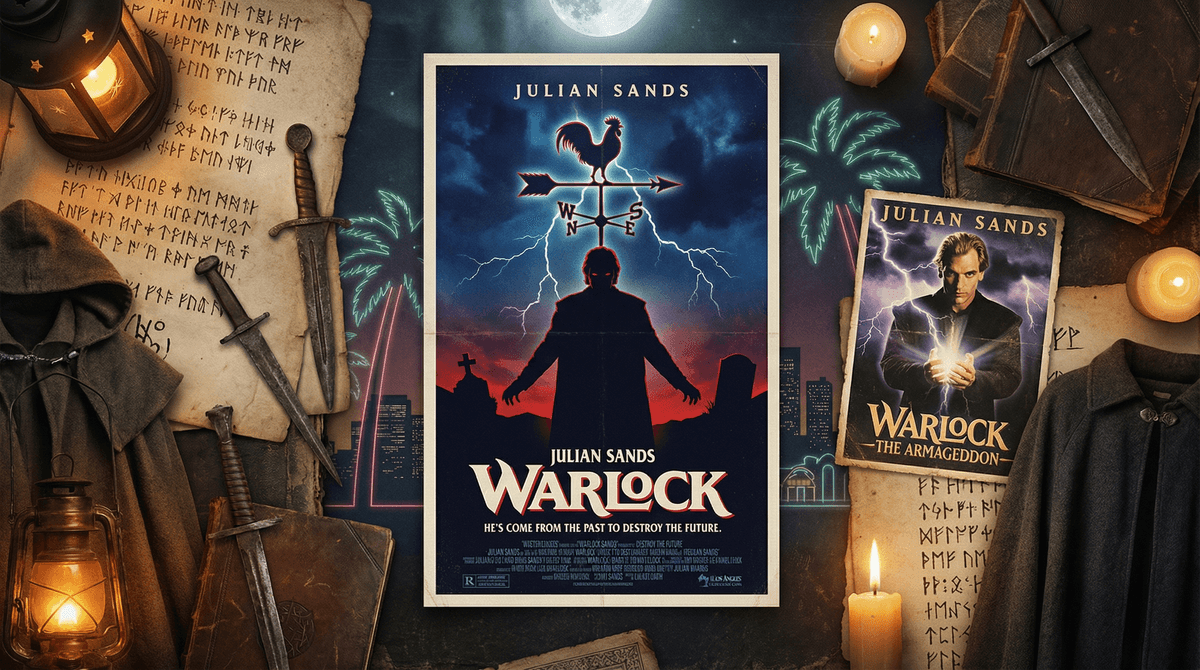
The Julian Sands show
While the first film was a fish-out-of-water chase through the 1600s and modern-day Los Angeles, this sequel pivots into a full-blown supernatural slasher. It functions more like an anthology entry than a direct continuation. You don't need to have seen the original to understand what’s happening here, though knowing why the 1989 Warlock is a cult classic helps explain why this franchise ever got a second installment.
The main draw—and arguably the only reason to watch—is Julian Sands. He isn't playing a subtle villain; he is playing a theatrical, high-camp force of nature who seems to be having a much better time than anyone else on screen. Critics may have handed this a zero on Rotten Tomatoes, but they were looking for a "good" movie. Fans who keep this alive on Tubi and Plex are looking for a vibe. It’s the kind of performance that turns a standard horror flick into a piece of unintentional performance art.
Practical effects and 90s weirdness
If you grew up on the CGI-heavy scares of the 2010s, the "creative madness" of this era will feel like a fever dream. The movie relies heavily on practical effects to handle its most gruesome moments. We’re talking about a Warlock who turns people into statues, messes with their anatomy, and generally treats the human body like play-dough. It’s gross, but it has that tactile, handmade quality that modern digital horror often lacks.
The plot involving Druid teens training to fight ancient evil is secondary to the spectacle. You’re here to see how the Warlock is going to dispatch the next person standing between him and those rune stones. If your teen is a fan of the Leprechaun series or the more absurd Nightmare on Elm Street sequels, they’ll recognize the rhythm. It’s less about tension and more about the payoff of a bizarre death scene.
The "so bad it's good" threshold
There is a specific kind of viewer who finds a 5.4 IMDb score more enticing than a 9.0. This movie is for them. It sits in that sweet spot of early-90s "straight to video" energy where the budget was just high enough to be ambitious but the script was unhinged.
The friction for a modern audience usually comes down to the pacing and the protagonist's "training" arc, which can feel like a generic teen drama from a different movie entirely. Whenever Sands isn't on screen, the energy plummets. If you’re watching this with a horror-obsessed teen, it’s a great case study in how a charismatic lead can carry a failing production. It’s not a masterpiece, and it’s certainly not "safe" by any standard metric, but as a relic of 90s horror excess, it’s a fascinating, messy artifact.