

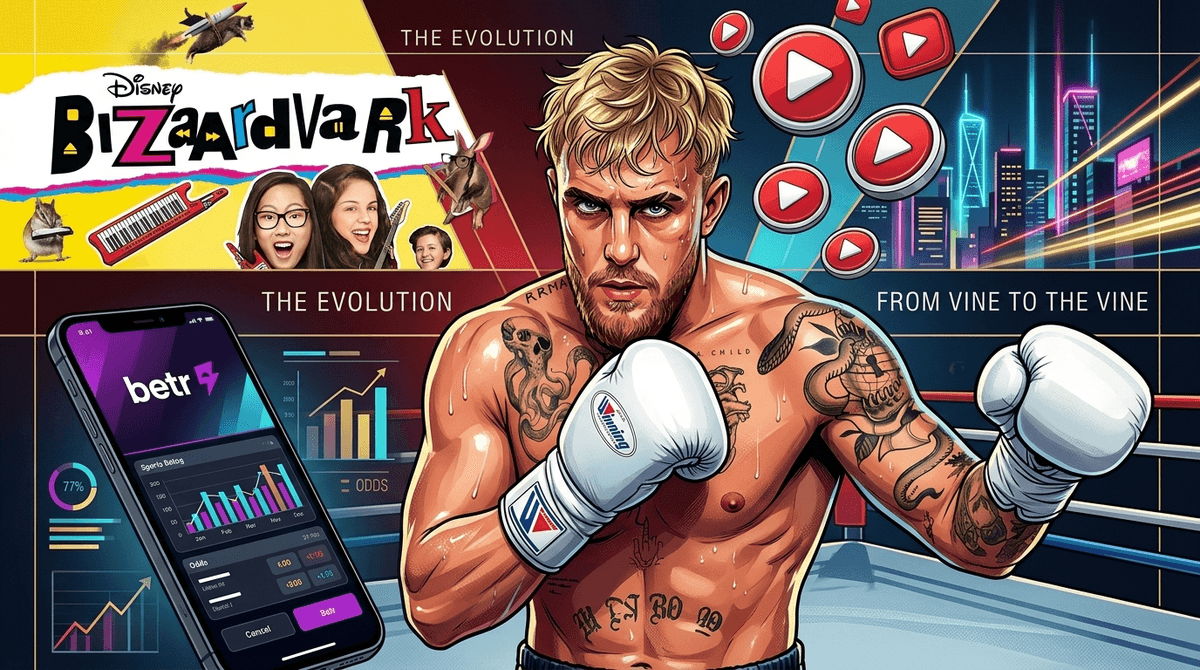
TL;DR: Jake Paul has transitioned from a chaotic Disney Channel star and prank YouTuber to a high-stakes professional boxer and sports betting mogul. While your kids might see him as a symbol of "disruptive success," the primary concerns for parents in 2026 are his promotion of "micro-betting" via his app Betr and the "alpha" bravado that defines his brand. He isn't "brain rot" in the Skibidi sense, but he is a gateway to the world of sports gambling and influencer-led consumerism.
Ask our chatbot about the risks of sports betting apps for teens
If you haven't thought about Jake Paul since 2017, you probably remember him as the guy who set a fire in an empty swimming pool and got fired from the Disney show Bizaardvark. Back then, he was the king of "clout" culture—living in a mansion with a bunch of other influencers (Team 10), filming obnoxious pranks, and releasing the infamously bad song "It's Everyday Bro" on YouTube.
Fast forward to 2026, and Jake Paul has undergone one of the most successful (and polarizing) rebrands in media history. He is no longer just a "YouTuber." He is a professional boxer who has headlined massive events on Netflix and pay-per-view, fighting everyone from retired UFC champions to the legendary Mike Tyson.
More importantly for parents, he is a massive businessman. Alongside his brother Logan Paul (the face of the Prime hydration empire), Jake has mastered the art of "attention engineering." He knows exactly how to stay in your child's feed on TikTok and Instagram by being the "Problem Child"—the guy everyone loves to hate, but everyone watches.
To a 13-year-old boy, Jake Paul represents a specific kind of modern American dream. He’s wealthy, he’s fit, he drives supercars, and most importantly, he did it all by "disrupting" the system.
- The Underdog Narrative: Despite his massive wealth, Jake constantly positions himself as the outsider fighting against the "boxing establishment" or "mainstream media." Kids who feel like they don't fit into traditional structures find this incredibly compelling.
- Peak Masculinity: In a digital landscape where boys are often looking for direction, Jake Paul offers a version of masculinity centered on physical toughness, financial success, and "winning" at all costs.
- The Spectacle: His fights aren't just sporting events; they are cultural moments. Whether he’s winning or losing, the drama leading up to a fight is tailor-made for YouTube Shorts and TikTok consumption.
This is where we need to have a real talk about the "Problem Child." Jake Paul’s current biggest venture is Betr, a sports betting company focused on "micro-betting."
Unlike traditional sports betting where you bet on who wins the game, micro-betting allows you to bet on every single play. Will this next pitch be a strike? Will this drive result in a touchdown? It turns sports into a high-frequency slot machine.
While the app has age gates, Jake Paul’s marketing of the brand is heavily integrated into his content, which is consumed by millions of underage fans. He isn't just selling a lifestyle anymore; he’s selling the idea that sports are only interesting if you have money on the line. For intentional parents, this is a much bigger red flag than a few "Ohio" jokes or some cringe-worthy pranks.
Learn more about how "gamified" gambling affects the developing brain
Jake Paul’s content is generally aimed at Ages 13+, but his reach starts much earlier.
Elementary School (Ages 5-10)
At this age, kids might see his face on Prime bottles or hear his name in school. He is essentially a cartoon character to them.
- The Verdict: Avoid. There is nothing in his catalog that provides value to this age group, and the language/themes are often inappropriate. If they want sports content, try Dude Perfect instead.
Middle School (Ages 11-13)
This is the "danger zone" for Jake Paul consumption. This is when the "alpha" rhetoric and the lure of "get rich quick" schemes start to take hold.
- The Verdict: Supervision and conversation are key. If they are watching his training videos, that’s one thing. If they are watching his podcasts where he discusses "crushing" opponents and making millions, it’s time to talk about what "success" actually looks like.
High School (Ages 14-18)
High schoolers are the primary target for his sports betting brand. They are also the ones most likely to buy into the "disruptor" persona.
- The Verdict: Focus on media literacy. Talk about how he makes his money (attention) and the ethics of promoting gambling to a young audience.
If your child is a Jake Paul fan, you don't need to panic, but you do need to be aware of the "side effects" of his media diet:
- The "Alpha" Mindset: Jake often leans into a "me against the world" attitude that can translate into entitlement or lack of empathy in real-world social dynamics.
- Consumerism: Everything in the Paul brothers' world is for sale. Whether it’s a $100 hoodie, a $5 energy drink, or a betting app, the "fan" is always a "customer" first.
- Desensitization to Risk: Whether it's physical risk in the ring or financial risk with betting, Jake’s brand celebrates high-stakes gambling with one’s life and money.
If your kid is drawn to Jake Paul because they like boxing, sports, or the "grind" of training, there are much better ways to feed that interest without the toxic baggage.
For the kid who loves the drama and intensity of boxing, the Creed series (and the original Rocky movies) offers a much more grounded and emotional look at what it means to be a fighter. It emphasizes discipline, legacy, and heart over "clout."
If they like the "stunt" aspect of YouTube but you want to avoid the brain rot, Mark Rober is the gold standard. He does massive, viral-worthy stunts, but they are rooted in engineering, science, and genuine curiosity.
If they are obsessed with the "entrepreneurial" side of Jake Paul—making money and building an empire—steer them toward Stardew Valley. It’s a masterclass in resource management and the rewards of hard work, without the predatory microtransactions found in Roblox or the gambling undertones of sports betting.
For teens who love the high-stakes, high-wealth lifestyle of athletes, this show provides the spectacle and the drama of professional sports with a bit more "prestige" and actual sporting history.
You don't have to start the conversation by saying "Jake Paul is bad." That’s a one-way ticket to your kid tuning you out. Instead, try these angles:
- On Boxing: "Do you think Jake Paul is a great boxer, or is he just a great promoter? What’s the difference?"
- On Wealth: "He talks a lot about his cars and money. Why do you think he feels the need to show that off so much? Does it make his advice more or less trustworthy?"
- On Betting: "I see he’s promoting Betr a lot. Do you know how those apps actually make money? (Spoiler: They make money when you lose.)"
Jake Paul isn't going away. In 2026, he is a permanent fixture of the sports and media landscape. He is a master of the "Attention Economy."
As a parent, your job isn't necessarily to ban his videos—that usually just makes them more enticing. Your job is to be the "commentary track" to his content. Help your child see the difference between discipline (which Jake actually has—you don't get in that shape by accident) and predatory marketing (which he also has in spades).
If your kid is spending hours on YouTube watching Paul brother highlights, it might be time to introduce some cozy games or a family movie night to reset the dopamine levels.
Check out our guide on navigating "Alpha" influencer culture
Next Steps:
- Check your child's YouTube history for "Jake Paul" or "BS w/ Jake Paul" (his podcast).
- Talk to them about the concept of "micro-betting" and why it's designed to be addictive.
- If they are interested in boxing, look into a local gym where they can learn the actual sport, which values respect and humility over trash talk.