

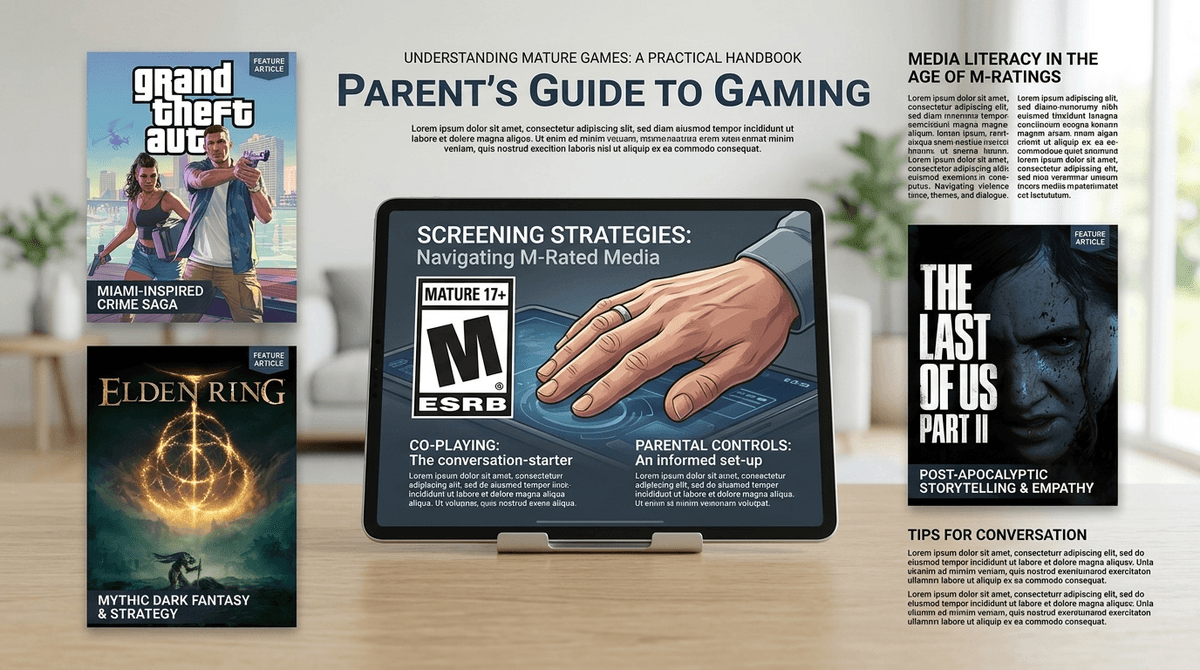
TL;DR: When your kid asks for an M-rated game, they aren't usually looking for "mature themes"—they're looking for social currency, high-fidelity graphics, or a challenge they can't find in Minecraft. Not every "M" is the same; there is a massive difference between the historical violence of Ghost of Tsushima and the nihilistic chaos of Grand Theft Auto VI. Your best move is to look past the box art and understand the specific "why" behind the request.
Quick Links for the "Big Ones":
It usually happens around 5th or 6th grade. Your kid has been perfectly happy building dirt huts in Minecraft or doing "the Griddy" in Fortnite, and then suddenly, they’re asking for Call of Duty. Or worse, they’ve seen the trailer for Grand Theft Auto VI and they’re trying to convince you that "it’s basically just a driving simulator, Mom."
First off, take a breath. Asking for an M-rated game isn’t a sign that your child is becoming a delinquent. In the world of middle school social dynamics, M-rated games are the new "R-rated movies." They represent a rite of passage. But as intentional parents, we know that the ESRB rating (Mature 17+) is a blunt instrument. It doesn't tell you if a game is "artistic but bloody" or "pointlessly cruel."
It’s rarely about the violence itself. If your kid is asking for these titles, it’s usually for one of three reasons:
- The Social Loop: If 60% of the boys in their grade are playing Call of Duty on Friday night, your kid feels like they’re missing out on the "real" locker room talk.
- The "Brain Rot" Escape: After years of Roblox and Skibidi Toilet memes, some kids are genuinely craving something with a serious story, better graphics, and higher stakes.
- The Challenge: Games like Elden Ring are M-rated because they are dark and creature-heavy, but for kids, the draw is the legendary difficulty. It’s about the "clout" of beating a hard boss.
Check out our guide on why kids are obsessed with "sweaty" gaming
The ESRB puts Halo Infinite (which is T for Teen) in a different category than Call of Duty, but to a parent’s eyes, they both look like "guys with guns." However, within the M-rating, there are levels to this.
The "War Movie" M: Call of Duty
This is the most common request. It’s fast, it’s loud, and the online lobbies can be... toxic. The violence is intense but "military." The real concern here isn't usually the blood; it's the unmonitored voice chat with 24-year-olds who have no filter.
- Verdict: If they're 13+, many parents allow it with voice chat muted. Under 12? It’s a lot.
The "HBO Drama" M: The Last of Us
These games are rated M for heavy emotional themes, extreme gore, and "adult" situations. They are essentially interactive prestige TV.
- Verdict: If you wouldn't let them watch a TV-MA show like Game of Thrones, they aren't ready for this. The emotional weight is often heavier than the physical violence.
The "Hard No" M: Grand Theft Auto VI
Let's be real: GTA is in a league of its own. It’s not just the violence; it’s the strip clubs, the drug deals, and the satirical celebration of being a criminal. It is designed for adults.
- Verdict: This is the one where you can comfortably say "not until you're older" without feeling like a prude. There is very little "educational" or "entrepreneurial" value here for a 12-year-old.
If your kid wants that "mature" feel without the full-blown M-rated content, there are incredible "T for Teen" games that feel like a step up from the "kiddy" stuff.
It’s technically rated M, but it plays like a satirical sci-fi action movie (think Starship Troopers). It’s cooperative, which means they’re working with friends rather than screaming at enemies. It feels "cool" and "current" without the gritty realism of a modern war simulator.
If they want a competitive shooter but you aren't ready for Call of Duty, this is the gold standard. It’s T-rated, stylized, and requires actual strategy and teamwork.
Don't let the Nintendo logo fool you. This game is massive, complex, and deeply rewarding. It’s the perfect "prestige" game for a kid who thinks they've outgrown Roblox.
It’s a T-rated pirate sandbox. It’s gorgeous, can be played with friends, and has enough "danger" to satisfy that craving for adventure without the gore.
While every kid is different, here is the general community vibe we see at Screenwise:
- Ages 9-11: Generally, M-rated games are a no-go. Stick to "T" rated shooters or action games. If they want "scary," try Five Nights at Freddy's.
- Ages 12-14: This is the "gray zone." Many parents start allowing M-rated games that are "fantasy violence" or "historical," like Skyrim or Ghost of Tsushima, while still holding the line on GTA or Cyberpunk 2077.
- Ages 15+: At this point, they've likely seen most of this content via YouTube or Twitch anyway. This is the time to pivot from "gatekeeper" to "mentor," talking about the themes they're seeing.
When the request comes in, don't just say "No, it's bad." That makes it forbidden fruit. Instead, try the "Show Me the Gameplay" approach.
- Watch a "Let's Play" together: Go to YouTube and search for "[Game Title] gameplay no commentary." Watch 10 minutes. You’ll see exactly what the "vibe" is.
- Ask about the "Why": "What do you like about this game? Is it because your friends are on it, or do you like the story?"
- The "Co-Play" Trial: Tell them, "I’ll let you get it, but for the first five hours, you have to play it in the living room while I'm around." Most kids who just want to play with their friends will agree. If they get defensive, they probably know the content is over the line.
An M-rating isn't a monolith. Some M-rated games are beautiful works of art that explore grief and sacrifice, while others are just digital playgrounds for mayhem. Your job isn't to be a censor, but to be a filter.
If they aren't ready for the "Big M" titles, steer them toward high-quality "T" titles that respect their intelligence. They’ll get the "grown-up" feeling they crave, and you’ll get to sleep at night knowing they aren't learning how to run a digital cartel.