

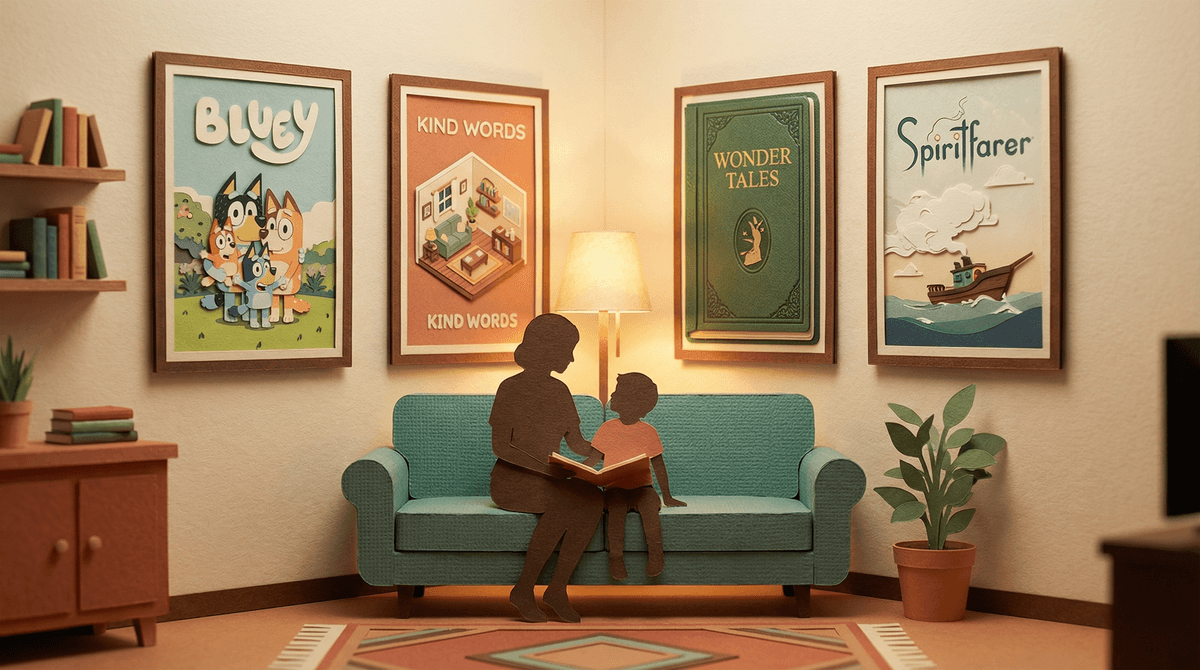
Look, screens are already part of your kid's life. Whether it's a Saturday morning cartoon binge, a post-homework Roblox session, or the movie you put on so you can make dinner in peace — media is happening. So here's a thought: what if instead of just managing screen time, we actually used some of it to help our kids become kinder humans?
I'm not talking about turning every episode into a teachable moment or ruining movie night with a lecture. I'm talking about intentionally choosing some media that naturally opens doors to conversations about empathy, kindness, and understanding people who are different from us. Because honestly? Some shows and games are genuinely great at this. And some are... not.
The research backs this up, by the way. Studies show that narrative media — stories with characters kids care about — can actually increase empathy and prosocial behavior. But it's not automatic. The magic happens when kids process what they're watching, playing, or reading, especially when adults help them connect the dots.
Kids today are growing up in a world that's both more connected and more divided than ever. They're seeing conflict, cruelty, and "othering" everywhere — in the news, on social media, in their games' chat functions. At the same time, they have unprecedented access to stories from different cultures, perspectives, and experiences.
The question isn't whether media influences kids (it does), but whether we're going to be intentional about what that influence looks like. Compassion isn't something kids just absorb from the air. It's learned through stories, modeled by people they admire (including fictional characters), and reinforced through practice.
Plus, let's be real: if your kid is going to spend two hours on a screen anyway, wouldn't you rather it be Hilda than some YouTube compilation of people getting hit in the face?
For younger kids (ages 4-8):
Bluey is the gold standard here. Every episode is basically a mini-masterclass in emotional intelligence, perspective-taking, and working through conflicts. The episode "Copycat" deals with death and grief in a way that's gentle but real. "Sleepytime" explores a kid's anxiety about growing up. And the parents actually model apologizing and repairing relationships.
Daniel Tiger's Neighborhood is more on-the-nose (those strategy songs can get stuck in your head for days), but it's incredibly effective for this age group. Each episode explicitly teaches emotional regulation and empathy skills.
Elinor Wonders Why sneaks in compassion through curiosity about the natural world and different ways of experiencing it. It's PBS, so you know it's been vetted to death, but it's actually engaging.
For middle elementary (ages 7-11):
Avatar: The Last Airbender (the animated series, not the movie that shall not be named) is a beautiful exploration of trauma, forgiveness, cultural genocide, and choosing compassion even when it's hard. Zuko's redemption arc alone is worth the watch.
Hilda on Netflix features a protagonist who literally befriends everyone — trolls, giants, ghosts — by trying to understand their perspective first. It's gorgeous, weird, and genuinely funny.
The Owl House tackles found family, neurodivergence, and LGBTQ+ identity with a ton of heart. The show demonstrates that "different" isn't dangerous, it's just... different.
For tweens and teens (ages 11+):
Heartstopper is a masterclass in healthy relationships, consent, and supporting friends through mental health struggles. It's also just ridiculously wholesome.
Anne with an E (Netflix's adaptation) doesn't shy away from hard topics — racism, sexism, trauma — but always comes back to the transformative power of kindness and imagination.
Everything Everywhere All at Once — okay, this one's PG-13 and has some intense moments, but for older teens, it's an incredible exploration of generational trauma, parent-child relationships, and choosing kindness in a chaotic universe.
Yes, really. Not all games are about headshots and loot boxes.
Kind Words is a game where you literally just write and receive anonymous kind letters. It's simple, it's beautiful, and it's a reminder that small acts of kindness matter.
Spiritfarer is about caring for spirits before they pass on to the afterlife. It's a game about death, but also about listening, supporting, and letting go. Teens especially connect with this one.
Unpacking tells a wordless story through the objects someone owns across different life stages. It teaches observation, inference, and empathy through environmental storytelling.
Even Stardew Valley, while primarily a farming sim, is built around building relationships, helping your community, and understanding each character's backstory and struggles.
Here's where a lot of parents stall out. You pick a great show, your kid watches it, and then... nothing. The compassion doesn't just osmose into their brain.
Co-view when you can. I know, I know. The whole point of screen time is sometimes that you get a break. But even occasional co-viewing — especially of new shows or movies — lets you gauge their reactions and opens natural conversation.
Ask open-ended questions. Not "what did you learn?" (ugh), but "Why do you think she did that?" or "How do you think he felt when that happened?" or "What would you do in that situation?"
Connect it to their life. "Remember when you had a conflict with your friend? That's kind of like what happened in the show, right? What did the character do that might have worked for you?"
Don't force it. If they're not in the mood to talk, let it go. The seed is planted. Sometimes they'll bring it up later, in the car or at bedtime, when you least expect it.
Use it as a bridge to harder topics. Media gives you a safe, third-party way to discuss things like discrimination, loss, mental health, or social justice without making it about them or someone they know.
Oh, absolutely. Wonder by R.J. Palacio is basically required reading for empathy education at this point. The Crossover by Kwame Alexander explores family, brotherhood, and loss through basketball and poetry. New Kid by Jerry Craft tackles microaggressions and code-switching with humor and heart.
For podcasts, Brains On! occasionally tackles social-emotional topics alongside science. Story Pirates celebrates creativity and different perspectives. Circle Round adapts folktales from around the world, each with a lesson about kindness, courage, or compassion.
You're not going to turn your kid into a saint by showing them the right TV show. But you can give them stories that expand their world, characters who model kindness, and opportunities to practice perspective-taking in low-stakes situations.
The goal isn't perfection. It's not even that every piece of media needs to be educational. Sometimes Nailed It! is exactly what everyone needs.
But when you're choosing what to watch, play, or read together — or when you're approving what they want to watch on their own — you can be intentional about including some media that helps them see the world through someone else's eyes.
Because empathy is a skill. And like any skill, it gets better with practice. Even if that practice happens on a screen.
Want to find more compassion-building content for your specific kid's age and interests? Find compassion-building shows to get personalized recommendations based on what your family already loves.
Dealing with a kid who seems glued to content that's... less than kind? Let's talk about how to shift their media diet without starting World War III.