

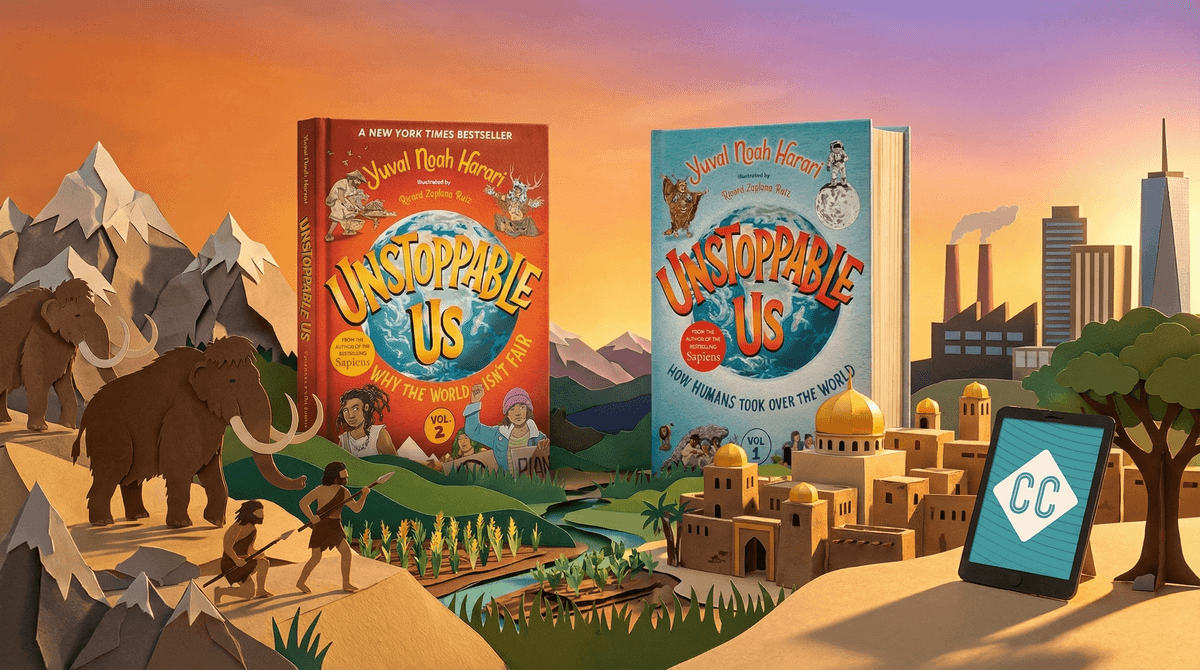
Unstoppable Us is a two-book series by Yuval Noah Harari, the historian who wrote Sapiens (the book every adult you know bought and may or may not have finished). But here's the thing: he adapted it for kids, and it actually works.
The series covers human history from the Stone Age through agriculture, empires, and beyond. Book 1 is How Humans Took Over the World and Book 2 is Why the World Isn't Fair. These aren't your typical "here are some dates to memorize" history books. Harari tackles big questions: Why did humans become dominant? How did we go from hunting mammoths to building cities? Why do some people have more power than others?
The books are heavily illustrated, conversational, and don't shy away from complex topics like evolution, inequality, and how humans have treated each other (and animals) throughout history. Think Horrible Histories meets actual academic rigor.
Here's the surprise: kids are voluntarily picking up 200+ page nonfiction books and getting genuinely excited about the agricultural revolution. Why?
The writing doesn't talk down to them. Harari writes like he's having a conversation with a curious 10-year-old who can handle real concepts. He uses humor, asks provocative questions, and doesn't sanitize history into a boring parade of "great men doing great things."
The illustrations are legitimately engaging. Ricard Zaplana Ruiz's artwork throughout the books is colorful, funny, and actually helps explain complex ideas. It's not just decorative—it's doing pedagogical work.
It connects to their digital world. Kids who spend time on YouTube watching explainer content and deep-dive videos recognize the format. This is the book version of a really good educational YouTube channel. (Speaking of which, about 42% of kids in your community are using YouTube solo, and another 38% with supervision—this book series feels familiar to that generation of learners.)
The questions are genuinely interesting. Instead of "When did the Bronze Age begin?" it's "Why did humans decide to start farming when it made their lives harder?" That's the kind of question that gets kids thinking.
The Evolution Thing
Let's address this upfront: the entire series is grounded in evolutionary biology and scientific consensus about human origins. If your family approaches human history from a different perspective, this isn't going to align. No judgment—just want you to know before you buy.
The "Fair" Conversation
Book 2 explicitly tackles inequality, power structures, and why the world isn't fair. Harari discusses slavery, colonialism, gender inequality, and class systems. He's not pushing a specific political agenda, but he's definitely not pretending these systems don't exist. Some parents love this; others feel it's too much for middle schoolers. You can explore different perspectives on teaching kids about systemic inequality here .
.
Reading Level vs. Concept Level
The books are marketed for ages 10+, but there's a gap here worth noting. The reading level is accessible for strong 3rd-4th grade readers. The concept level is more appropriate for 5th grade and up. A 9-year-old might be able to read every word but miss the deeper ideas about power, cooperation, and social structures.
It's Not Neutral (And That's Okay)
Harari has a perspective. He's skeptical of agricultural revolution as "progress," critical of how humans treat animals, and interested in questioning assumptions about civilization. This isn't a "just the facts" textbook. Some kids (and parents) will find this refreshing. Others might want something more straightforward.
Ages 8-9: Can read it, but you'll want to read together and discuss the bigger concepts. Great for curious kids who love Who Was... biographies and are ready for something meatier.
Ages 10-12: The sweet spot. Old enough to grasp the concepts, young enough to still be excited about illustrated nonfiction. Perfect for kids who loved The Wild Robot or Wonder and are looking for nonfiction that doesn't bore them.
Ages 13+: Still great, especially for reluctant readers who think nonfiction is automatically boring. Can handle all the concepts independently and might want to discuss/debate Harari's conclusions.
Don't just hand it over and walk away. These books are conversation starters. The best way to use them is to read alongside your kid (or at least check in regularly about what they're learning).
Expect questions. If your kid is actually engaging with the material, they're going to have questions about inequality, power, why humans do terrible things to each other, and whether we're actually the "good guys" of Earth's story.
Connect to what they're already learning. If they're studying ancient civilizations in school, this gives them a completely different lens. If they're into Minecraft or Civilization VI, they'll recognize concepts about resource management and empire building.
Use it as a bridge to other content. Kids who love these books often enjoy Crash Course World History on YouTube, Extra History series, or podcasts like Radiolab for Kids.
Unstoppable Us is legitimately good nonfiction for kids who are ready to think about big questions. It's not going to work for every family—the evolutionary framework and discussions of inequality are baked in, not optional.
But if you've got a curious kid who's tired of fiction and wants to understand how the world actually works? This is one of the best options out there. It's the rare book that treats kids like capable thinkers while still being accessible and genuinely interesting.
Is it perfect? No. Some sections drag, and Harari occasionally oversimplifies complex topics for narrative flow. But it's doing something most history books for kids don't even attempt: making them think critically about human civilization instead of just memorizing it.
Start with Book 1 and see how your kid responds before committing to the series. If they're into it, Book 2 goes deeper and more complex.
Read reviews together. Before buying, look at reviews on Goodreads with your kid. See what other young readers thought. This teaches critical consumption of media and sets expectations.
Consider the audiobook. The narration is solid, and some kids absorb nonfiction better by listening. Plus it makes long car rides way more interesting than Baby Shark for the millionth time.
Want to explore more nonfiction that doesn't put kids to sleep? Or wondering how to talk about evolution and human origins with your kids?