

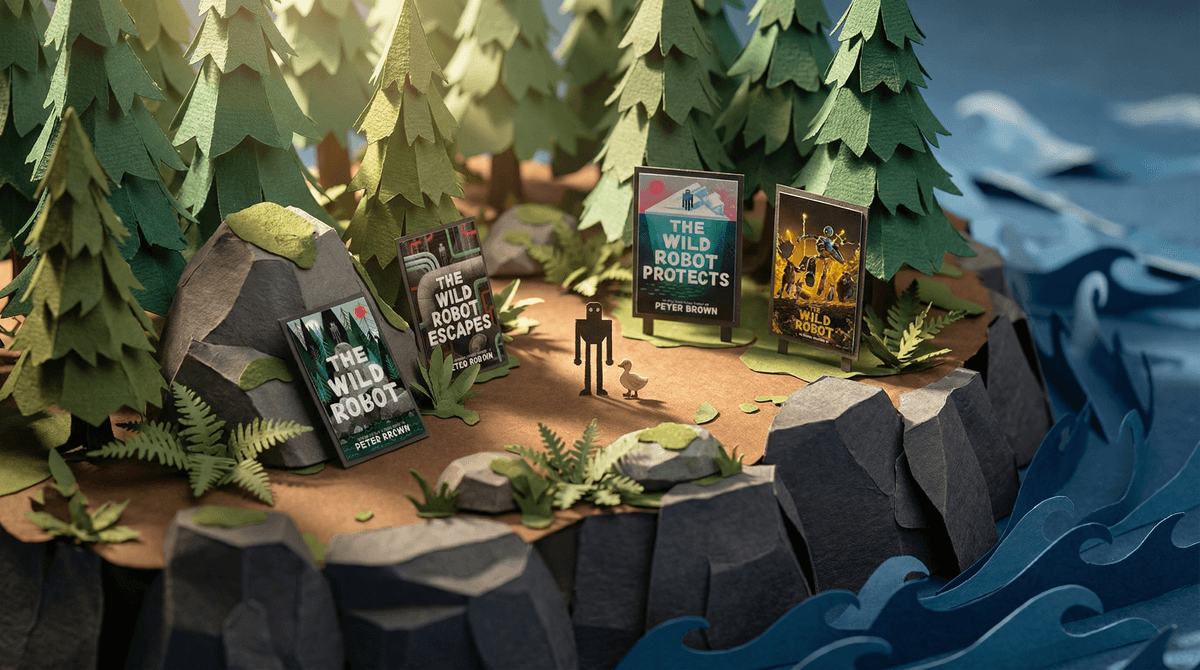
The Wild Robot by Peter Brown is a middle-grade novel that's become a genuine phenomenon in elementary and middle schools. It tells the story of Roz, a robot who washes ashore on a remote island after a hurricane. With no humans around and no instructions to follow, she has to figure out how to survive among wild animals who are initially terrified of her. The story follows her journey from being a piece of technology completely out of place to becoming part of the island's ecosystem—and eventually, a mother to an orphaned gosling named Brightbill.
The book spawned two sequels (The Wild Robot Escapes and The Wild Robot Protects), and in 2024, DreamWorks released an animated film adaptation that introduced even more kids to Roz's story. If your child is suddenly asking questions about whether robots can feel emotions or talking about "learning from nature," this book is probably why.
The story hits differently than typical robot narratives. Unlike the action-packed robot stories kids see in games like Roblox or shows, this is about a robot learning to be gentle, to observe, and to care. Roz literally has to learn how animals communicate, what they need, and how to help—all without a manual or Wi-Fi connection.
The found family element is huge. Kids are drawn to the relationship between Roz and Brightbill, especially the complicated parts. Brightbill struggles with being different (he's raised by a robot, after all), and there's a heartbreaking moment when he rejects Roz because he's embarrassed. If you've got a kid navigating friendship dynamics or feeling like they don't quite fit in, this story resonates hard.
It's genuinely funny. Roz's literal interpretation of animal behavior creates comedy gold. She tries to "act natural" by standing completely still for days or mimicking animal sounds with hilariously awkward results. Kids love these moments, and they break up the heavier emotional beats.
The book respects kids' intelligence. It doesn't shy away from death, survival, or the complexity of belonging. Animals die. Winter is harsh. Roz makes mistakes. But it's all handled in a way that's accessible without being sanitized.
Ages 6-8: The book is officially recommended for ages 8+, but many second graders can handle it, especially as a read-aloud. The chapters are short, and the illustrations help. Be aware that there are predator-prey relationships (a bear eats fish, for example) and the reality of survival that might need some context for sensitive kids.
Ages 8-10: This is the sweet spot. Kids this age can read it independently and really engage with the themes of empathy, adaptation, and what makes someone a "real" parent. Great for book reports or independent reading challenges.
Ages 10-12: Older elementary and middle schoolers often reread this book or move straight into the sequels. They're ready for deeper discussions about artificial intelligence, environmental themes, and the complexity of Roz's choice between her programming and her learned emotions.
Content notes: There's some mild peril and animal death (nature being nature), but nothing graphic. The emotional content around belonging and rejection might hit hard for kids dealing with social struggles—which can be a feature, not a bug, if you're ready to talk through it together.
This is a gateway to bigger conversations. The book naturally opens up discussions about:
- What makes someone a "real" parent (spoiler: it's not biology)
- How we treat things that are different from us
- Whether intelligence and emotion require a biological brain
- Environmental adaptation and climate (the sequels get more into this)
It pairs beautifully with kids' existing tech interests. If your kid is already into Minecraft redstone engineering or asking Alexa weird questions, this book gives you a framework to talk about AI and robotics in a more thoughtful way. Want to explore how to talk about AI with kids?
The movie changes some things. The 2024 film is gorgeous and stays true to the emotional core, but it adds characters and changes plot points. If your kid sees the movie first, they'll still love the book, but expect some "that's not how it happened!" conversations. Both versions have value—the book gives you more time inside Roz's processing and learning.
It's a rare book that works across a wide age range. You can read this aloud to a six-year-old and a ten-year-old simultaneously without anyone being bored. That's gold for families with multiple kids trying to find shared media experiences.
As a read-aloud: The chapters are perfectly sized for bedtime reading (10-15 minutes each). The cliffhangers are gentle enough that you won't have riots if you stop for the night.
For reluctant readers: The illustrations, short chapters, and action-forward plot make this accessible for kids who claim they "don't like reading." The robot protagonist also appeals to kids who typically gravitate toward screens over books.
For book clubs or classroom discussions: Teachers love this book because it's rich with themes but accessible. If your kid's class is reading it, ask what they think about whether Roz is "alive" or what makes someone part of a family.
As a bridge to other media: If your kid loves this, try Wall-E (similar themes of a robot learning to care), Hatchet by Gary Paulsen (survival story), or The One and Only Ivan (animal perspective, found family).
The Wild Robot is one of those rare books that feels like required reading for this generation of kids growing up with AI assistants and increasing climate anxiety. It's not preachy about either topic—it just tells a beautiful story about an outsider learning to belong and choosing love over programming.
If your kid is into it, lean in. Read it together, watch the movie, talk about what Roz would do in different situations. This is the kind of media that helps kids develop empathy and critical thinking without feeling like a lesson.
And honestly? It might make you tear up a little when Roz realizes that being a parent means letting your kid go, even when you're programmed to protect them forever. Just saying.
If your kid loved this book: Check out the sequels, but also explore what specifically grabbed them. Was it the survival aspect? The robot character? The animal friendships? Get recommendations based on what resonated based on what resonated.
Want to talk about AI and emotions? This book is a perfect entry point. Explore age-appropriate ways to discuss artificial intelligence.
Looking for more quality middle-grade fiction? The Wild Robot sits alongside books like Wonder by R.J. Palacio, Refugee by Alan Gratz, and Fish in a Tree by Lynda Mullaly Hunt as stories that help kids process big emotions and social challenges through compelling narratives.