

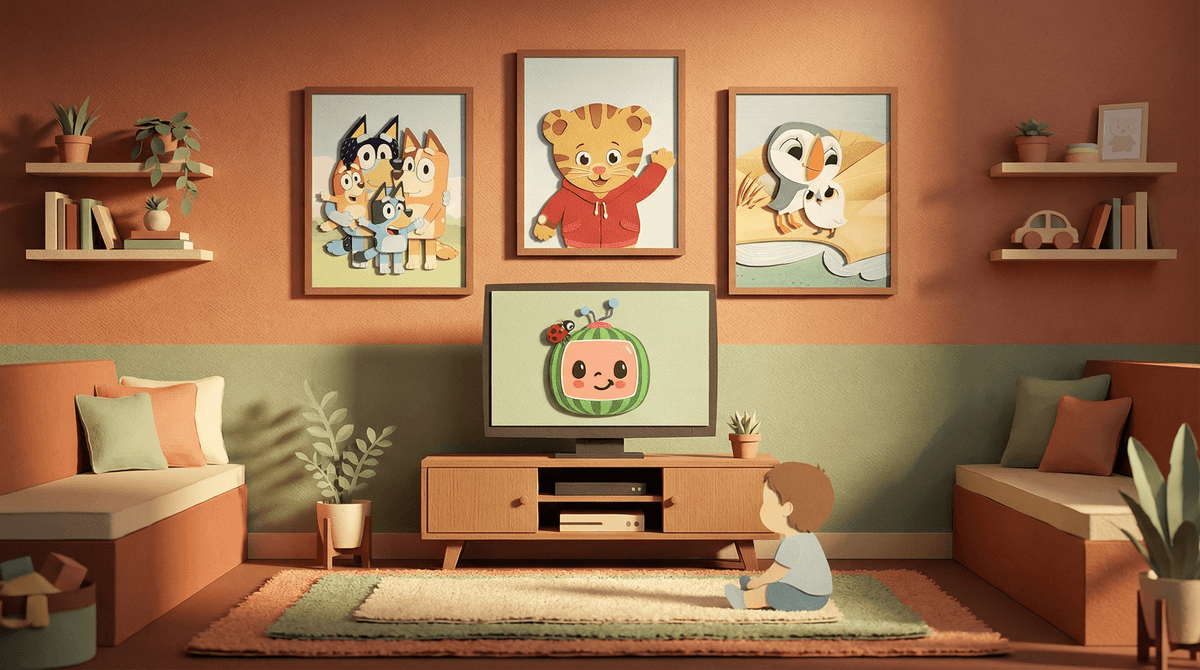
If you've ever walked into the room and seen your toddler sitting completely still, mouth slightly open, eyes glazed over while watching CoComelon, you know exactly what I'm talking about. It's not just CoComelon—lots of toddler shows can create this zombie-like state. The flashing colors, rapid scene changes, and constant stimulation can be genuinely hypnotic.
Here's the thing: not all toddler shows are created equal, and that trance-like state isn't just your imagination. Research shows that shows with very fast pacing and frequent scene changes can make it harder for young kids to focus afterward. Their little brains get so overstimulated that when the TV turns off, everything else feels boring by comparison.
But before you panic and throw the remote out the window—screen time for toddlers isn't inherently evil. It's about what they watch, how much they watch, and how you incorporate it into your day.
Toddlers are drawn to shows like CoComelon, Blippi, and similar content because they're designed to capture and hold attention. Bright colors, exaggerated expressions, catchy songs, constant movement—it's like digital candy.
The problem? These shows can be so engaging that they don't leave much room for your toddler's brain to do anything except consume. There's minimal space for imagination, problem-solving, or even just processing what's happening on screen.
Compare that to slower-paced shows where characters pause, ask questions, or leave room for kids to think—and you start to see why some shows feel more like a conversation and others feel like a fire hose.
Quality toddler programming typically has a few things in common:
Slower pacing: Characters talk at a normal speed, scenes don't change every 3 seconds, and there's actual breathing room in the storytelling.
Educational intent: Not just ABCs and 123s (though those are fine), but also emotional intelligence, problem-solving, and social skills.
Engagement, not just entertainment: The best shows invite kids to participate—answering questions, singing along, or thinking through a problem with the characters.
Relatable situations: Shows that reflect real life help toddlers process their own experiences and emotions.
Some shows that actually check these boxes:
-
Bluey (Ages 2+): Honestly the gold standard. It's about imaginative play, family relationships, and emotional intelligence—and parents actually enjoy watching it too. If you haven't discovered Bluey yet, start here.
-
Daniel Tiger's Neighborhood (Ages 2-4): Based on Mister Rogers' Neighborhood, it teaches emotional regulation and social skills with memorable songs. Yes, those songs will live in your head rent-free forever.
-
Sesame Street (Ages 2-5): Still going strong after 50+ years. Educational, diverse, and genuinely funny.
-
Elinor Wonders Why (Ages 3-5): Teaches scientific thinking and curiosity in a gentle, engaging way.
-
Puffin Rock (Ages 2-4): Slow-paced, nature-focused, with a soothing Irish narrator. Great for winding down.
The American Academy of Pediatrics recommends no screen time for kids under 18 months (except video chatting), and no more than one hour of high-quality programming per day for kids 2-5. But let's be real—life happens. You need to make dinner, take a work call, or just survive a rainy afternoon.
Here's what actually works:
Be intentional about when screens happen: Using TV as a babysitter during your witching hour? Totally fine. But try to avoid screens during meals, before bed, or as the default response to boredom.
Co-view when you can: Sitting with your toddler and talking about what's happening on screen makes a huge difference. Ask questions, point things out, connect what they're watching to real life. This turns passive viewing into active learning.
Create a routine: Toddlers thrive on predictability. If screen time happens at the same time each day (like after lunch or before dinner), it becomes just another part of the routine rather than a constant negotiation.
Use a visual timer: Toddlers have zero concept of time. A visual timer (there are tons of apps, or just use a kitchen timer they can see) helps them understand when screen time is ending. It won't eliminate all meltdowns, but it helps.
Offer alternatives: Have some go-to activities ready for when the TV goes off—blocks, Play-Doh, books, or even just following you around while you narrate what you're doing. Sometimes they just need a bridge to the next activity.
CoComelon isn't going to ruin your kid, but it's also not the best tool in your parenting toolkit. If your toddler is deep in the CoComelon phase, you don't need to go cold turkey—but you can start mixing in some slower-paced, higher-quality alternatives.
The goal isn't to be the perfect screen-free parent (that person doesn't exist). It's to be intentional about what your toddler watches and how it fits into your family's life. Some days that means Bluey and co-viewing. Other days it means 45 minutes of whatever keeps them quiet while you handle a crisis. Both are okay.
-
Audit what your toddler is currently watching: Is it all high-stimulation content? Try swapping one show for something slower-paced this week.
-
Set one screen boundary: Pick the easiest win—no screens during meals, or no screens in the hour before bed, or screen time only happens in the living room.
-
Download a few quality shows: Check out this guide to the best toddler shows and have some better options ready to go.
-
Join Screenwise: Take our quick survey to see how your family's screen habits compare to others in your community, and get personalized recommendations that actually fit your life.
You've got this. And hey, if you need to put on CoComelon to survive the next 20 minutes, no judgment here. We're all just doing our best.