

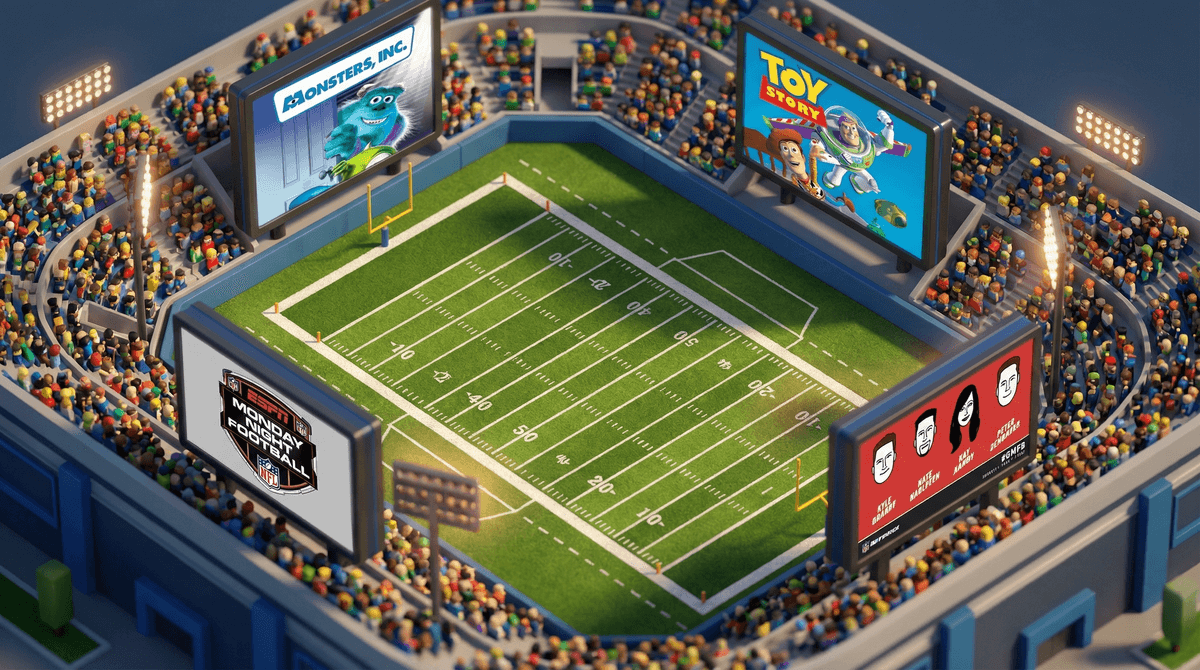
So here's something I didn't expect to be writing about: animated NFL broadcasts designed specifically for children. But here we are in 2026, and ESPN is genuinely trying to make Monday Night Football accessible to kids through what they call "alternacasts" — separate animated broadcasts of real games that air simultaneously with the regular coverage.
The most notable example is Funday Football (previously called Toy Story Funday Football), which takes the live game action and overlays it with animated characters, simplified commentary, and kid-friendly explanations of what's happening on the field. Think of it like watching a football game through a cartoon filter, where the players become animated characters and the announcers actually explain what a "first down" means instead of assuming you've been watching football for 30 years.
The latest version features characters from Monsters, Inc. — yes, Mike Wazowski is now explaining pass interference to your 8-year-old. ESPN has also done versions with Marvel superheroes and Simpsons characters. It's weird, it's kind of brilliant, and it's definitely a thing that exists now.
Look, I get it — you might be thinking "great, another way to get my kid staring at a screen." But there's actually something interesting happening here that's worth understanding, especially if you have a sports-loving kid or you're trying to find family viewing that isn't just rewatching Bluey for the 47th time (no judgment, Bluey is perfect).
Traditional sports broadcasts are genuinely hard for kids to follow. The commentary assumes knowledge, the pacing is slow, and there's a lot of standing around. Kids tune out, get bored, and then we're back to YouTube or Roblox. These alternacasts are ESPN's attempt to make live sports actually engaging for younger viewers while also teaching them the game.
From a screen time perspective, this is co-viewing content — it's designed for families to watch together, not for kids to zone out alone. That's a meaningful distinction. Watching a football game with your kid while animated characters explain the rules is fundamentally different from them scrolling TikTok in their room.
The key differences in these kid-friendly broadcasts:
Simplified commentary: Announcers explain basic concepts like what each position does, why penalties happen, and what teams are trying to accomplish. It's genuinely educational if your kid is learning the sport.
Animated overlay: Real players are transformed into cartoon characters. In the Monsters version, the field becomes Monstropolis, and players have monster avatars. It's visually engaging in a way that standard broadcasts aren't for young kids.
Interactive elements: Graphics pop up explaining plays, there are kid-focused stats, and the presentation is more dynamic and game-like.
Tone: The whole vibe is lighter and more playful. Less "THIS IS SERIOUS PROFESSIONAL SPORTS" and more "hey, this is fun, let's learn together."
Availability: These alternacasts typically air on Disney+ or ESPN+, not regular cable, which means you need a subscription to access them.
Ages 5-8: Honestly, this is probably still a stretch for most kids this age unless they're already into sports. The games are still 3+ hours long, and even with animation, that's a big ask. If you try it, plan on watching in chunks or just catching a quarter or two. The Monsters version is probably most appealing to this age group since they're likely familiar with the characters.
Ages 8-12: This is the sweet spot. Kids this age can follow the game, appreciate the strategy being explained, and stay engaged for longer periods. If they play youth football or are getting into sports culture at school, this can be a great entry point. It's also a solid bonding activity if you're trying to share your love of football with your kid.
Ages 12+: Most kids this age will probably prefer the regular broadcast if they're actually into football, but the alternacasts can still work for kids who are curious about the sport but haven't gotten into it yet. The animated versions might feel a bit young for middle schoolers, though.
It's still a full-length NFL game. The animation doesn't make it shorter. You're committing to a 3+ hour broadcast, which is a significant chunk of time. Plan accordingly — make it an event, have snacks, be realistic about attention spans.
It's not available on regular TV. You need Disney+ or ESPN+ to watch these alternacasts. If you're already paying for those services, great. If not, this might not be worth adding another subscription just for occasional Monday night games.
The educational value is real. If your kid is learning football, this is genuinely helpful. The explanations are clear, the strategy breakdowns are accessible, and it's teaching them to understand a complex sport in real-time. That's actually pretty cool.
It's still the NFL. This means commercials (lots of them), beer ads, gambling references, and all the other stuff that comes with professional sports. The broadcast is kid-friendly, but the commercial breaks aren't specifically curated for children. You'll want to be prepared for that.
The characters are marketing. Let's be clear about what's happening here: Disney/ESPN is using beloved characters to create young NFL fans. This is brand building. The Monsters, Marvel heroes, and Simpsons characters are there to make kids associate football with things they already love. That's not necessarily bad, but it's worth being aware of the strategy.
Here's where this could actually be valuable: these broadcasts are designed for you to watch together. They give you natural conversation starters about strategy, teamwork, rules, and sportsmanship.
If you're looking for alternatives to everyone on their own devices , a Monday night football alterncast is genuinely a family activity. You can talk about what's happening, explain things the announcers don't cover, and share an experience that's happening live (which feels different from streaming a show you could watch anytime).
For families trying to be more intentional about screen time, live sports occupy an interesting space — they're time-limited, they're social, and they're often tied to real-world communities and relationships. If your kid watches the Monday night game and then talks about it with friends at school the next day, that's a different kind of engagement than passive consumption.
Monday Night Football alternacasts are a clever solution to a real problem: how do you make professional sports accessible to kids who don't already understand the game? The animated versions genuinely work for the right age range (roughly 8-12), especially if you're watching together and your kid has some interest in sports.
This is not a replacement for active play — if your kid wants to watch football, they should also be outside playing football, or some other sport, or just moving their body. But as screen time goes, this is pretty defensible. It's educational, it's time-limited, it's designed for co-viewing, and it's teaching something beyond just passive consumption.
The real question is whether it's worth it for your family. If you're already into football and want to share that with your kids, this is a great tool. If you're not a sports family, you're probably not going to start with animated Monday Night Football. And that's totally fine.
If you do try it, go in with realistic expectations about attention spans, have a plan for the 3+ hour commitment, and use it as an opportunity to talk about what you're watching together. That's when screen time actually becomes family time.
If you're interested in trying it:
- Check if you have Disney+ or ESPN+ (you need one of these to access the alternacasts)
- Look up the schedule — these don't happen every Monday night, just select games throughout the season
- Start with just one quarter if your kid is younger or new to football
- Make it an event with snacks and a clear plan for the evening
If you're not sure:
- Try watching a few minutes of a regular Monday Night Football game with your kid first to gauge interest
- Check out other family co-viewing options that might be a better fit
- Consider whether your kid is actually interested in football or if this is more about you wanting them to be
And if your kid watches one of these and then wants to play Madden NFL for 6 hours straight, well, that's a different conversation we can have another time.