

The Ultimate Guide to Cool Engineering Games That Actually Teach Real Skills
TL;DR: Engineering games aren't just fun—they're secretly teaching physics, problem-solving, and systems thinking. Here are the best ones that'll have your kids designing rockets, building circuits, and thinking like actual engineers:
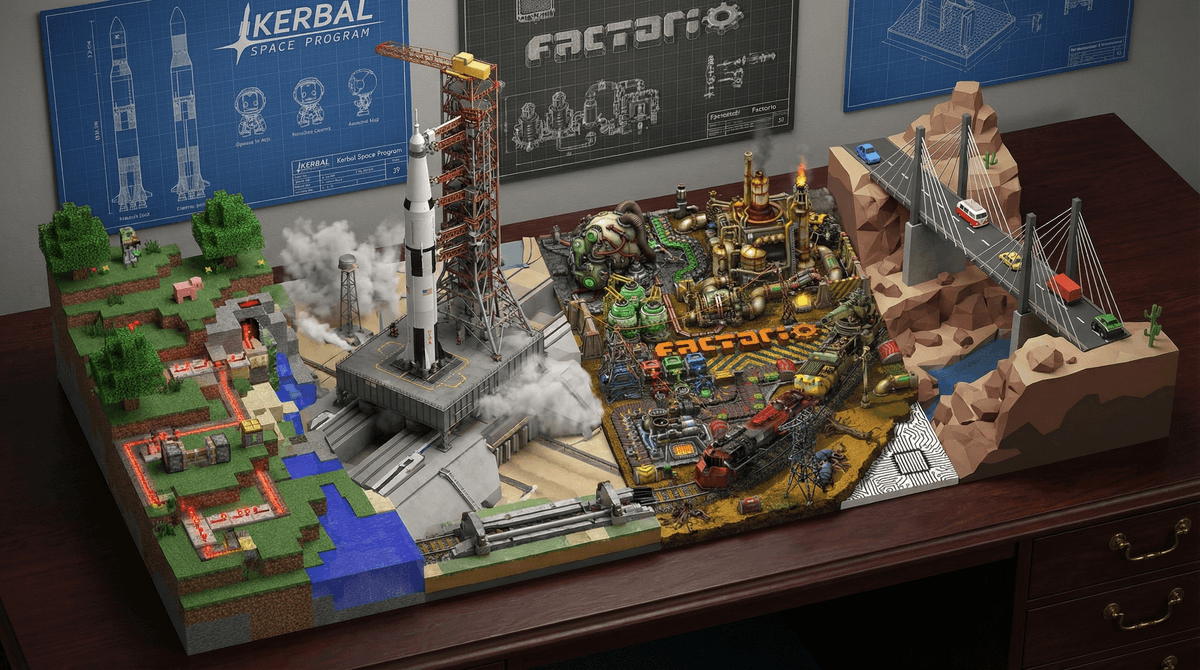
- Kerbal Space Program - Rocket science made adorable (Ages 10+)
- Minecraft with redstone - Digital circuitry disguised as blocks (Ages 8+)
- Poly Bridge - Bridge engineering puzzles (Ages 9+)
- Human Resource Machine - Programming fundamentals (Ages 10+)
- Besiege - Medieval war machine physics (Ages 10+)
- Factorio - Industrial automation masterclass (Ages 12+)
Most "educational" games feel like vegetables disguised as dessert—kids see right through them. But engineering games? They're legitimately fun and they're teaching real skills that transfer to actual engineering careers.
When your kid is troubleshooting why their rocket keeps exploding in Kerbal Space Program, they're learning orbital mechanics, thrust-to-weight ratios, and iterative design. When they're optimizing their factory in Factorio, they're thinking about supply chains, bottlenecks, and systems efficiency—concepts that mechanical and industrial engineers use daily.
The difference between these and actual homework? Failure is fun. Your bridge collapses in Poly Bridge? Hilarious. Try again. That's the engineering mindset right there.
Ages 10+ | PC, Mac, PlayStation, Xbox, Switch
This is the gold standard for engineering games. You're running a space program staffed by adorable green aliens called Kerbals, and your job is to design rockets that don't explode (they will explode) and get to space (eventually).
What they're actually learning: Orbital mechanics, delta-v calculations, staging, center of mass, thrust vectors, aerodynamics. This isn't simplified—it's using actual physics equations. NASA engineers play this game for fun.
Parent reality check: The learning curve is STEEP. Expect the first dozen rockets to fail spectacularly. That's the point. If your kid gets frustrated easily, this might not be their jam. But if they're the type who likes figuring things out? They'll be hooked for years.
The community: Massive. The KSP subreddit and forums are full of people sharing designs, tutorials, and increasingly absurd missions. Your kid will learn to read forums, watch tutorials, and iterate on designs—all real engineering skills.
Minecraft (Redstone Engineering)
Ages 8+ | Everything
Yeah yeah, you know Minecraft. But have you seen what kids can build with redstone? We're talking functional calculators, working computers, automatic farms, and complex logic gates. Redstone is basically digital circuitry with a friendlier interface.
What they're actually learning: Logic gates (AND, OR, NOT), circuit design, binary counting, timing circuits, memory storage. Kids are learning the fundamentals of computer engineering without realizing it.
How to encourage it: If your kid already plays Minecraft but hasn't discovered redstone yet, look up some beginner redstone tutorials . The jump from building houses to building functioning machines is magical to watch.
Modding bonus: Once they master vanilla redstone, mods like Create add mechanical engineering concepts—gears, rotational power, conveyor belts. It's like a whole mechanical engineering degree in game form.
Ages 12+ | PC, Mac, Linux, Switch
This is the game that makes kids understand why their packages from Amazon sometimes arrive late. You're building and optimizing factories on an alien planet, managing increasingly complex supply chains and automation systems.
What they're actually learning: Systems thinking, optimization, logistics, automation, resource management. This is industrial and systems engineering in game form. Many actual engineers cite Factorio as the best representation of their job.
The time sink warning: This game is infamous for making time disappear. "Just one more optimization" turns into 4am before you know it. The community literally calls it "Cracktorio." Set time limits.
Why it's worth it: Kids who play Factorio start thinking about efficiency everywhere. They'll start optimizing their homework workflow, their morning routine, everything. It changes how they see systems.
Ages 9+ | PC, Mac, Linux, iOS, Android, Switch
Build bridges. Try not to let cars fall into rivers. Fail. Rebuild. This is structural engineering made accessible and genuinely funny.
What they're actually learning: Structural engineering principles, tension vs compression, load distribution, material costs vs strength tradeoffs. The physics engine is legit—bridges fail in realistic ways.
Why it works: Each level is a puzzle with multiple solutions. You can build an overengineered monstrosity that costs a fortune, or optimize for the cheapest possible design. Both approaches teach something.
Sequels: Poly Bridge 2 and 3 add more mechanics and complexity. Start with the first one unless your kid is already into this stuff.
Ages 10+ | PC, Mac, Linux, Switch
Build medieval siege weapons and war machines to destroy castles and solve physics puzzles. It's like if an engineering degree and a Monty Python sketch had a baby.
What they're actually learning: Physics, mechanical advantage, projectile motion, structural integrity, creative problem-solving. Also: things exploding is funny.
The creativity factor: There's no "right" answer. Kids build everything from simple catapults to elaborate Rube Goldberg machines. The workshop community shares insane creations—flying machines, walking robots, automatic aiming systems.
Content note: You're destroying stuff and occasionally there are little figures that get squished. It's cartoony, not graphic, but worth knowing.
Ages 10+ | PC, Mac, Linux, iOS, Android, Switch
Programming fundamentals taught through office worker puzzles. You're writing simple assembly-language-style programs to move boxes around. It sounds boring. It's weirdly addictive.
What they're actually learning: Programming logic, loops, conditionals, optimization, debugging. This is computer engineering/computer science fundamentals without needing to type code.
Why it works: The puzzles are brilliantly designed. Each one introduces a new concept and builds on previous ones. By the end, kids are writing surprisingly complex programs.
Follow-up: The sequel, 7 Billion Humans, adds parallel processing concepts. Both are from Tomorrow Corporation, who make consistently excellent puzzle games.
Ages 9+ | PC, iOS, Android
Like Kerbal Space Program but more accessible. Still real physics, still rocket science, but with a gentler learning curve and better tutorials.
What they're actually learning: Same aerospace engineering concepts as KSP but with more hand-holding. Good stepping stone if KSP feels too overwhelming.
The building tools: The rocket designer is more intuitive than KSP's. Kids can get to successful launches faster, which means less frustration early on.
Ages 8+ | Various platforms
Classic Rube Goldberg machine builders. Place conveyor belts, ramps, fans, explosives, and other objects to solve puzzles. Pure cause-and-effect physics fun.
What they're actually learning: Chain reactions, energy transfer, creative problem-solving, spatial reasoning. It's physics without the equations.
Modern alternatives: Contraption Maker is the spiritual successor to The Incredible Machine. The Crazy Machines series is still getting new entries.
Ages 11+ | PC, Mac, Linux, Switch
Alchemy-themed programming puzzles. You're designing automated machines to transmute elements. It's chemical engineering meets assembly line optimization, wrapped in a steampunk aesthetic.
What makes it special: Three optimization metrics (cost, speed, size) mean there's always another way to improve. Kids get obsessed with optimization.
Ages 12+ | PC
First-person Factorio. You're building factories on an alien planet, but you're running around inside them. The 3D perspective makes the scale of your creations more impressive.
The building satisfaction: There's something deeply satisfying about standing inside a massive factory you designed, watching resources flow through conveyor belts you planned out.
Ages 9+ | PC
Build vehicles and machines from scrap parts. It's like LEGO Technic meets Minecraft. The physics are goofy but the engineering principles are real.
Multiplayer bonus: Great for siblings or friends to build together. Collaborative engineering projects are their own kind of fun.
Ages 13+ | PC, Mac, Linux
For the kid who wants to understand how computers ACTUALLY work. You start building logic gates and end up building a complete CPU from scratch.
Reality check: This is HARD. Like, computer engineering degree hard. But if your kid is ready for it? Mind-blowing.
Ages 7-9: Start with Minecraft redstone basics, The Incredible Machine, or Scrap Mechanic. Focus on cause and effect, basic physics, creative building.
Ages 10-12: Kerbal Space Program, Poly Bridge, Besiege, Human Resource Machine. They can handle more complex systems and longer-term projects.
Ages 13+: Factorio, Opus Magnum, Turing Complete, Satisfactory. These teach college-level concepts through gameplay.
The frustration factor: Engineering is about iteration and failure. These games will frustrate your kids sometimes. That's not a bug, it's a feature. Learning to push through frustration and try new approaches is maybe the most valuable skill they'll learn.
The time investment: These aren't quick-play mobile games. A single Factorio factory can be a months-long project. A Kerbal Space Program mission to another planet might take hours of planning and attempts. Talk with your kid about project planning and time management.
The community aspect: Most of these games have active communities sharing designs, tutorials, and challenges. Your kid will probably end up watching YouTube tutorials and reading forums. That's actually great—learning to find and use resources is an engineering skill too. Just keep an eye on where they're getting information (stick to established communities like official forums, subreddits, and known YouTube creators).
The "is this actually educational?" question: These games won't replace math class. But they're teaching problem-solving approaches, systems thinking, and persistence that are arguably more valuable than memorizing formulas. Many engineering students say games like these sparked their career interest.
The cost factor: Most of these are premium games ($10-$30), not free-to-play. That's actually good—no microtransactions, no ads, no pressure to spend. You pay once and get the full experience. Minecraft is the exception with its marketplace, but the base game is plenty.
Ask about their designs: "How does that work?" is engineering gold. Having to explain their creation reinforces their learning and often reveals gaps in their understanding that lead to improvements.
Encourage documentation: Suggest they screenshot their designs, write down what worked and what didn't. This is what real engineers do. Some kids love making design journals.
Connect to real world: "That's like how real bridges work" or "NASA uses those same physics" helps them see the connection between game and reality. Look up real engineering examples together.
Support the obsession: If your kid gets deep into one of these games, that's not "too much gaming"—that's a kid developing expertise in something complex. Feed that interest. Get them books about the real-world equivalent. Visit science museums. Watch engineering documentaries together.
The multiplayer option: Games like Minecraft, Scrap Mechanic, and Satisfactory support multiplayer. Engineering with friends teaches collaboration, communication, and compromise—all crucial engineering skills.
Engineering games are the rare sweet spot where "educational" and "actually fun" overlap completely. Kids aren't tolerating learning to get to the fun part—the learning IS the fun part.
Will these games turn your kid into an engineer? Maybe, maybe not. But they'll teach problem-solving, systems thinking, persistence through failure, and the satisfaction of making something complex actually work. Those skills transfer everywhere.
Start with whatever matches your kid's interests and frustration tolerance. A kid who loves space? Kerbal Space Program. Already into Minecraft? Show them what redstone can do. Loves puzzles? Poly Bridge or Human Resource Machine.
The best part? While your kid is having a blast building rockets or optimizing factories, they're developing the exact mindset that engineers use to solve real problems. That's not screen time you need to feel guilty about—that's screen time doing serious work.
Want more game recommendations? Check out puzzle games that teach logic, coding games for kids, or creative building games.