

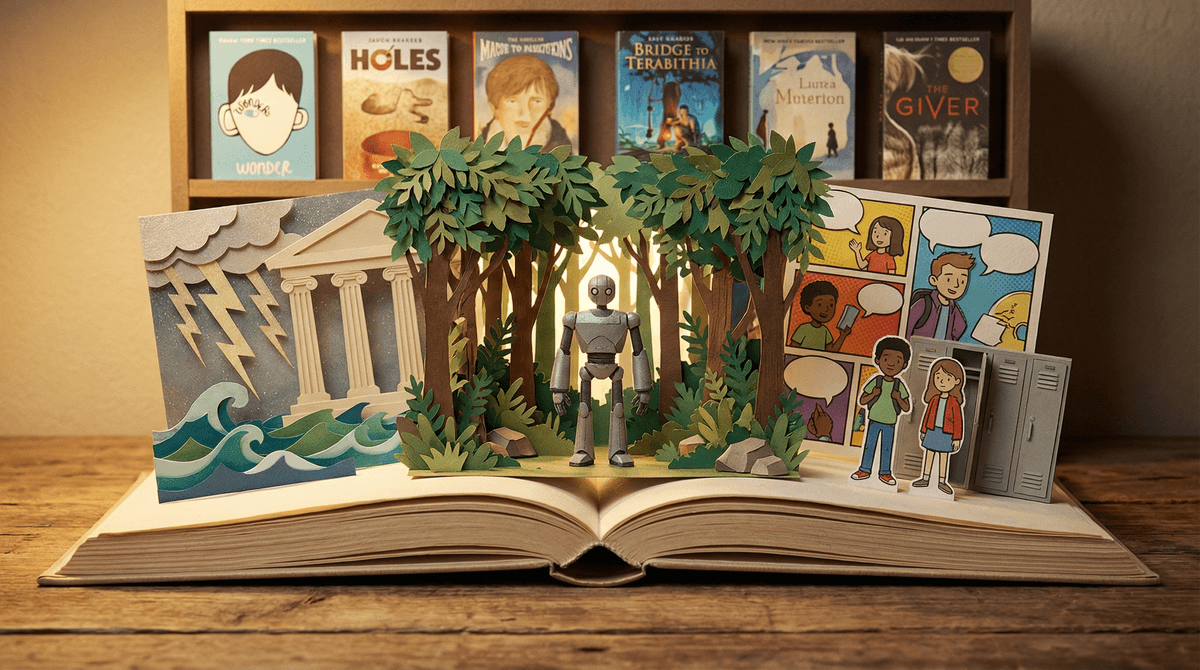
The Ultimate 5th Grade Reading List: Best Books for Kids Age 10 and 11
TL;DR: Fifth grade is when reading either clicks into high gear or starts to fade. These books hit that sweet spot between "baby books" and "boring adult stuff" — with humor, adventure, real emotions, and characters who actually feel like people. Skip to: Fantasy & Adventure • Realistic Fiction • Graphic Novels • Mystery & Suspense
Fifth graders are in this fascinating reading zone. They're old enough to handle complex plots and real emotional depth, but they still want a good story that moves. They're starting to figure out who they are, which means they're drawn to characters navigating identity, friendship drama, family stuff, and finding their place in the world.
Screenwise Parents
See allThe challenge? This is also the age when a lot of kids start to drift away from reading. They've got more homework, more activities, and honestly, screens are really good at grabbing attention. The key is finding books that feel worth it — stories that pull them in fast and keep them hooked.
Here's what actually works for this age group.
If your kid hasn't discovered Percy Jackson yet, this is the year. A 12-year-old with ADHD and dyslexia finds out he's actually a demigod, and suddenly his learning differences are superpowers. The whole series is fast-paced, genuinely funny, and sneaks in Greek mythology without feeling like homework. Plus, kids love that Percy is sarcastic and imperfect — he's not some chosen one who's naturally good at everything.
Why it works: The chapters are short, the action is constant, and Riordan gets middle school social dynamics. If they like this one, there are literally dozens more books across multiple series.
A robot washes up on an island and has to learn to survive in nature. It's part survival story, part meditation on what it means to be alive and belong somewhere. The illustrations are beautiful, and the story hits emotional notes without being heavy-handed. Great for kids who like both adventure and feelings.
Bonus: There's a sequel (The Wild Robot Escapes) and the movie just came out, so this is having a moment.
If your kid loved Harry Potter but you're looking for something fresh, this is it. Morrigan is cursed and destined to die on her 11th birthday, but instead gets whisked away to a magical city where she has to compete for a spot in a prestigious society. It's whimsical, clever, and has that same "magical world with rules and mystery" appeal.
A 13-year-old survives a plane crash and has to figure out how to stay alive in the Canadian wilderness with nothing but a hatchet. This book is tense, detailed, and incredibly engaging. It's been around since 1987 but still holds up because survival stories are timeless. Great for kids who like figuring out how things work.
Auggie has a facial difference and is starting school for the first time in fifth grade. This book is about kindness, but it's not preachy — it's honest about how hard it is to be different and how complicated middle school social stuff can be. The structure is smart too: different chapters are told from different characters' perspectives, so you see how everyone is dealing with their own stuff.
Parent note: This is a great conversation starter about empathy and inclusion. The movie is also excellent if your kid prefers watching.
A novel written entirely in verse about twin brothers who play basketball. It sounds gimmicky but it's absolutely not — the poetry makes it move fast and hit hard emotionally. It's about sports, family, growing up, and dealing with change. Even kids who "don't like poetry" tend to love this one because it feels more like rap lyrics than English class.
Stanley Yelnats is sent to a detention camp where boys dig holes in the desert all day. The plot is intricate and satisfying — multiple storylines that seem unrelated but all come together perfectly. It's funny, suspenseful, and has that "I can't believe how clever this is" quality. A modern classic for good reason.
Ally has been hiding the fact that she can't read by being the class troublemaker. When a new teacher figures out she has dyslexia, everything starts to change. This is a great book for any kid who's ever felt "different" or struggled in school. It's hopeful without being unrealistic.
Let's be clear: graphic novels are real reading. The visual literacy skills kids develop are valuable, and for reluctant readers, these books can be the bridge that keeps them reading at all.
Jordan is one of the few kids of color at his fancy private school, and he's navigating two worlds — his neighborhood and his school. It's funny, honest, and handles race and class in a way that feels real without being heavy. Won the Newbery Medal, which is rare for a graphic novel.
The series: Class Act and School Trip continue the story with different characters.
Raina trips and severely injures her front teeth right before starting middle school, leading to years of dental work. It's a memoir about growing up, changing friendships, and feeling self-conscious. Telgemeier's books (Sisters, Drama, Guts) are hugely popular with this age group, especially girls.
After their father dies, Emily and Navin move with their mom to an old family house, where their mom gets kidnapped and they follow her through a door to a magical underground world. It's epic fantasy in graphic novel form — beautiful art, complex world-building, real stakes. Nine books in the series, so if they're into it, you've got plenty of reading ahead.
Sixteen people are named as potential heirs to a millionaire's fortune, but they have to solve a mystery to claim it. This book is a genuine puzzle that kids can try to solve along with the characters. It's clever, surprising, and rewards careful reading. Another Newbery winner that's stood the test of time.
Two siblings are thrown into a global treasure hunt after their grandmother's death. It's fast-paced, involves history and puzzles, and was designed to hook reluctant readers. There are a lot of books in this series (written by different authors), so quality varies, but the first several are solid.
Milo's family runs an inn for smugglers, and when a group of mysterious guests arrive during winter break, strange things start happening. It's atmospheric, cozy, and has that "snowed-in mystery" vibe. Great for kids who like puzzles and slightly spooky (but not scary) stories.
Three kids in different time periods — 1930s Nazi Germany, 1990s Cuba, and 2010s Syria — all fleeing their countries. The stories are intense but age-appropriate, and they help kids understand that refugee experiences aren't abstract history. Gratz is excellent at making historical events feel immediate and personal.
Mia's family immigrates from China and ends up managing a motel in California. She deals with racism, helps other immigrants, and dreams of being a writer. It's based on the author's real experiences and manages to be both honest about hardship and full of hope. The sequels (Three Keys, Room to Dream) are equally good.
Castle "Ghost" Cranshaw has natural running talent but a lot of anger and trauma from his past. When he joins a track team, he has to figure out how to channel his energy and deal with his emotions. Reynolds writes in a way that feels authentic to how kids actually think and talk. Part of the Track series — all four books are excellent.
If you find a series your kid loves, lean into it. Reading momentum is real, and sometimes "not the most challenging book" is better than "not reading at all."
Wings of Fire by Tui T. Sutherland — Dragons, prophecies, war, and politics. Fifteen books and counting. Massive with this age group.
Land of Stories by Chris Colfer — Twins fall into a book of fairy tales. Six books, fun twists on classic stories.
Keeper of the Lost Cities by Shannon Messenger — Sophie discovers she's an elf and enters a magical world. Ten books, popular with kids who like fantasy and mystery.
Some kids love classics, some find them slow. Charlotte's Web and Bridge to Terabithia are beautiful but might feel young to some fifth graders. A Wrinkle in Time is genuinely weird and wonderful if your kid is into science fiction. The Giver is often assigned in school but many kids find it compelling on their own too.
The key with classics is not forcing it. If they're not into it, that's fine — there are so many great books out there.
Let them choose. Seriously. Even if it's a graphic novel about fart jokes. Reading anything is better than reading nothing.
Audiobooks count. If they're listening to Harry Potter while building in Minecraft, that's still reading. The Jim Dale versions are particularly great.
Read together. Some families do read-alouds even with older kids, or read the same book separately and discuss it. If that's not your thing, don't force it, but it can be a nice way to connect.
Library trips. Let them wander and grab whatever looks interesting. The "wrong" book they chose themselves beats the "right" book they're forced to read.
Don't make it homework. Book reports and forced discussions can suck the joy out of reading. Sometimes just asking "are you liking it?" is enough.
Fifth grade reading should feel like an adventure, not a chore. These books work because they respect kids' intelligence, deal with real emotions, and tell genuinely good stories. Some will land, some won't — and that's fine. The goal is finding the books that make your kid want to keep turning pages.
If you're looking for more recommendations tailored to your specific kid's interests, check out our personalized reading recommendations or explore alternatives to popular series. And if screens are dominating and you're trying to make space for reading, we've got thoughts on that too .
.