

TL;DR
Gaming isn't going anywhere, and fighting it creates more problems than it solves. The question isn't whether your kids should play games—it's how they play them. This guide walks you through choosing age-appropriate games, setting boundaries that actually work, understanding what makes gaming healthy vs. problematic, and creating a family culture around play that doesn't end in daily battles.
Quick wins:
- Start with cozy games for kids if you're new to gaming
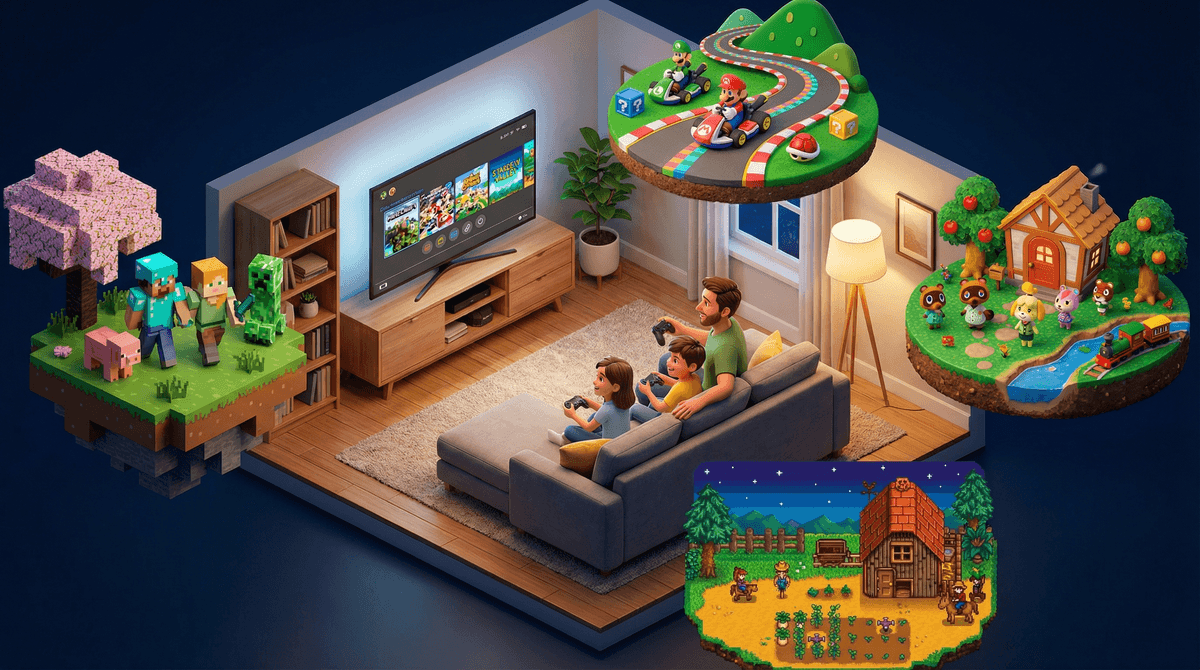
- Check out Minecraft for creative play (ages 7+)
- Try Mario Kart for family gaming nights (ages 5+)
- Explore Stardew Valley for older kids who love building (ages 10+)
About 90% of kids play video games. By middle school, it's basically universal. Gaming is the primary way many kids socialize, decompress, and develop problem-solving skills. But here's what makes it tricky: not all gaming is created equal, and the difference between healthy gaming habits and problematic ones often comes down to how families approach it.
The parents who struggle most with gaming are usually in one of two camps: those who ban it entirely (creating forbidden fruit syndrome), or those who have no boundaries at all (leading to the "just one more level" battles at bedtime). Neither extreme works.
The goal isn't to eliminate gaming—it's to make it one healthy part of a balanced childhood.
Your parents could say "30 minutes of TV" and that was that. Games don't work this way. A Fortnite match takes 20 minutes. A Roblox game with friends might need 45 minutes to feel complete. Pausing isn't always possible in multiplayer games—your kid isn't lying when they say "I can't pause, I'm playing with real people."
This is why time limits alone often backfire. "30 minutes of gaming" sounds reasonable until you realize it means your kid is perpetually stressed about the clock, rushing through experiences, or rage-quitting mid-game because time's up.
Better approach: Focus on natural stopping points. "You can play until you finish this match/level/quest, then we're done." This respects the game's structure while maintaining your boundary.
Ages 5-7: The Foundation Years
At this age, gaming should be:
- Short sessions (20-30 minutes)
- Primarily single-player or couch co-op
- Heavy on creativity and exploration
Great starting games:
- Animal Crossing - Gentle, no time pressure, teaches resource management
- Mario Kart - Perfect family gaming, easy to learn
- Pokémon - Reading practice, strategy, collecting
- Kirby games - Forgiving difficulty, adorable
What to avoid: Online multiplayer, games with in-app purchases they can access, anything with voice chat.
Ages 8-10: Building Independence
This is when kids start wanting games their friends play. Minecraft and Roblox dominate here—and honestly, both can be great if set up correctly.
For Minecraft, start with single-player creative mode, then move to private servers with known friends. Here's how to set up Minecraft parental controls.
For Roblox, the platform is massive and wildly uneven in quality. Some games are genuinely creative and fun; others are pure cash grabs designed to extract Robux. Learn how to navigate Roblox safely before letting your kid loose.
The big shift: This is when you introduce the concept of "earning" game time through other activities. Not as punishment, but as balance. "You can play after homework and 30 minutes of outdoor time" creates a natural rhythm.
Ages 11-13: The Social Gaming Years
Middle school is when gaming becomes primarily social. Your kid isn't just playing Fortnite—they're hanging out with friends who happen to be playing Fortnite. This is actually developmentally healthy! It's this generation's version of talking on the phone for hours.
Games that dominate this age:
Critical safety note: Voice chat is now part of the equation. You need to talk about online stranger danger, what to do if someone's being inappropriate, and why they should never share personal information. Get advice on talking to kids about voice chat safety .
.
Ages 14+: Negotiating Autonomy
High schoolers need more independence, but they still need boundaries. The shift here is from "I control your gaming" to "let's agree on expectations together."
Some families do well with:
- No gaming until homework/chores are done (self-enforced)
- No devices in bedrooms after 10pm (prevents all-night gaming)
- One screen-free family dinner per day (non-negotiable)
Games get more intense and mature here. Call of Duty, Grand Theft Auto, The Last of Us—these are M-rated for a reason. Whether your 14-year-old is ready for mature content depends on your kid and your values. Read more about navigating M-rated games.
Let's talk about the elephant in the room: Robux, V-Bucks, and every other digital currency designed to separate you from your money.
Here's what kids don't understand: These currencies are deliberately confusing. Spending 1,000 V-Bucks doesn't feel like spending $10, which is exactly the point. Games use this psychological trick to encourage spending.
What works:
- Set up purchase approvals on all devices (iOS, Android, gaming consoles)
- Give a monthly gaming budget - "You get $10/month for in-game purchases, use it however you want"
- Teach the difference between cosmetic and pay-to-win - Skins are fine, but games that require payment to be competitive are problematic
- Never, ever save your credit card in a gaming account a kid has access to
The Roblox economy deserves special mention because it's both fascinating and predatory. Yes, some kids are learning entrepreneurship by creating and selling items. But the vast majority are just spending money on digital clothes for their avatar. Understand how Roblox economics actually work before your kid asks for $50 in Robux.
Most gaming is fine. But watch for these warning signs:
Immediate red flags:
- Extreme anger when asked to stop (beyond normal disappointment)
- Lying about how much they're playing
- Declining grades or abandoned hobbies
- Playing through the night regularly
- Only socializing through games (no in-person friendships)
The rage-quitting problem: Some kids have explosive reactions to losing or dying in games. This isn't about the game—it's about emotional regulation. If your kid is throwing controllers or screaming at the screen regularly, that's a sign they need help managing frustration, not more gaming time.
The "just one more" spiral: When stopping feels impossible, when every boundary becomes a negotiation, when your kid seems genuinely unable to regulate their own gaming—these are signs you need to pull back and reset.
Family gaming can be genuinely fun if you pick the right games:
- Mario Kart - The classic for a reason
- Overcooked - Chaotic co-op cooking, hilarious
- It Takes Two - Designed specifically for two players, creative puzzles
- Jackbox Party Packs - Use phones as controllers, great for groups
- Stardew Valley - Relaxing farming sim with co-op mode
Playing together gives you insight into what your kid loves about gaming, creates shared experiences, and honestly? Some of these games are legitimately entertaining.
Forget arbitrary time limits. Instead, create structure:
The "gaming window" approach: Gaming is allowed between 4-6pm on school days, longer on weekends. This gives kids something to look forward to without consuming the whole day.
The "earn it" system: Gaming time is earned through other activities. Not as punishment, but as balance. "One hour of outdoor play = one hour of gaming" teaches that screens are part of life, not all of it.
The "natural stopping point" rule: Instead of "30 minutes," try "finish this match/level/quest, then you're done." This respects the game's structure while maintaining boundaries.
The "no devices in bedrooms" policy: Gaming (and all screens) happen in common areas. This prevents late-night gaming and makes monitoring easier.
The "screen-free zones" approach: No screens during meals, during the first hour after school, or during family activities. These boundaries create space for other types of connection.
Your kids are speaking a different language. Here's what they mean:
- "GG" = Good game (sportsmanship)
- "Toxic" = Mean players/bad behavior
- "Grinding" = Repetitive gameplay to level up
- "Rage quit" = Quitting in anger
- "Sweaty" = Trying really hard/competitive
- "Bot" = Bad player (insult)
Understanding this vocabulary helps you have actual conversations about their gaming experiences rather than talking past each other.
Gaming isn't the enemy. Unstructured, unmonitored, unlimited gaming is the problem. The difference between kids who game healthily and kids who struggle comes down to:
- Age-appropriate content - Not every game is for every kid
- Reasonable boundaries - That respect both the game's structure and family needs
- Balance - Gaming as one part of childhood, not the only part
- Communication - Talking about what they're playing and who they're playing with
- Modeling - If you're on your phone constantly, they'll game constantly
The goal isn't to raise kids who never game. It's to raise kids who can enjoy gaming without it consuming their lives, who can stop when asked (even if they're disappointed), and who have the emotional tools to handle losing, frustration, and the end of a gaming session.
Start here: Pick one boundary to implement this week. Not five, not ten—one. Maybe it's "no gaming until homework is done" or "all devices charge in the kitchen at night" or "we play one family game together on Sundays." Start small, be consistent, and build from there.
And if you need help figuring out whether a specific game is appropriate for your kid? That's literally what Screenwise is for. Check out our game recommendations by age, explore alternatives to popular games, or just use our list maker to ask "Is [specific game] okay for my 10-year-old?"
You've got this.