

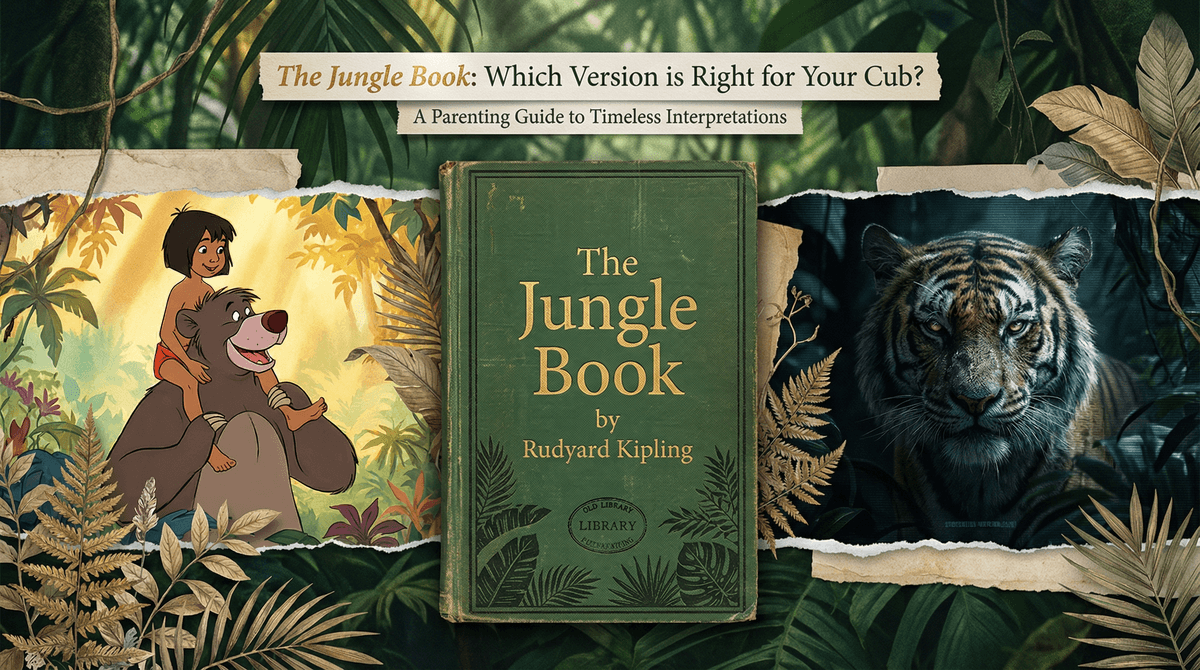
TL;DR: If you’re looking for a low-stakes, catchy musical for a rainy Tuesday with a preschooler, go with the 1967 classic. If you have an older kid (9+) who wants a cinematic experience that feels like a high-stakes nature documentary come to life, the 2016 remake is a masterpiece—but it’s intense.
Quick Links:
- The Jungle Book (1967) – Best for ages 4+.
- The Jungle Book (2016) – Best for ages 9+.
- The Jungle Book by Rudyard Kipling – For the kids who want the "real" story.
- Mowgli: Legend of the Jungle – The Netflix version (Warning: very dark).
At its core, The Jungle Book is about Mowgli, a "man-cub" raised by wolves in the Indian jungle. After the tiger Shere Khan threatens his life, Mowgli’s animal mentors—Bagheera the panther and Baloo the bear—try to escort him back to the "Man-Village" for his own safety.
It’s a story about belonging, the "Law of the Jungle," and the inevitable transition from childhood to the world of adults. But depending on which version you hit "play" on within Disney+, you’re either getting a jazzy vaudeville show or a survivalist thriller.
This was the last film Walt Disney personally supervised before he passed away, and it feels like it. It’s loose, character-driven, and centers entirely on the music. The plot is basically a series of vignettes where Mowgli meets a new animal, they sing a song, and he moves on.
The Vibe: Lo-fi, nostalgic, and genuinely funny. Baloo is the ultimate "fun uncle" archetype, and the Sherman Brothers' soundtrack is arguably one of the best in the Disney vault.
The "Yikes" Factor: We have to talk about King Louie. While the song "I Wan'na Be Like You" is a bop, the character has long been criticized as a racial caricature. If you’re watching this with your kids, it’s a natural moment to discuss how older movies sometimes used stereotypes that we recognize as harmful today.
Director Jon Favreau (the guy who gave us Iron Man and The Mandalorian) took the 1967 skeleton and put some serious muscle on it. This isn't a cartoon; it’s photo-realistic CGI that looks so real you’ll forget you’re looking at pixels.
The Vibe: Epic and visceral. This version leans much harder into the "Law of the Jungle." It’s about the hierarchy of nature, the danger of fire (the "Red Flower"), and the reality of being a small human in a world of giant predators.
The "Yikes" Factor: Shere Khan. In the 1967 version, he’s a posh, slightly arrogant villain. In 2016, voiced by Idris Elba, he is a terrifying, scarred murderer. There are jump scares, animal fights that feel heavy and violent, and a scene with a giant snake (Kaa) that might trigger some nightmares for the younger set.
Ages 4-7: Stick to the 1967 Classic
At this age, kids mostly want to see Baloo scratch his back on a tree and hear the vultures sing like the Beatles. The stakes are low enough that even the "scary" parts (the fire at the end) are handled with a colorful, hand-drawn touch that doesn't feel life-threatening.
Ages 8-10: The 2016 Remake is the Sweet Spot
This is when kids start appreciating "real" movies. The 2016 version offers a lot to talk about regarding courage and using your brain (Mowgli’s "tricks" or human inventions) to solve problems. However, if your kid is sensitive to animal peril (think The Lion King levels of trauma), maybe pre-screen the Shere Khan scenes.
Ages 11+: Check out the Rudyard Kipling Book
If they’ve seen the movies, they might be surprised by the original source material. Kipling’s stories are more of a collection of fables. They’re tougher, more philosophical, and don’t feature a singing bear. It’s a great way to introduce the concept of "literary adaptation" and how Disney sanitizes stories for the big screen.
If you’re leaning toward the 2016 version, here is the "No-BS" breakdown of what might actually freak your kid out:
- The Stampede: There’s a scene involving a mudslide and buffalo that is loud, chaotic, and claustrophobic.
- Kaa’s Introduction: Scarlett Johansson’s Kaa is massive and uses hypnosis. It’s a very "predator-prey" vibe that can be unsettling.
- King Louie’s Size: In the 1967 version, Louie is an orangutan. In 2016, he’s a Gigantopithecus (an extinct giant ape) the size of a small house. He chases Mowgli through a crumbling temple in a scene that feels like a horror movie.
- Character Death: Without spoilers, the 2016 version handles death with much more weight and permanence than the cartoon.
Believe it or not, there’s a sub-theme in the 2016 movie that parents of "techie" kids will love. Bagheera constantly tells Mowgli to stop using his "tricks"—human tools like pulleys and ropes—and to "act like a wolf."
By the end of the movie, the narrative flips. Mowgli realizes that his strength isn't in being a mediocre wolf; it’s in being a brilliant human. It’s a great jumping-off point for a conversation about:
- Individual Strengths: Why trying to "fit in" sometimes holds us back from our actual potential.
- Innovation: How humans use tools to level the playing field (you can even bridge this to how we use AI tools today).
If you watch the 2016 version, ask your kids:
- "Why was Shere Khan so afraid of the 'Red Flower' (fire)?"
- "Do you think Mowgli was safer in the jungle or the village?"
- "Was Baloo being a good friend when he tried to make Mowgli stay, or was he being selfish?"
If you watch the 1967 version, ask:
- "How does the music change how you feel about the scary animals?"
- "Why do you think the monkeys wanted to be like humans so badly?"
The Jungle Book (1967) is a "vibes only" movie. It’s great for a low-energy afternoon when you just want something colorful and rhythmic on the screen. It’s the digital equivalent of a warm blanket.
The Jungle Book (2016) is a "theatre experience" at home. It’s intense, beautiful, and slightly stressful. It’s for the kids who are ready to move past "kiddie" content and into something that respects their ability to handle a bit of danger.
Avoid Mowgli: Legend of the Jungle (the Netflix one) unless your kids are older teens. It’s hyper-violent and lacks the heart (and the songs) that make the Disney versions work.
If your cub is obsessed with the jungle after watching these, here are a few ways to keep the momentum going without just re-watching the same thing:
- Watch Planet Earth: See the real-life inspirations for Shere Khan and Bagheera.
- Play Animal Jam: A safe-ish way for younger kids to explore animal habitats and facts.
- Read The Wild Robot by Peter Brown: A modern "nature vs. nurture" story that hits many of the same emotional beats as Mowgli’s journey.
Check out our guide on the best nature documentaries for kids