

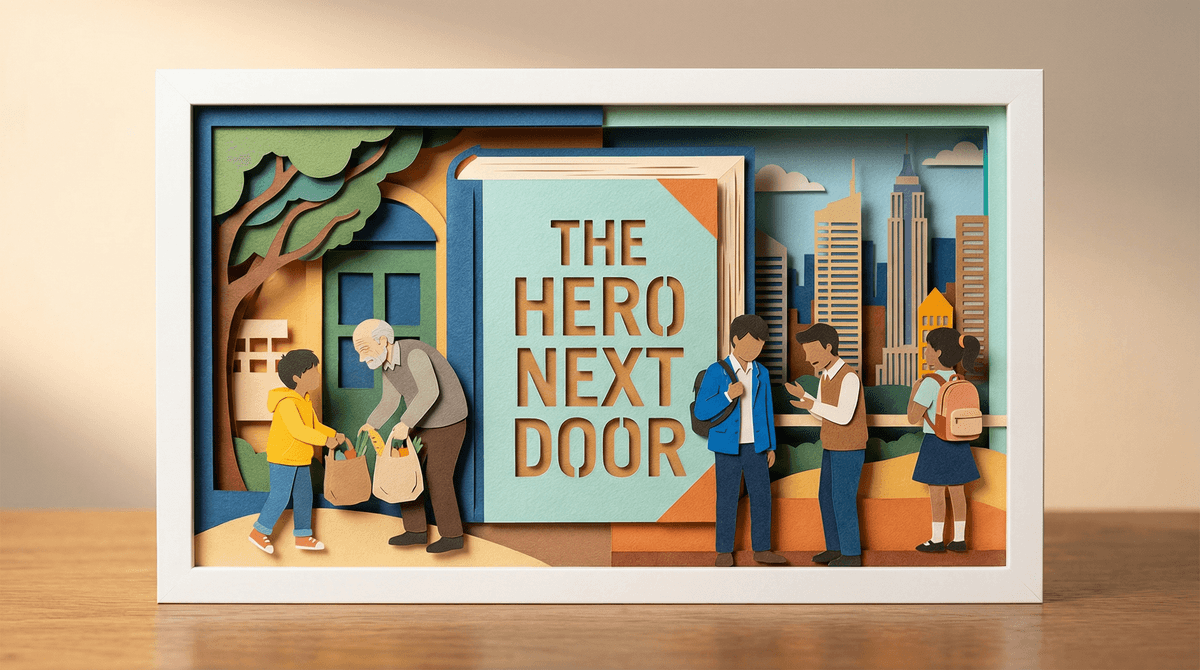
The Hero Next Door: Is This Diverse Story Collection Right for Your 8-Year-Old?
Yes, The Hero Next Door is age-appropriate for most 8-year-olds who are reading at or above grade level. This award-winning anthology from We Need Diverse Books offers thirteen short stories about everyday heroes from authors like R.J. Palacio (Wonder) and Linda Sue Park. The reading level (Lexile 730L, ATOS 4.8) hits right at 4th-5th grade, making it accessible for confident 8-year-old readers. However, it does contain mild language and one story with domestic abuse themes, so a quick parental preview might be worth it if those topics are sensitive for your family.
The Hero Next Door isn't your typical "kid saves the world from aliens" hero anthology. Instead, it celebrates the small, brave acts that happen every day—a martial arts teacher who stands up for a student, a kid who talks to ghosts to help them find peace, siblings who protect each other, neighbors who show up when it matters.
Editor Olugbemisola Rhuday-Perkovich assembled thirteen stories from heavy-hitter authors, and the result is a collection that shows kids what real heroism looks like: messy, small-scale, and deeply human. It won Bank Street's Best Children's Book of the Year, and for good reason—it's the kind of book that sparks actual conversations about kindness, courage, and community.
The short-story format is perfect for kids transitioning from chapter books to longer novels. At around 50,000 words total, readers can dip in and out, experiencing different voices and perspectives without committing to a 300-page narrative. Some kids will tear through it in a weekend; others will savor one story at bedtime for weeks.
The publisher lists ages 8-12 (roughly grades 3-7), and the Lexile score of 730L puts it squarely in 4th-5th grade territory. The ATOS level of 4.8 confirms this—it's written for readers around 9-10 years old, but plenty of strong 8-year-old readers will handle it just fine.
If your kid is reading books like Ramona Quimby, early Percy Jackson, or Junie B. Jones chapter books independently, they're probably ready for this. The vocabulary isn't overly complex, but the themes require some emotional maturity—understanding loneliness, recognizing injustice, processing fear.
The beauty of an anthology is that if one story feels too heavy or complex, you can bookmark it and move to the next. Not every story will resonate with every kid, and that's completely fine.
This is where I need to be straight with you: The Hero Next Door contains mild language and one story with domestic/physical abuse elements. The Junior Library Guild specifically flags this, and parents who are sensitive to these topics should preview before handing it over.
The story in question is Hena Khan's "Home," which deals with a family experiencing domestic violence. It's handled thoughtfully and age-appropriately—this isn't graphic or gratuitous—but it's real. For some families, this will be an important conversation starter about recognizing abuse and helping others. For others, it might be a story you save for when your kid is 10 or 11.
The mild language scattered throughout is exactly that: mild. We're not talking about f-bombs or slurs, but there are moments where characters speak authentically, including occasional "hell" or "damn." If your family has strict language boundaries, you'll want to flip through first.
Here's my take: these elements don't disqualify the book for 8-year-olds, but they do mean it's not a "hand it over and forget about it" read. Think of it as a "read alongside" or "read first, then discuss" book rather than a solo independent read for younger or more sensitive kids.
Yes, this is a diverse anthology—the characters represent different races, cultures, abilities, and family structures. But what makes it actually good (not just well-intentioned) is that the diversity serves the stories rather than the other way around.
A Pakistani-American girl navigating her identity isn't a lesson in multiculturalism—it's just her life, and the story explores her specific struggles and triumphs. A neurodivergent character isn't a teaching moment about differences—they're the hero of their own adventure. The representation feels organic because these authors are writing from lived experience.
For kids who rarely see themselves in books, this anthology is a gift. For kids who see themselves everywhere, it's an opportunity to understand that "normal" looks different for everyone. And for all kids, it's a chance to see heroism redefined—not as superhuman strength, but as everyday courage.
The themes hit on friendship, family, cultural identity, social justice, and community—big concepts that 8-year-olds are absolutely capable of understanding when wrapped in a good story. One tale features inventors and soccer players, another explores what it means to be a good neighbor, another examines sibling loyalty. The variety means there's something for every kid.
Option 1: Read it together
This is my top recommendation for younger 8-year-olds or first-time readers tackling this level. Read one story at a time, then talk about it. Ask questions like "What made that character a hero?" or "Have you ever done something brave like that?" The short-story format makes this totally doable—you're not committing to weeks of read-alouds.
Option 2: You read first, then hand it over
If your kid is an independent reader but you're unsure about the mature elements, preview it yourself. Flag any stories you want to discuss together or save for later. This gives you control without hovering.
Option 3: Let them read independently, then check in
For confident readers who are mature enough to handle the content, let them go for it. Then casually ask which stories they liked best and why. You'll learn a lot about how they're processing the themes.
Option 4: Use it as a conversation starter
If your family is navigating discussions about diversity and inclusion, social justice, or recognizing everyday heroism, this book is a fantastic tool. The stories provide concrete examples that make abstract concepts tangible for young kids.
- 8-year-olds reading at or above grade level who are ready for more complex themes
- Kids who love short stories and variety in their reading
- Readers who are tired of the same old protagonists and want to see different kinds of heroes
- Families looking for conversation starters about kindness, courage, and community
- Kids transitioning from early chapter books to longer middle-grade novels
- Younger or more sensitive 8-year-olds who aren't ready for themes of abuse or injustice
- Kids who prefer longer, single-narrative stories over anthology formats
- Families with very strict content boundaries around language or mature themes
The Hero Next Door is a genuinely excellent anthology that treats young readers with respect. It doesn't talk down to kids, doesn't shy away from real issues, and doesn't present heroism as something only special people can achieve. The stories are engaging, the representation is authentic, and the messages about everyday courage are exactly what kids need to hear.
For most 8-year-olds, this is absolutely age-appropriate, especially if they're reading at grade level or above. The mature elements (mild language and one story about domestic abuse) mean it's not a blind hand-off for every family, but they're handled thoughtfully and can spark important conversations.
If you're looking for books that celebrate kindness, expand your child's worldview, and show them that heroes look like regular people doing brave things—this is it. Just maybe flip through it yourself first, especially if your kid is on the younger end of 8, so you know what you're working with.
And if you're curious about other diverse books for middle-grade readers or books that teach empathy, those are great next steps to explore.